

From the screen to reality: gender-based violence in the era of deepfakes
October 27, 2026
The meeting organized by FBK and Women4Cyber Italia examined new forms of digital abuse against women. From forensic analysis techniques to unmask fakes to the provisions of the AI Act, an interdisciplinary solution combining technology, law, and education is needed.
A female parliamentarian is 33 times more likely than a male colleague to have her image associated with pornographic content that has been manipulated or shared without her consent. This is what emerges from a study conducted by Agora Digital Transformation, which examined the 720 current members of the European Parliament by cross-referencing their names with 200 websites known to host deepfake pornography, celebrity leaks, or stolen photos: of the 50 cases identified, 46 involve women. This is a worrying statistic that raises a broader question about how much the risk of experiencing online violence can affect women’s decisions to enter public life, both today and in future generations.
These are forms of violence that occur in the digital space, but whose consequences are entirely real. They can compromise people’s reputation, safety, and well-being through tools that are increasingly accessible, fast, and inexpensive.
“At Fondazione Bruno Kessler, we focus on developing strategies and tools to make the digital environment more secure and to mitigate the risks that can affect people and organizations. Deepfakes are a prime example of how the same technology can be used for very different purposes: artificial intelligence makes it possible to create increasingly realistic fake content, but it can also help us recognize it and counter its spread when used for malicious purposes. Research therefore plays a key role, not only in understanding these new threats but also in developing tools capable of limiting their fallout,” commented Cecilia Pasquini, a researcher at FBK’s Center for Cybersecurity.
So how can we protect ourselves from these threats, and what technological and legal tools do we have at our disposal to counter them?
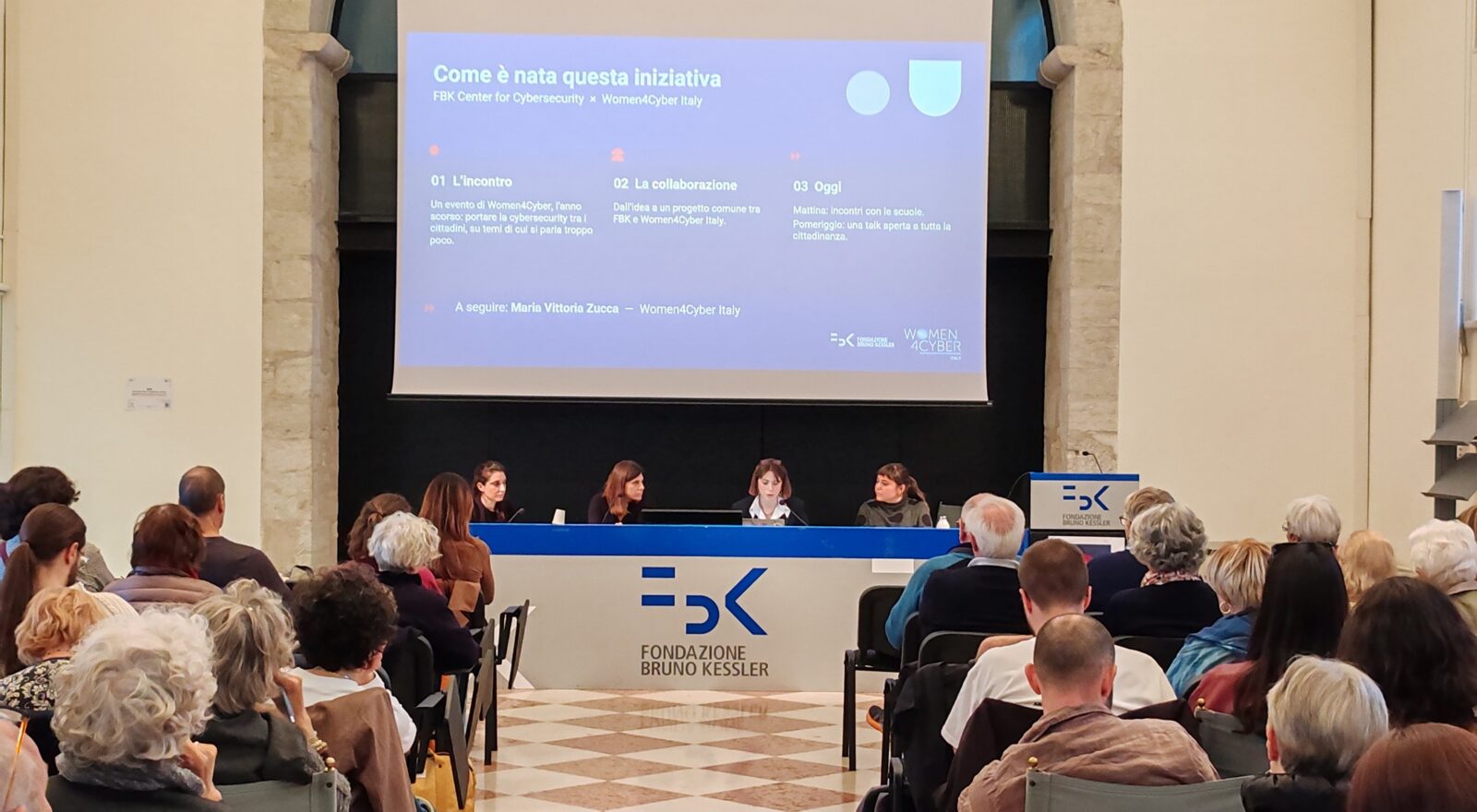
These were some of the questions addressed on October 22 at the event From the Screen to Reality: Gender-Based Violence in the Era of Deepfakes, organized by the Center for Cybersecurity at Fondazione Bruno Kessler in collaboration with Women4Cyber Italia—an association committed to promoting women’s participation in the cybersecurity sector and combating gender stereotypes. The event was presented by Maria Vittoria Zucca, a Ph.D. student in Cybersecurity at IMT Lucca and Scuola Superiore Sant’Anna.
There are many ways in which digital content can be manipulated. We are talking about deepfakes—images, videos, or audio generated or altered using artificial intelligence—as well as deepnudes (fake nudity content) and voice cloning (the replication of a voice, which can be done even from a short audio recording). These English terms risk making us perceive a phenomenon as distant when, in reality, it can affect anyone.
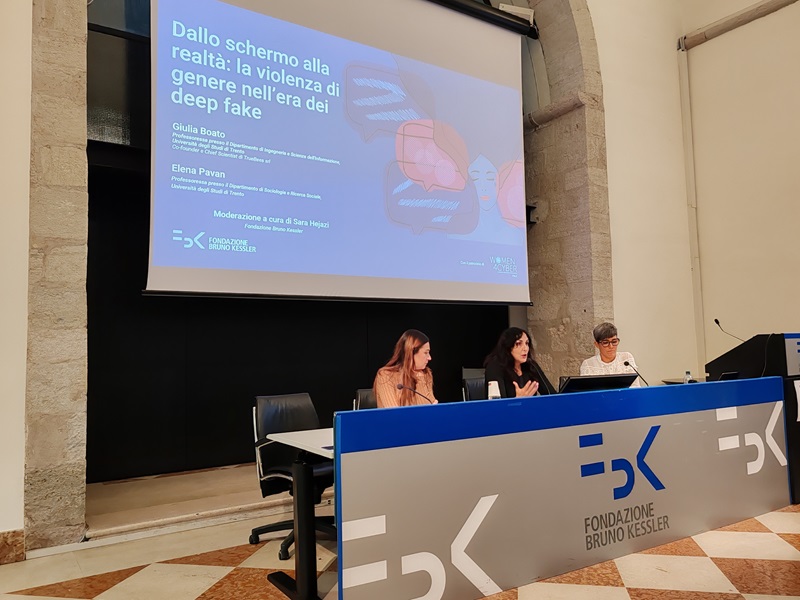
Giulia Boato, full professor at the University of Trento and an expert in multimedia forensics and artificial intelligence, explained how the technology works and presented potential solutions offered by technology itself.
Specifically regarding the detection of manipulated content, digital forensics makes it possible to spot traces invisible to the naked eye, identify inconsistencies in images and videos, or detect signs produced by AI generation systems. Other tools include watermarking synthetic content and embedding digitally signed metadata to declare its provenance—both of which are required under the European AI Act, which introduces transparency obligations for certain content generated or altered using artificial intelligence. However, none of these solutions is sufficient on its own: detection systems are constantly playing catch-up with rapidly evolving generation tools.
Combating digital violence therefore requires an interdisciplinary approach that combines technological research with regulatory frameworks and critical reflection on the social dynamics driving these issues.
Elena Pavan, Associate Professor at the University of Trento and an expert in social and gender movement studies, focused her talk on this latter point. Online violence cannot be understood without considering the economic model of digital platforms, where attention, interactions, and content circulation drive value. In this environment, apps that promise to fulfill any user request can contribute to normalizing practices that undermine human dignity and consent.
Platforms are already subject to specific responsibilities under the Digital Services Act, which provides mechanisms for reporting illegal content and mandates risk management, while the AI Act addresses specific uses of artificial intelligence. However, regulation alone is not the answer. For Pavan, sex and relationship education plays a crucial role, as it is essential to address new forms of technology-facilitated violence. Understanding consent, recognizing power dynamics, and cultivating greater awareness of one’s online actions are skills that apply just as much to digital life as to life off-screen.
It is precisely this boundary between the two, moreover, that is becoming increasingly unsustainable. Technology changes the tools through which violence is inflicted, but it does not erase its social roots. To combat it, we need more secure systems, effective regulations, and people equipped to recognize it. Because while an image may be fake, the harm it causes is real.
The author/s
Related articles