

AI and health: between innovation and ethical stringency
October 3, 2025
From maternal health solutions to neurotechnology supporting individuals with paralysis, the conversation highlighted key challenges, emerging opportunities, and the importance of strong ethical standards. The common goal? That AI becomes a reliable, integrative and understandable tool for citizens, doctors and the media.
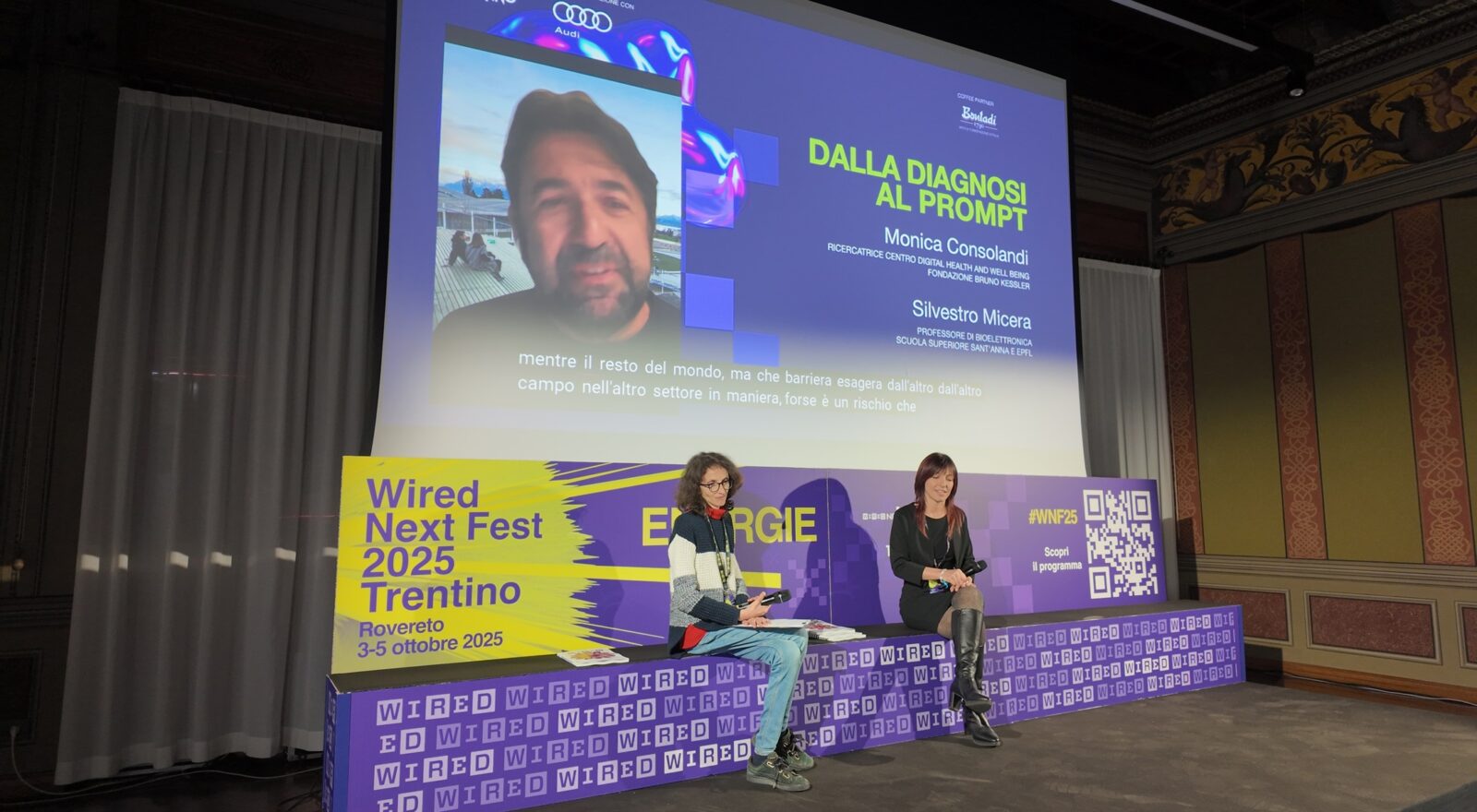
At the Wired Next Fest in Rovereto, researcher Monica Consolandi from the Center for Digital Health & Wellbein at Fondazione Bruno Kessler and Professor Silvestro Micera, an expert in Bioelectronics at the Sant’Anna High School and EPFL, discussed – in a meeting moderated by journalist and physicist Marta Abbà – the applications of artificial intelligence in healthcare.
From established projects focused on maternal health and the first 1,000 days after childbirth to innovative digital media designed to enhance communication between healthcare professionals, patients, and their families, FBK is committed to improving the quality of life for all citizens.
“These applications must be based on certified information and the scientific research project itself must be solid, so as to give us reliable answers.” Monica Consolandi explains, and continues: “Sometimes ethics is seen as a brake on the work of scientific research, but this is not the case: it is what allows us to go further and further and do better.” However, according to Silvestro Micera—who, in collaboration with San Raffaele in Milan, is developing a neuroengineering solution to help paralyzed individuals regain mobility—AI legislation should be developed with greater input from technicians and field experts to avoid becoming a barrier to innovation
Different points of view, but a single request for the future: to increase the literacy of citizens in the field of Artificial Intelligence so that these innovations are welcomed responsibly. In this context, the role of the media is crucial: innovation—especially in the field of healthcare—captures public interest, engages audiences, and at times may even cause concern. This is why it must be communicated clearly, explained thoroughly, and explored in depth.
Any more dreams still to be fulfilled?
For Micera, bringing all the neurotechnologies you have studied in recent years to the clinic and for this purpose, AI can really help. An AI that should never be left alone, but must be a tool, a tool to be guided, a means to reach clinical practice.
Consolandi has already started the project that he hopes will soon become a reality: “We are still in the evaluation phase, to create an ethically sound apparatus – he said – but I would like the project that wants to avoid misunderstandings between patients and health professionals to soon become a reality. These misunderstandings are very frequent, but with just as much ease and really non‑invasive tools, they could be avoided. In any case, artificial intelligence must always be integrative and never a substitute.”
_________________________________________________________________________________________________
The WIRED Next Fest Trentino is organized by WIRED Italia in partnership with the Autonomous Province of Trento – Department of Economic Development, Work, Family, University and Research – Trentino Marketing, Trentino Sviluppo, Azienda per il Turismo Rovereto, Vallagarina e Monte Baldo, Municipality of Rovereto.
The Scientific Committee chaired by the Head of Content of WIRED Italia works on the construction of the program, with the participation of the University of Trento, Fondazione Bruno Kessler, Fondazione Edmund Mach, Fondazione Hub Innovazione Trentino, the Provincial Institute for Research and Educational Experimentation – IPRASE and MUSE – Museo delle Scienze.
The author/s
-
 Monica Consolandi
Researcher @ Intelligent Digital Agents (IDA) unit of the FBK Center for Digital Health and Wellbeing
MORE INFO
Related articles