

Financial Education: Literacy for the future
November 26, 2025
An in-depth look at the key topics discussed at the meeting organized by FBK-IRVAPP with Elsa Fornero.
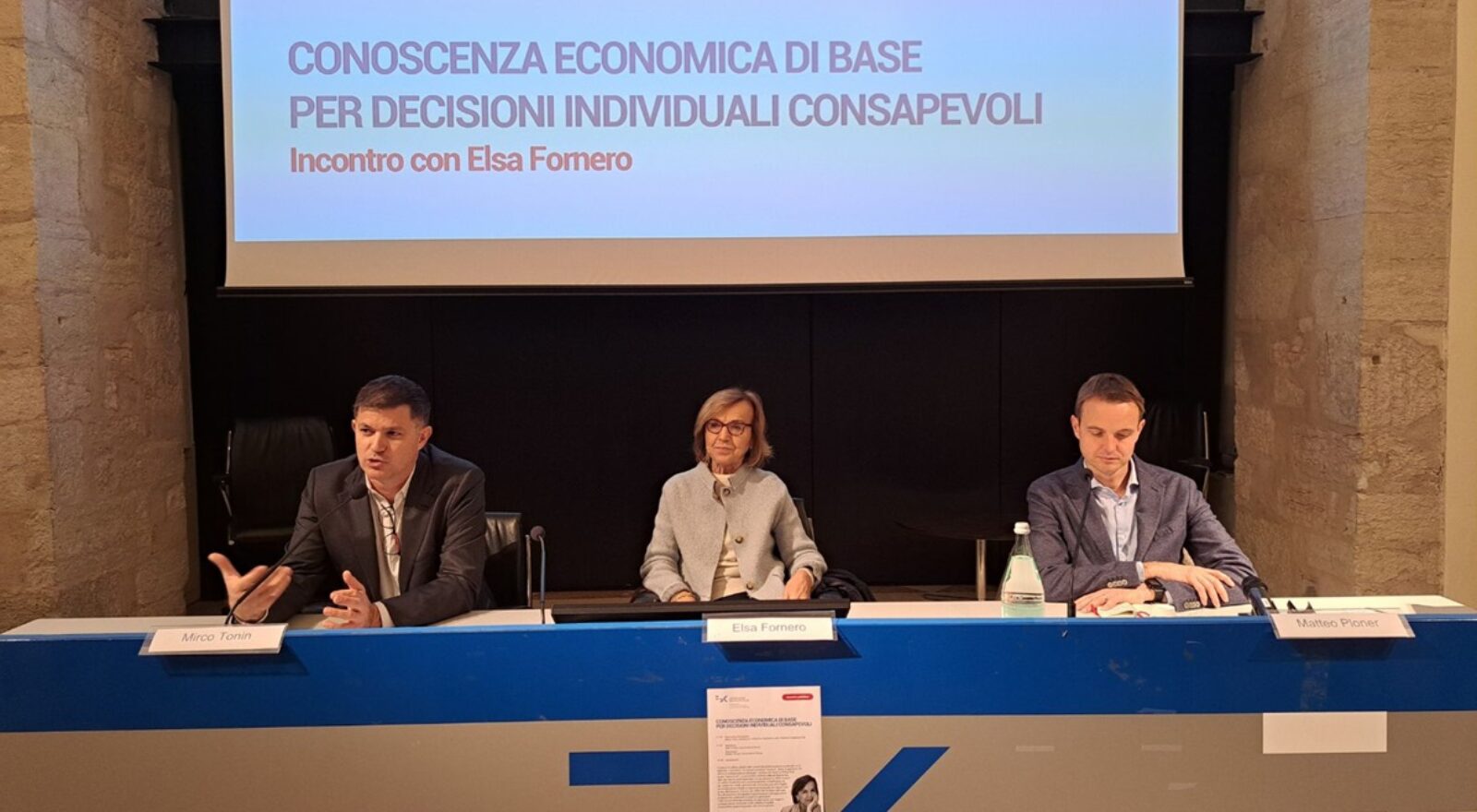
On November 21, as part of the month dedicated to financial education, the Institute for Evaluation Research on Public Policies at Fondazione Bruno Kessler (FBK-IRVAPP) organized a public event entitled “The basics of economics for nformed individual decisions” with Elsa Fornero, Honorary Professor of Economics in the Department of Economic-Social Sciences and Mathematics-Statistics at the University of Turin.
Introduced by FBK-IRVAPP Director Mirco Tonin, Full Professor of Economic Policy at the Free University of Bolzano, and moderated by Matteo Ploner, Full Professor in the Department of Economics and Management at the University of Trento, the meeting addressed the crucial topic of economic and financial education as a tool for informed citizenship.
What does economic and financial education mean?
“If we don’t want to deal with economics, economics will deal with us,” Mirco Tonin concluded, before giving the floor to Elsa Fornero. She emphasized that knowing the basics of economics today is as essential as reading and writing once were. The term economic-financial education, used by the Edufin Committee promoting the “Month of Financial Education” to which the event was aligned, does not refer to training finance experts but to a true form of basic literacy—one that enables citizens to understand fundamental economic mechanisms relevant to their day-to-day decisions.
The idea of financial education originated in the United States thanks to the pioneering work of Italian economist Annamaria Lusardi. From there, it gradually spread throughout Europe and was promoted globally by the OECD and the World Bank, with particular attention to women and developing countries.
Gender and language inequalities
In her remarks, Elsa Fornero focused specifically on gender inequalities, explaining how women often delegate financial decisions to their husbands and tend to underestimate their financial abilities. Much of this stems from familiarity with economic concepts and language. From childhood, girls are less involved in conversations about money, and the language of finance often draws on sports, mythology, and military terms—areas traditionally more familiar to boys. This seemingly harmless linguistic gap contributes to a genuine literacy gap that limits women’s decision-making capacity and economic independence, further fueling economic violence.
Time as a resource and education as an investment
Recalling the model of Italian Nobel laureate Franco Modigliani, Professor Fornero illustrated the theory of spending and saving decisions across the education–work–retirement life cycle. In the education phase, time is the most valuable resource for young people, yet no one teaches them how to manage it responsibly.
To put it another way: time is money and education is an investment, underscoring the close connection between education and finance. Understanding fundamental economic concepts—such as opportunity cost—helps us value time appropriately and make better, more informed choices. As highlighted during the meeting, economics does not teach us to make the “right” choices but the choices we are least likely to regret.
Demographic challenges and sustainability
Several structural challenges facing the Italian economy were also discussed: the demographic crisis, the sustainability of the pension system, intergenerational inequalities, and the brain drain issue. Breaking this vicious cycle will require action on several fronts: increasing employment rates—especially for women—and boosting productivity through investment in technology and human capital, supported by education and vocational training.
In this context, the meeting cited the positive example of Trentino-Alto Adige, which recently introduced a contribution for opening a pension fund for newborns.
Economy between the common good and education
In closing, Elsa Fornero emphasized how today’s economy is evolving with a stronger focus on the common good through the integration of ESG (Environmental, Social, Governance) criteria and the United Nations 2030 Agenda for Sustainable Development. This represents an attempt to incorporate collective well-being into the utility-maximizing functions typical of economics. Such a paradigm shift once again requires economically literate citizens who can understand and support it.
It is no coincidence that we speak of financial “education.” The two terms are connected in two ways: to make informed decisions, citizens must develop economic and financial literacy that helps them understand the world; at the same time, they must recognize the value—including the economic value—of education as a true investment.
Those who understand economic mechanisms can fully appreciate the value of educational investments, and those who invest in education can acquire the economic awareness needed to navigate complexity.
The author/s
Related articles