
AI and consciousness: FBK’s thinking
October 7, 2025
At the first edition of Conscience 2025, six world-renowned experts met to discuss the relationship between artificial intelligence and consciousness, in an exchange of views between science, technology and society. FBK brought its vision of integrative and responsible AI. Paolo Traverso: "Intelligence is different from consciousness, knowing how to do it is different from being conscious."
Will we ever truly understand what consciousness is? And above all, can a machine be equipped with it? From this fascinating and controversial question, the Conscience Committee (composed of four citizens engaged in different sectors—Corrado Tononi, Franco Larentis, Pasquale Mazza and Marco Scartezzini) began organizing the first edition of an event that brought experts in the fields of artificial intelligence, neuroscience and philosophy of mind to Trento, in front of a wide and diverse audience of students, professionals, families and the curious.
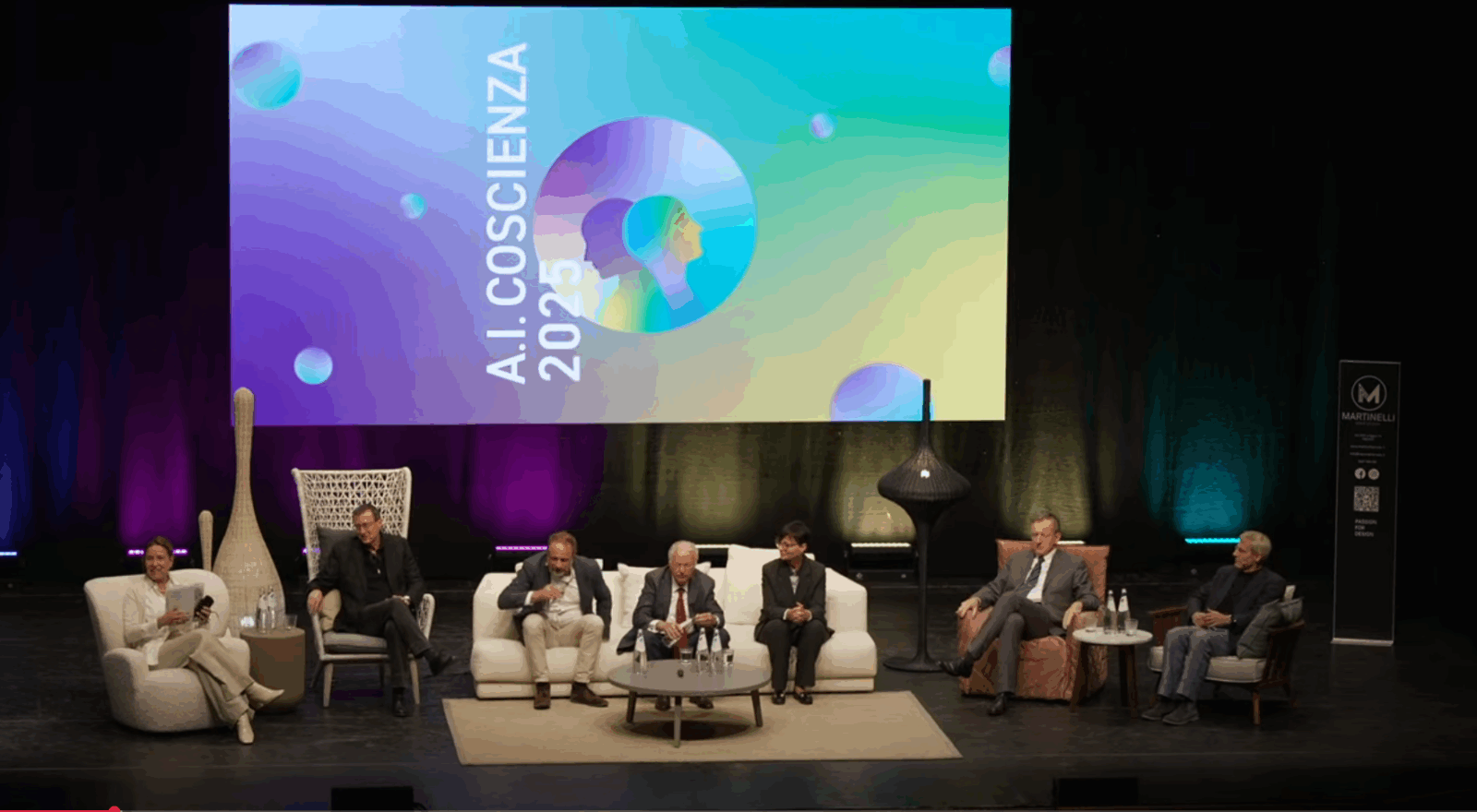
On Saturday, October 4 — in the Santa Chiara Auditorium in Trento, which sold out early — Giulio Tononi, professor of Psychiatry and director of the Wisconsin Institute for Sleep and Consciousness; Federico Faggin, physicist-inventor-entrepreneur-writer; Maria Chiara Carrozza, President of Scuola Superiore Sant’Anna and former president of the CNR; Marcello Massimini, doctor and neuroscientist; Roberto Battiston, professor of Experimental Physics and former president of ASI; and Paolo Traverso, director of Strategic Planning at FBK, met in a panel moderated by Il Sole 24 Ore journalist Rosalba Reggio.
FBK brought to this context the perspective of those who, for over forty years, have been studying and developing digital technologies with constant attention to the human dimension. Paolo Traverso recalled that the topic of conscience is not a theoretical exercise, but a critical issue that closely touches on practical aspects, including those in the medical, ethical and social fields.
“Understanding what we mean by conscience and how to recognize it is a cultural challenge,” Traverso explained. He continued: “First of all, I would like to define what Artificial Intelligence is: a set of functions that allow a computer to calculate, not understand. Artificial intelligence is profoundly different from human intelligence: it can surpass man in some specific tasks and we must be aware of these potentialities, which can be used to do good for humanity.”
FBK‘s contribution focused on concrete examples of how artificial intelligence can improve people’s lives: from collaborating with the Trentino health system for medical applications that support professionals (and are strongly requested by them), to research projects on climate and sustainable industry. From weather forecasts for emergency management to reducing waste in production chains, technology becomes a tool for knowledge and collective growth.
“Today FBK’s work — Traverso explained — is oriented towards the Artificial Intelligence of the future, with the aim of developing systems capable of independently finding data, recognizing when they have learned enough and identifying causal links, i.e., understanding the ‘why’ of phenomena. All this is useful for the most effective models, so that AI can be of help, without causing harm.”
Traverso also referred to a crucial risk: attributing to machines qualities that they do not have. “The worst thing we can do,” he warned, “is to think that a thing or a machine has a conscience when it doesn’t. It is our task to spread the idea that doing is different from being.
FBK’s vision aligns with the other points of view gathered in a shared memorandum at the end of the meeting, which clarifies the clear boundary between the intelligence of know-how and consciousness, typical of human beings.
The success of Conscience 2025 shows that society is ready to reflect on these issues — and to face them with… conscience.
The author/s
-
 Paolo Traverso
Paolo Traverso is the Director of Strategic Planning at Fondazione Bruno Kessler
MORE INFO
Related articles