
Artificial Intelligence and Religious Freedom: rights, ethics and innovation
December 18, 2025
What connects technology innovation and religious freedom? What kind of relationship links technological development, law, and ethics? Which questions allow us to critically engage with the transformations brought about by the widespread adoption of new technologies, rather than passively undergoing them?
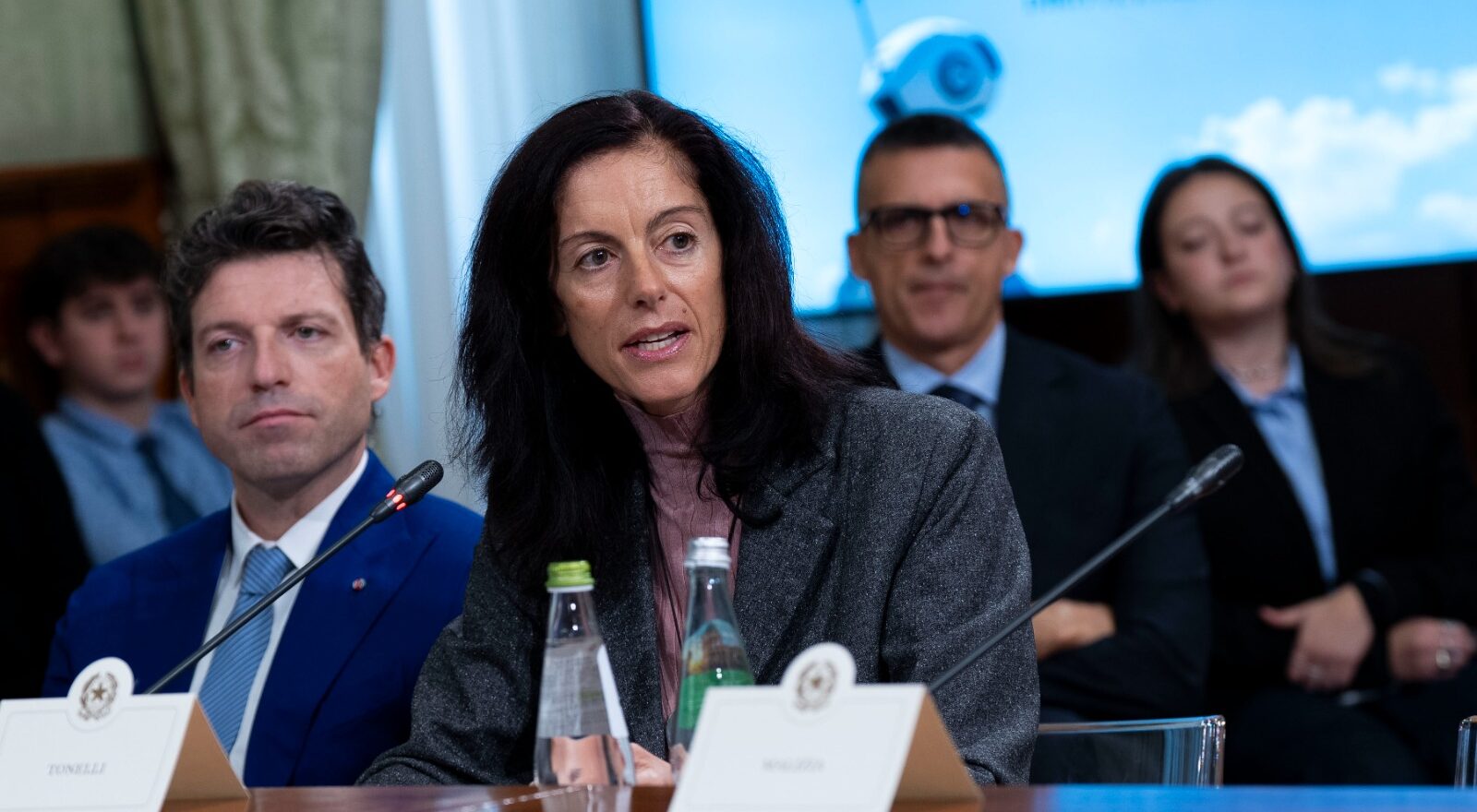
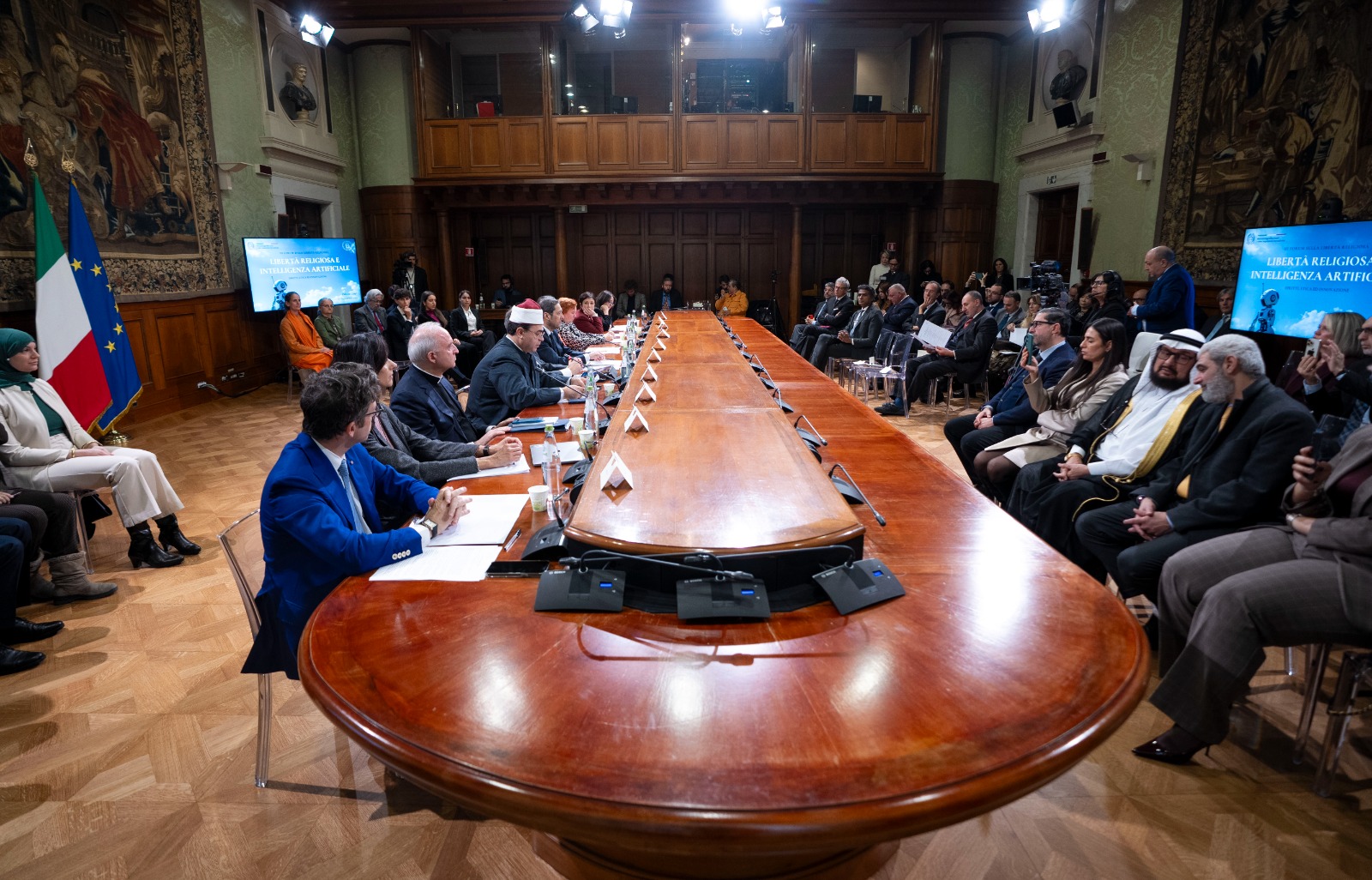
These were some of the questions at the center of the Third Forum on Religious Freedom, dedicated to “Artificial Intelligence and Religious Freedom: Rights, Ethics, and Innovation,” organized by Dr. Davide Dionisi on November 27, 2025, at Palazzo Chigi. The event is part of a broader project on religious freedom entrusted by Foreign Minister Antonio Tajani to Davide Dionisi—journalist, spokesperson, and Special Envoy of the Ministry of Foreign Affairs for the promotion of religious freedom and the protection of religious minorities worldwide.
The forum’s panel discussion brought together scholars and religious leaders, including Father Antonio Spadaro, Undersecretary of the Dicastery for Culture and Education; Imam Nader Akkad, Counselor for Religious Affairs at the Islamic Cultural Center of Italy – Great Mosque of Rome; Svamini Shuddananda Ghiri, Vice President of the Italian Hindu Union; Maria Angela Falà, former President of the Italian Buddhist Union; and Marta Petrosillo, Director of the Report on Religious Freedom for Aid to the Church in Suffering. The academic and research community was represented by Beatrice Serra, Professor of Canon and Ecclesiastical Law at Sapienza University of Rome; Debora Tonelli, researcher at FBK-ISR and Representative of Georgetown University in Rome; and Fabio Bolzetta, professor at LUMSA University and President of the Italian Catholic Web Association. The discussion was moderated by Davide Dionisi.
The roundtable opened with a message from Pope Leo XIV, sent through Cardinal Parolin and read by Msgr. Marco Malizia, Ecclesiastical Councilor and Maeci chaplain, in which the Pontiff – on the one hand – urged to keep alive the attention for religious freedom and – on the other – to ensure that AI is a valid help for society, respecting the dignity and fundamental freedoms of each one.
Special Envoy Davide Dionisi opened the discussion by addressing the risks of algorithmic bias and the need to protect sensitive data related to religious beliefs. Father Antonio Spadaro focused on the unprecedented character of AI, which—unlike previous technological innovations—is not merely a tool but a new environment that must be inhabited with discernment. He also raised the possibility of an interreligious synod through which different faith traditions could walk together in addressing shared challenges. Imam Nader Akkad emphasized the centrality of human decision-making in relation to any form of algoretics, while Svamini Shuddananda Ghiri and Maria Angela Falà highlighted the importance of spiritual and inner education. Marta Petrosillo offered a perspective rooted in the current global situation, Beatrice Serra examined the legal dimensions of technological change, and Fabio Bolzetta addressed the challenges AI poses to communication within the digital ecosystem.
Several factors made this forum particularly significant: the consolidation of a tradition of reflection on religious freedom within political institutions; the development of interreligious dialogue on contemporary technological challenges; the participation of high-level institutional figures, strengthening the initiative within their respective traditions; and the originality of the perspectives presented.
What follows is the address delivered by Debora Tonelli, researcher at FBK-ISR and Representative of Georgetown University in Rome:
“Each word in the title of this panel discussion evokes conceptual horizons with long and distinct histories, rooted in different cultures and interpreted in diverse ways. The conjunction ‘and’ linking ‘artificial intelligence’ and ‘religious freedom’ does not suggest a polarization, but rather a relationship that invites us to ask how technology innovation intersects with religious freedom. These two domains may seem distant: the technological, traditionally understood as an instrumental means of improving human activity, and the religious, which has always been the space in which mystery opens the human search for meaning—of life, the cosmos, and death.
The ‘and’ that brings them together today points to a kind of transfer between the two, a crossing of boundaries in which the underlying anthropological vision is at stake. This is where I would like to focus.
As a philosopher, I reflect on the human being; as a Christian theologian, I reflect on God and the relationship between God and humanity. Different religious traditions interpret in different ways the space in which the mysteries of life and death unfold. Yet in all of them, the sacredness of mystery opens the path to ultimate questions—questions human beings are called to confront and take a position on. What is at stake is the very meaning of life and the possibility of fully living one’s humanity. Today, this horizon is being challenged by new technologies that are reshaping the context in which humans ask and confront questions of meaning.
Recent technological innovations have permeated every aspect of daily life. They have not only accelerated activities—as Hartmut Rosa has noted—but have also transformed them or created entirely new ones. Artificial intelligence, in particular, is shaping a new conception of the human being. It is changing habits, modes of interaction, relationships with the world, and even the way individuals understand themselves and reality. Recent studies indicate that, for the first time since measurements began, average human IQ is declining. New technologies affect not only abstract reasoning but also neural flexibility, in some cases inhibiting it, to the point that we may be becoming less cognitively agile than our grandparents.
At first glance, the impact of these changes may seem similar to that of the Industrial Revolution in Europe. Then, too, technology promised to liberate human beings from fatigue and superstition, leading toward a better life. That promise, only partially fulfilled, instead made human beings prisoners of their own progress. Social alienation, widening inequalities, weapons of mass destruction, and the commodification of life itself were among the symptoms that led Horkheimer and Adorno to found the Frankfurt School, driven by one central question: how did we get here? The rationality meant to enable liberation and progress failed to equip humanity to manage freedom or progress itself. Art, literature, history, myth, economics were some of the areas through which the members of the School tried to answer that question, while society was undergoing profound transformations.
Today, however, new technologies are not merely intensifying the challenges inherited from the Industrial Revolution; they are reconfiguring the horizon of meaning within which individuals and communities build identity, form judgments, embrace values, and confront ultimate questions such as the meaning of life and death. As Argentine philosopher Miguel Benasayag has observed, the choice facing humanity today is between ‘functioning’ and ‘existing’: between adapting to the mental and social structures produced by technology or centering oneself through awareness, discernment, and values. At the same time, technological innovation and artificial intelligence cannot be regarded as evil in themselves. Rather, they challenge us to rethink freedom and self-awareness.
From multi-faith prayer rooms in European airports—where technology recreates sacred spaces for travelers—to robots assisting the sick; from robot monks in China leading prayer in Buddhist temples to ghostbots that simulate the presence of deceased loved ones to help the grieving detach, the questions raised across this spectrum are numerous. Our reactions to these phenomena vary widely depending on cultural context, and often say more about us than about the technologies themselves. For example, while the idea of a robot celebrating Mass is unthinkable in the West, Buddhists have developed the Xian’er robot at the Longquan Monastery in Beijing to lead prayer, attributing to it a purity greater than that of humans, as studies by Travagnin show.
Even more radical is the challenge posed by ghostbots designed to help the living detach from the dead. Their goal is to ease the grieving process until individuals feel ready to let go. The trauma of separation—sometimes sudden and always a source of deep suffering—is, so to speak, softened through a process tailored to those who remain. In this case, suffering is viewed as something purely negative, no longer—even potentially—as a regenerative resource capable of awakening new inner energies. The risk lies in judging what is good or bad for the human being solely based on symptoms, without considering the role that even painful experiences play within the totality of human life.
More radical still is the evolution of ghostbots envisioned by Hurtado through the concept of the Virtual Deceased Person, in which individuals create digital versions of themselves during their lifetime that continue to exist and interact socially after death. Sparrow and Zhang push this further by hypothesizing the digital resurrection of ancestors, with their continued participation in social life.
If multi-faith rooms arise from the recognition of religious pluralism and respond to the need for spaces to cultivate spirituality even while traveling, thanatechnology reaches into a far deeper existential dimension—one for which there is no single answer.
In the face of the global challenge posed by new technologies, there can be no single global response. Different cultures identify different problems—even within the same domains, such as religion—and adopt different strategies.
The challenge, then, is to manage the global spread of technology without erasing the specific cultural contexts in which it takes shape. It is clear that the tension between global and local dimensions inevitably brings about change—sometimes profound—within specific contexts and calls for the search for new forms of balance.
In humankind’s attempt to overcome the biological limits of life and its own existential anxieties, artificial intelligence proposes substitute forms of existence, aimed at overcoming those limits and avoiding the need to face those anxieties, but without solving them. What are we afraid of when we attempt to evade what belongs to our nature? How would our self-understanding change if we became immortal? Would immortality alone be able to tell us the meaning of life, to reveal – namely – thmystery that opens to the human as a question?
This new ‘religion’ of artificial intelligence, which promises empowerment and the overcoming of human limits, feeds on the fear of meaninglessness. The real problem is not AI itself, but the purposes to which we direct it. The inability to distinguish between technologies that support human life and those that replace what gives it meaning reflects not progress, but a failure to discern who we are from how we function. Biological limits do not spare individuals the experience of their own death, nor do they provide ready-made tools for meaning. Digital tools, by contrast, help construct the illusion of permanence among the living: anxiety is eased but not resolved, and the space of existence is illusorily expanded rather than truly filled.
Even if technology were someday able to delay biological death indefinitely, it would still be unable to answer the fundamental questions of meaning. In these attempts to replace “God,” what becomes evident is an inability to dwell within the very void where the mystery of the question opens. Yet it is precisely from that space that we should begin, because human intelligence lies first and foremost in the capacity to ask questions—especially uncomfortable ones—and the freedom to choose our horizon of meaning, whether religious, virtual, or digital, cannot be realized without awareness. The real question is not the freedom to live forever or to overcome death, but which question of meaning this effort seeks to answer, what fear it responds to, and how we would inhabit such an endless life. The illusion that technology can duplicate and enhance reality pushes us to experience as real and true what, in fact, deceives us and evades the challenge of meaning—the only thing that truly makes us human, and the only part of ourselves that we should seek to cultivate.”
The author/s
Related articles