


FBK in Brussels to support the European Democracy Shield
December 9, 2025
Research, innovation, and shared strategies to strengthen democratic resilience in the age of online disinformation.
Research and innovation as tools to counter digital disinformation were at the center of the third edition of Meet the Future of AI, held on December 2 at the Representation of the EUREGIO Tyrol–South Tyrol–Trentino in Brussels. Alongside other partners of the European Cluster against Disinformation, FBK co-organized the event and contributed by presenting advanced AI-based technologies and collaborative strategies to protect European democratic processes from disinformation and digital manipulation, including a preview of results from the AI4TRUST project.
In a time of rapid technological change and rising geopolitical tensions, safeguarding European democratic processes has become increasingly urgent. The event, Meet the Future of AI: Support for the European Democracy Shield, brought together policymakers, researchers, and practitioners to explore how innovative AI solutions, cross-sector collaboration, and effective policy frameworks can strengthen democratic resilience against disinformation.
In the opening session, Krisztina Stump, Head of Unit at the European Commission responsible for social media policies and the fight against disinformation, emphasized the accelerating nature of these threats. “Disinformation is now a real threat, amplified by deepfakes and AI-generated content, especially in electoral contexts,” Stump said, noting the growing public concern: “Almost 80% of Europeans fear that voters may make decisions based on false information.”
Co-organized by the Horizon Europe projects AI4TRUST (coordinated by FBK), AI-CODE (with FBK as a partner), AI4Debunk, TITAN, veraAI, and ELLIOT, with support from the EU Disinfo Lab and EDMO (European Digital Media Observatory), the event showcased how European research and innovation are developing new capabilities to detect, assess, and counter disinformation—particularly in the era of generative AI and large-scale digital manipulation.
“The European Union has recognized the need to create a shield for democracy—the European Democracy Shield,” explained Riccardo Gallotti, Researcher and Science Ambassador at FBK and Coordinator of the AI4TRUST project. “Now we researchers are called on to discuss it and understand how this tool can be interpreted and built. The tools already exist and were developed through European projects such as AI4TRUST and AI-CODE, where FBK plays key roles. This is a major opportunity to create a new platform informed by AI research and studies, and to make our contribution.”
The final panel discussion, moderated by Gallotti, highlighted how Horizon Europe projects within the European Cluster against Disinformation—including AI4TRUST, AI-CODE, AI4DEBUNK, ELLIOT, TITAN, and PROMPT—have developed and continue to develop innovative tools to detect manipulated content, analyze dissemination networks, and support journalists and fact-checkers. The session presented automatic debunking tools, early-warning systems, and educational chatbots, all designed to counter the evolving techniques of information manipulation.
Concrete results and real-world use cases from active projects were also presented. The first, coordinated by Fondazione Bruno Kessler, was AI4TRUST. Funded by the EU, the project previewed its final results in Brussels, showcasing a hybrid system based on human-machine collaboration and advanced AI solutions. Its goal is to support media professionals and policymakers in the fight against disinformation. The system enables near real-time monitoring of multiple online social platforms and flags high-risk content for expert review by analyzing multimodal (text, audio, video) and multilingual content using new AI algorithms.
The event delivered a clear and shared message: no single actor can tackle disinformation alone. As Peter Friess, Senior Programme Officer at the European Commission’s DG CONNECT, noted, “If this community joins forces, we will be able to face the challenges with stronger tools and a common strategy.” Dialogue among policymakers, researchers, media professionals, and technology experts is set to become the foundation of a new European framework for democratic resilience.
The author/s
-
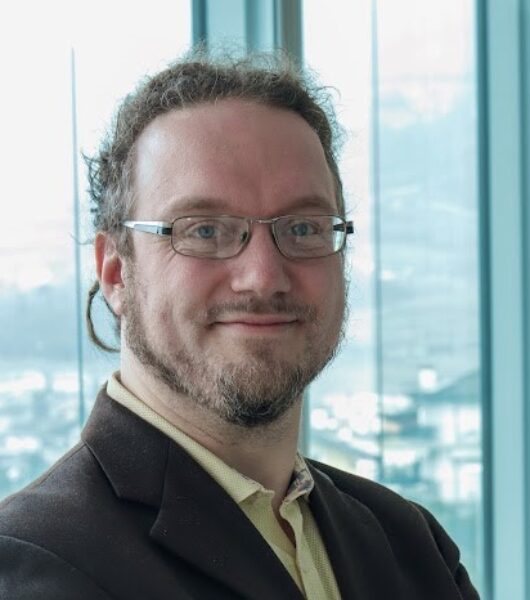 Riccardo Gallotti
Head of @ CHuB lab at Digital Society Center.
MORE INFO
Related articles