Mirco Ravanelli, from FBK to Canada in the footsteps of Yoshua Bengio
April 21, 2026
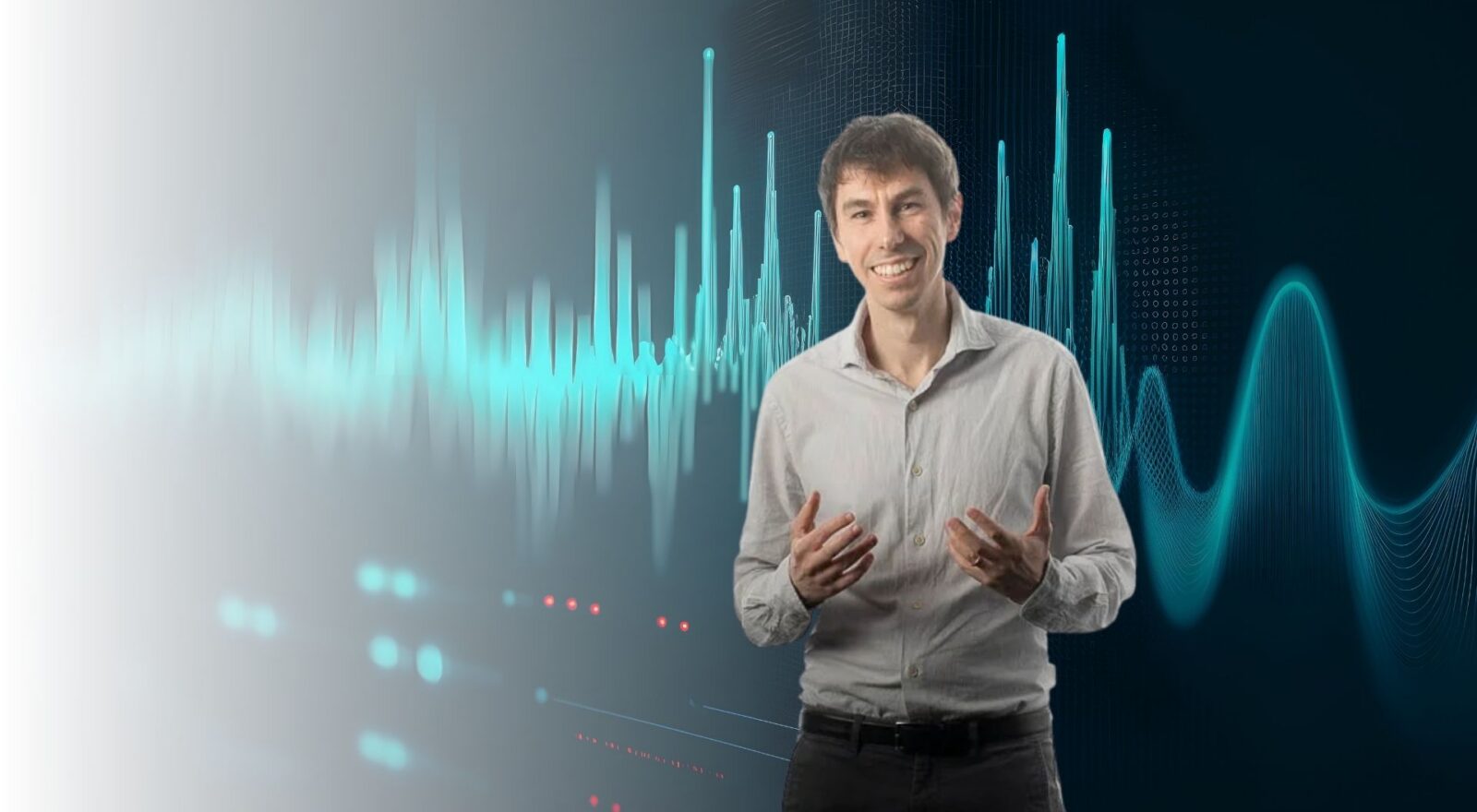
Interview with Mirco Ravanelli, a researcher born in Trento who completed his doctoral thesis at Fondazione Bruno Kessler. Today he is a professor at Concordia University in Montreal and an associate member of Mila, one of the world’s leading artificial intelligence research centers, founded by deep learning pioneer Yoshua Bengio.
Some scientific trajectories seem almost geographical: they start in one province and end on the other side of the ocean. Mirco Ravanelli’s career began in Trento, at Fondazione Bruno Kessler, in the years when deep learning was still a gamble pursued by only a few. It then passed through Berkeley and reached Montreal, where he met Yoshua Bengio—one of the fathers of modern artificial intelligence—and found himself in the middle of the technological revolution that is changing the way machines understand voice, text, and images. Today Ravanelli is a professor at Concordia University and leads an AI research group, but between the mountains of Trentino and the laboratories of Montreal there is still a direct connection.
Let’s start from the beginning. How did your research journey begin?
As is often the case, it all began during my master’s thesis at Fondazione Bruno Kessler in 2010, under the supervision of Maurizio Omologo, one of the pioneers in voice signal processing research. From there, a series of opportunities followed: I worked as a research assistant on several European projects, which allowed me to engage more deeply in the world of research. In January 2013, I also had an experience in Berkeley, in the United States, thanks to a mobility program. It was an important opportunity because I started working on technologies that were pioneering at the time but would soon take off: deep learning, an artificial intelligence technology that allows machines to analyze large amounts of data and better understand human language, and that laid the foundations for many of the chatbots and virtual assistants we use today.
Then came the doctorate.
Yes, I completed my PhD in ICT at the University of Trento and with FBK, working on deep learning applied to speech processing—namely, the speech recognition technologies we use daily on our devices today. During my PhD I had the opportunity to spend time abroad in Montreal, Canada. That’s where I worked with Yoshua Bengio, who today is one of the most cited scientists in the world and a professor at the University of Montreal, as well as the founder of the artificial intelligence research center Mila (Montreal-based Artificial Intelligence Research Institute), where I also work today.
How did the connection between Bengio and FBK in Trento come about?
The connection is older than you might think. Bengio’s PhD supervisor, Renato De Mori, is one of the most important Italian researchers in the field of artificial intelligence and speech processing. De Mori was also one of the “Prominent Scientists” invited to FBK (then the Trentino Institute of Culture) in the 1980s to launch research in AI, and it was thanks to this relationship that Bengio—when he was already a promising doctoral student—came to Trento for a research period. He often says he had a lot of fun: in addition to research, he spent a lot of time in the mountains. This created a historical link between Montreal and the Trentino research ecosystem, which continues today through informal contacts with researchers and colleagues.
What was it like to work in Montreal, the cradle of deep learning and emerging technologies of the moment?
When I arrived in 2016, Bengio’s research group was growing, but it still didn’t have the numbers it has today. I spent six months there as a visitor, and he was my supervisor during that time. After my doctorate it felt quite natural to ask him if I could do a postdoc with him. So I stayed in Montreal where, for the first four years, together with Bengio and the research group we managed to publish several interesting papers. Since 2022 I have been a professor at Concordia University and an associate member of Mila, the research center founded by Bengio himself and dedicated to developing artificial intelligence for the benefit of all.
What do you do in your research group today?
In Montreal I coordinate a group of about twenty researchers. We work on different areas of artificial intelligence. One very important direction is multimodal models, that is, Large Language Models (LLMs) that reason not only on text but also on audio and video. Another area concerns interpretability: today it is not always clear how these models make decisions, and there is still much to understand. In recent years we have also been working on the energy efficiency of models, because the computational cost of AI is becoming increasingly important. Yoshua Bengio, on the other hand, is focusing a lot on the issue of artificial intelligence safety.
Mila has become one of the most important AI centers in the world: it seems to be the “place to be” for researchers like you.
Mila—the Quebec Artificial Intelligence Institute—is a center founded by several universities. Today it is the largest academic center in the world dedicated to deep learning, with a very strong international reputation. In addition to this, I also work at Concordia University, which is the second-largest university in Montreal. It is a relatively young university—about fifty years old—but it is investing heavily in artificial intelligence and new research profiles.
Do you still have connections with Trentino and FBK?
Yes, I come back to Trentino at least a couple of times a year and I always try to stop by to see colleagues and friends. The link with the Trentino ecosystem has remained very strong, although today there is no formal, structured collaboration.
What is it like to live and do research in Canada?
Canada offers a very supportive environment for pure research. There is a great deal of freedom to explore new ideas and you are not always tied to industrial projects. Obviously, when you become a professor things change a bit, because you still have to find funding to support research activities. I also appreciate the cultural context of Montreal: it is a very international city with a fairly strong Italian community. My wife here is an Italian teacher, a much sought-after role.
Are there things you miss?
Certainly the human aspect of research. In Italy—and particularly at FBK—there are moments of spontaneous socializing: lunches together, conversations, friendships that arise naturally. These things also help research a great deal, because they build a sense of community. It is a little harder to build these relationships abroad. That’s why I try to recreate that atmosphere with my students: we often organize group dinners, informal gatherings, soccer games, or other activities. It is important to create a human as well as a scientific environment.
Now that you are a professor, how do you motivate students who want to pursue research?
The first piece of advice I feel like giving is to work hard. I have never seen anyone achieve important results without commitment. But above all, you have to do something you are truly passionate about. People only succeed when they are deeply interested in what they do. If research becomes just a job, it is probably not the right path. In my case I was very lucky: I always worked on topics I was truly passionate about.
The author/s
Related articles