The services of the Center for Digital Industry bring research closer to the market
December 5, 2025
The Center for Digital Industry fosters collaboration with Italian and European companies to close the gap between research and commercialization, helping advance and disseminate state-of-the-art industrial technologies. In a series of articles, we will highlight several cases in which the Center has supported the market adoption of AI and accelerated innovation through testing and validation services. These activities are carried out within three initiatives co-funded by the European Commission and MIMIT (Ministry of Business and Made in Italy): AgrifoodTEF, AI-MATTERS, and InnovAction.
As part of the InnovAction project, FBK’s Center for Digital Industry contributed to RailEvo—an autonomous, on-demand rail-taxi system—by providing the “Twin Transition in the Product: PoC” service, which involved simulating and validating new digital solutions for intelligent railway mobility.
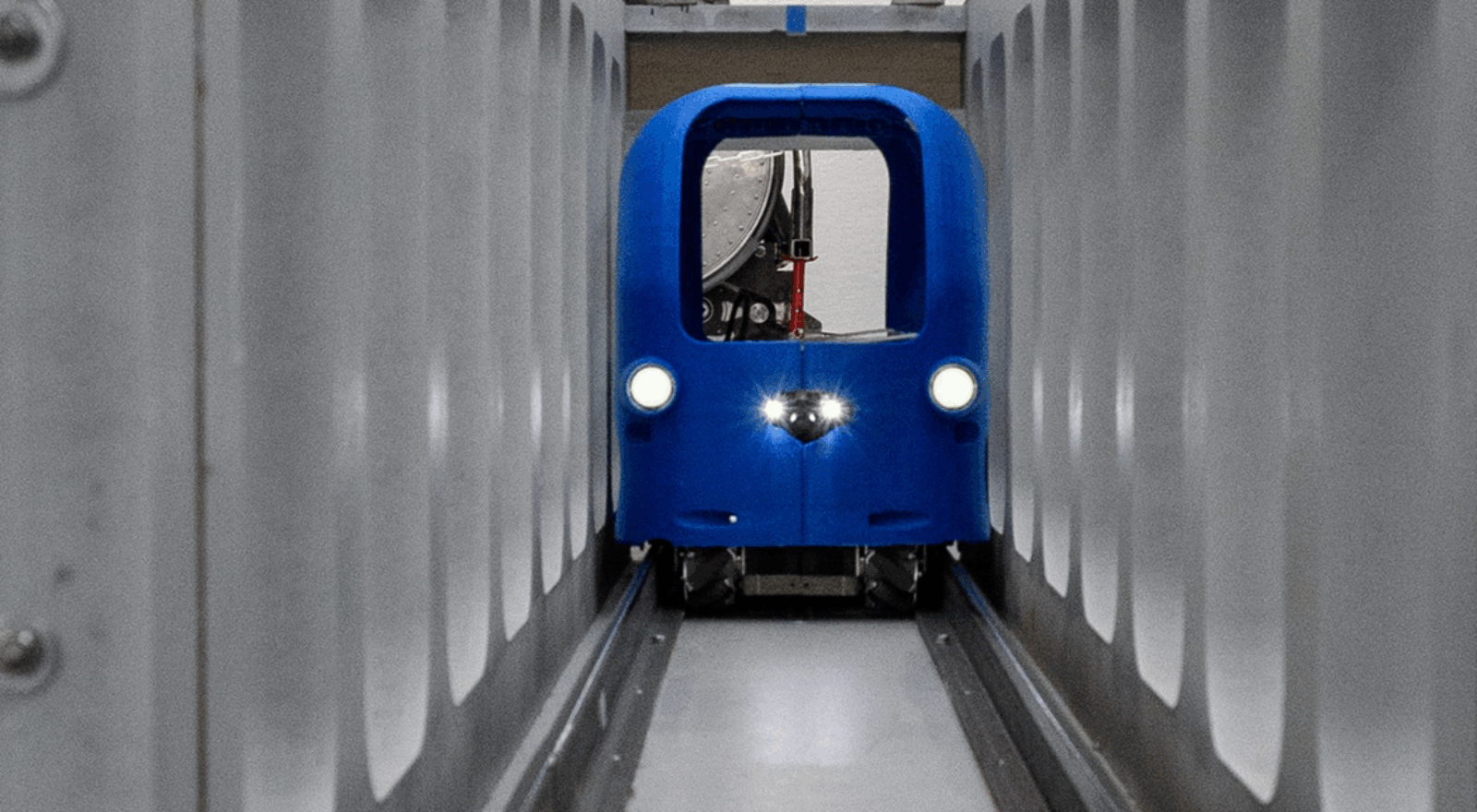
RailEvo proposes a 24/7 autonomous rail-taxi service operating on demand. The start-up’s idea is to repurpose decommissioned single-track railway lines for local public transit by converting them into double-track RailEvo lines. Instead of traditional trains and carriages, the system uses small autonomous vehicles with four or six seats. Passengers no longer have to wait on a platform for a scheduled departure—they can simply book a ride through the app whenever they need it and count on service being available 24/7. The tracks essentially become a dedicated, congestion-free “highway.”
The focus of the service delivered by FBK’s Center for Digital Industry is the design and assessment of a “vertical switch”—a technology that replaces traditional horizontal rail diverters. The new architecture introduces an entirely novel mechanism for routing vehicles onto and off the main line, reducing maneuvering times, enhancing safety, and minimizing component wear. Moreover, vertical switching systems enable more efficient land use and help reduce the environmental footprint of railway infrastructure.
FBK applied advanced Model-Based Design (MBD) methodologies—an approach that enables modeling, simulation, and validation of system behavior prior to implementation—to develop architectural and behavioral models describing the operation of the switching mechanisms and associated control systems. These models make it possible to predict system performance under realistic operating conditions and to optimize reliability.
This approach has enabled RailEvo to further strengthen the digital maturity of its proposed solution, integrating operational efficiency, safety, and energy sustainability in line with the principles of the Twin Transition.