
From research to business: Marcello Federico’s journey between leadership and innovation
April 22, 2026
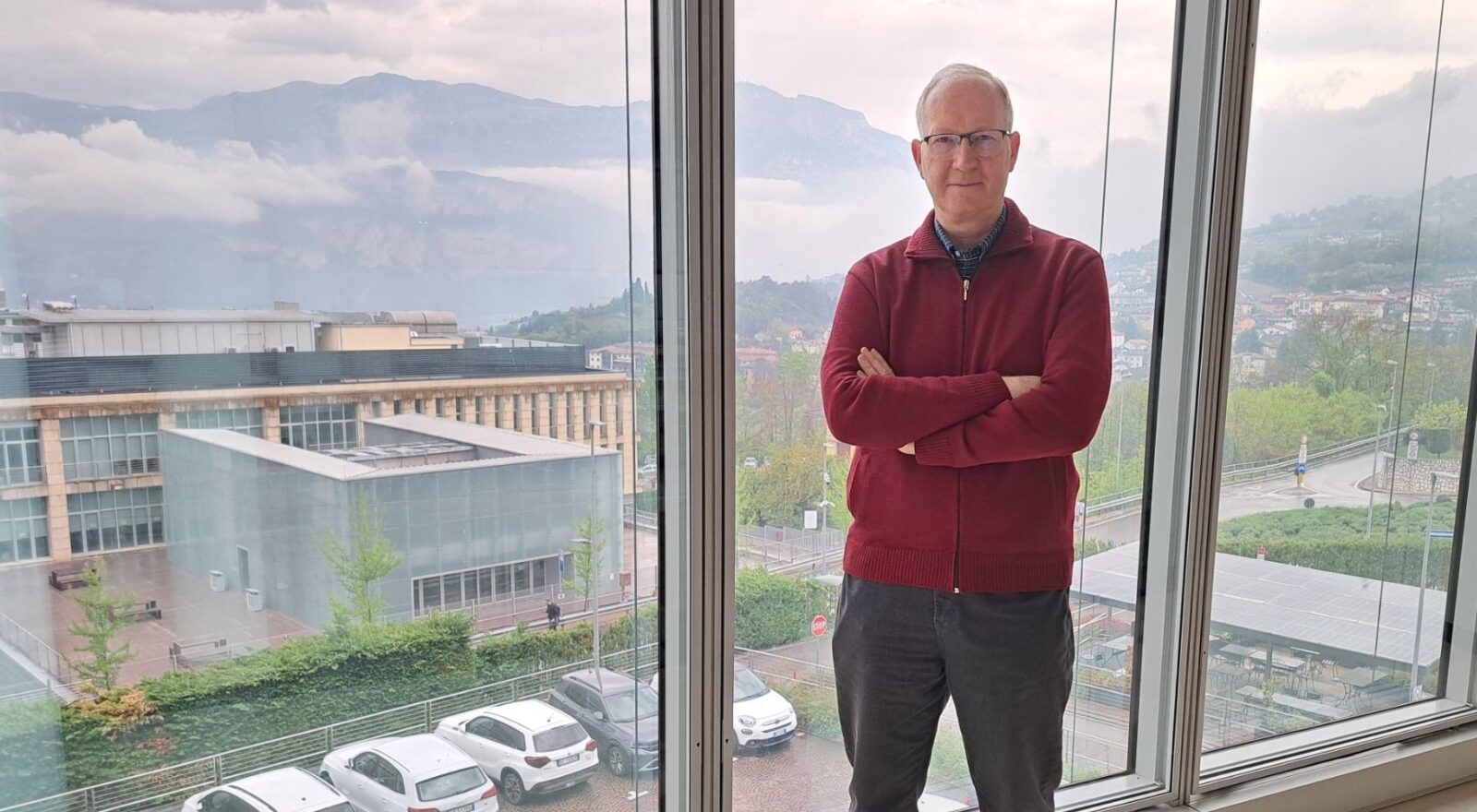
A pioneer in speech recognition and a leading figure in the global machine translation landscape, after a long career at FBK (1990–2017), he is now a Senior Principal Scientist at Amazon, where he has led scientific teams in both AWS AI Labs and the European technology hub of Amazon Stores. We met with him to hear lessons learned over the course of his long experience at the forefront of scientific innovation.
Federico began his career in applied research, working on pioneering projects such as automatic dictation for medical reporting and speech recognition. These projects, developed within the framework of ITC-IRST starting in the early 1990s, laid the foundations for the creation of spin-offs such as GST, bringing innovation directly to Italian hospitals. His journey continued with collaborations with RAI and his contribution to the creation of Pervoice, a company dedicated to automatic transcription services for institutions and the media. These experiences strengthened his ability to transform complex language technologies into high-impact industrial solutions.
Subsequently, the transition to statistical models and the adoption of open-source solutions represented an important step. Federico understood that collaboration and knowledge sharing were essential to accelerating innovation in machine translation and language models. This approach enabled the development of software that became a benchmark in both academic and industrial settings, creating opportunities in numerous startups, institutions such as the UN and the European Parliament, and technology companies such as eBay, Facebook, and Amazon.
Federico has gone through several phases, consolidating skills that he later shared with colleagues and students.
In this article/interview, we explore three aspects of his experience: the gradual transition from research to a multinational company, the role of mentor and leader, and the importance of the network of his former students and mentees as a resource for growth and exchange.
The transition from research to industrial implementation
Giancarlo Sciascia: “Going through the transition from research at FBK to major industrial players in the sector, what were the most significant differences you encountered, both in terms of daily work and mindset?”
Marcello Federico: “The main difference is speed and focus.In applied research centers, projects have short cycles, and the challenge is often to constantly reinvent proposals to secure funding.In industry, on the other hand, we work on short-term projects with long-term objectives, with resources available immediately. This allows you to focus on what you love to do, without fragmenting your efforts across multiple stakeholders. The quality of people is a common factor—high in both contexts—but in industry the priority is to solve concrete problems and create value for customers, not to publish papers. I’ve learned that speed and efficiency are core values, as is the ability to work in multidisciplinary teams—scientists, engineers, program managers, product managers—where every role is essential to moving quickly.”
The leadership Approach in a rapidly evolving Industry
Federico developed his leadership through a gradual path, starting with targeted projects and specific technologies. Acquiring knowledge and building credibility were key elements in navigating complex business environments. In large companies, corporate culture and the operating mindset play a fundamental role.
Federico highlighted the importance of values such as clarity, focus, and managing ambiguity. These principles are applied daily in practice, helping to define areas of action and guide teams toward clear objectives. The complexity of industry compared to research is greater, as it requires coordination across multiple roles and functions, but this also leads to greater clarity and precision in the work.
GS: “To get your bearings in a multinational and highly competitive organizational context, what can’t you do without?”
MF: “The complexity in Big Tech is different from that of a research center: it is more organizational than technical. This is why it is extremely important to understand the mindset that shapes company policies and translates into the ability to answer questions such as: How do you develop project proposals? What signals help you identify trends that will become more prominent in the future? How do you tune in to the next challenge?”.
The challenges of mentorship: leading with empathy and precision
GS: “How has your role as a mentor evolved?”
MF: “At the beginning, mentorship was very technical: I provided solutions or corrected methodological approaches. Over time, I realized that the real value lies in helping people develop their analytical and decision-making skills.
Today, I expect my team members to be autonomous and up to date on the latest techniques. In my role, it is critical to ask the right questions: Are we solving the right problem? Are the results truly useful? Are the experiments structured to obtain information at the lowest cost?”
GS: “Was there a failure or a mistake that taught you more than any success? How did you manage it and turn it into a growth opportunity for yourself and others? “
MF: “An important lesson was realizing that pursuing overly complex solutions can be counterproductive when a simpler one is already effective. At some point, it is better to make something work and then improve it over time, rather than devoting excessive effort to achieving ‘perfect’ solutions.
I learned the importance of failing fast: trying a solution in the field as soon as possible, rather than iterating experiments in the lab for months to gain a 5% improvement that may not have an impact. It is better to gain experience in production, because the real world shows you what other problems need to be solved and helps you improve interactions with all the systems connected to the problem you are addressing.
This lesson is especially useful for perfectionist scientists: method and efficiency are key, analyzing the literature and models is important, but in the end you have to stop chasing perfection and focus on what works. You need to know when to stop, because the real value emerges later: your solution’s interactions with the rest of the ecosystem will show what truly needs improvement. Success metrics also expand when you move from research to production. In the lab we evaluate only translation accuracy, but in production other critical factors emerge: latency, model cost, computational cost, and scalability. This is where the art of compromise and the learning by doing approach comes into play.”
The importance of the network
Federico has always placed great importance on his network of former colleagues and collaborators. For young people—especially PhD students—having access to experts across a range of industry and academic settings can be a game changer. Networking allows you to compare perspectives, understand company expectations, and better prepare for interviews and professional challenges. Over time, the network becomes a resource built on mutual trust.
“Human connections matter,” Federico emphasizes, “and trust is built through authentic conversations, not only through publications.”
Building and maintaining your network: strategies and tools
“Building and maintaining a network,” Federico continues, “requires ongoing commitment and an awareness of the value and benefits that participation brings to each member.
I have always tried to offer something useful to others—visibility, recognition, documentation of their work—without expecting anything in return in the short term. For example, in the research center I included interns on the group’s website, and after their internships ended I kept them listed as alumni with the reference year, so as to provide documented evidence they could include in their CVs.
Similarly, when organizing conferences I have always publicly acknowledged the contributions of colleagues involved, leaving a permanent record in the proceedings and on the event site. These are simple gestures, but they require intentionality: making others’ contributions visible does not happen by default; it must be done deliberately.
In practice, this approach has helped me and enabled me to help others: I have always found people willing to collaborate, received numerous job opportunities, and easily involved colleagues and researchers in shared projects—whether organizing a conference, attracting people to my teams, or starting new collaborations.”
Former students as a resource: value-generating collaborations
Federico has involved former colleagues and collaborators in new projects and initiatives, recognizing the added value of this network. One example is collaboration with scientists from other companies, such as Meta, Google, Apple, and Microsoft, which has led to concrete results beneficial to both parties and the broader scientific community.
These collaborations are based on clear and authentic communication, with well-defined expectations. Federico noted that clarity in communication is essential to avoid misunderstandings and ensure collaborations remain effective over time.
Last but not least: guiding principles
In summary, at the core of these dynamics is a simple balance: clearly communicating one’s own objectives and those of the group, aligning expectations, and maintaining relationships over time. In scientific work, where the natural tendency is to focus on individual contributions, having a network of people with whom to exchange support makes a tangible difference: it provides access to skills, opportunities, and perspectives that would not be available otherwise.
“In my experience,” Federico concludes, “success has depended largely on the collaborations I have built: I have shared my greatest achievements with others, and seeing the success of my former students and collaborators remains one of the most rewarding aspects. You don’t need elaborate strategies—just intentional, consistent actions like those described above. The result is a network of relationships that works in both directions: you find help when you need it, and you are in a position to offer it.”
————
Marcello Federico is Senior Principal Scientist (Director level) at EU INTech, the European technology hub of Amazon Stores. He previously led scientific teams at AWS AI Labs in the United States (2018–2024) and directed research units at Fondazione Bruno Kessler (1997–2017), while teaching at the University of Trento (2001–2022). His research in machine translation, natural language processing, and artificial intelligence has led to the publication of about 250 papers. He is co-founder of two technology companies and serves as Chair of the ACL Special Interest Group on Spoken Language Translation (SIGSLT). Marcello is a senior member of both IEEE and ACM.
The author/s
Related articles