
The PhD in industrial innovation as a strategic lever for companies
March 30, 2026
Promoted by University of Trento and Fondazione Bruno Kessler, the PhD in Industrial Innovation has, since 2019, combined three key factors for regional development: projects driven by business needs, applied research on real-world problems, and a dedicated three-year team. At its core is the connecting role played by each industrial PhD studentteam.
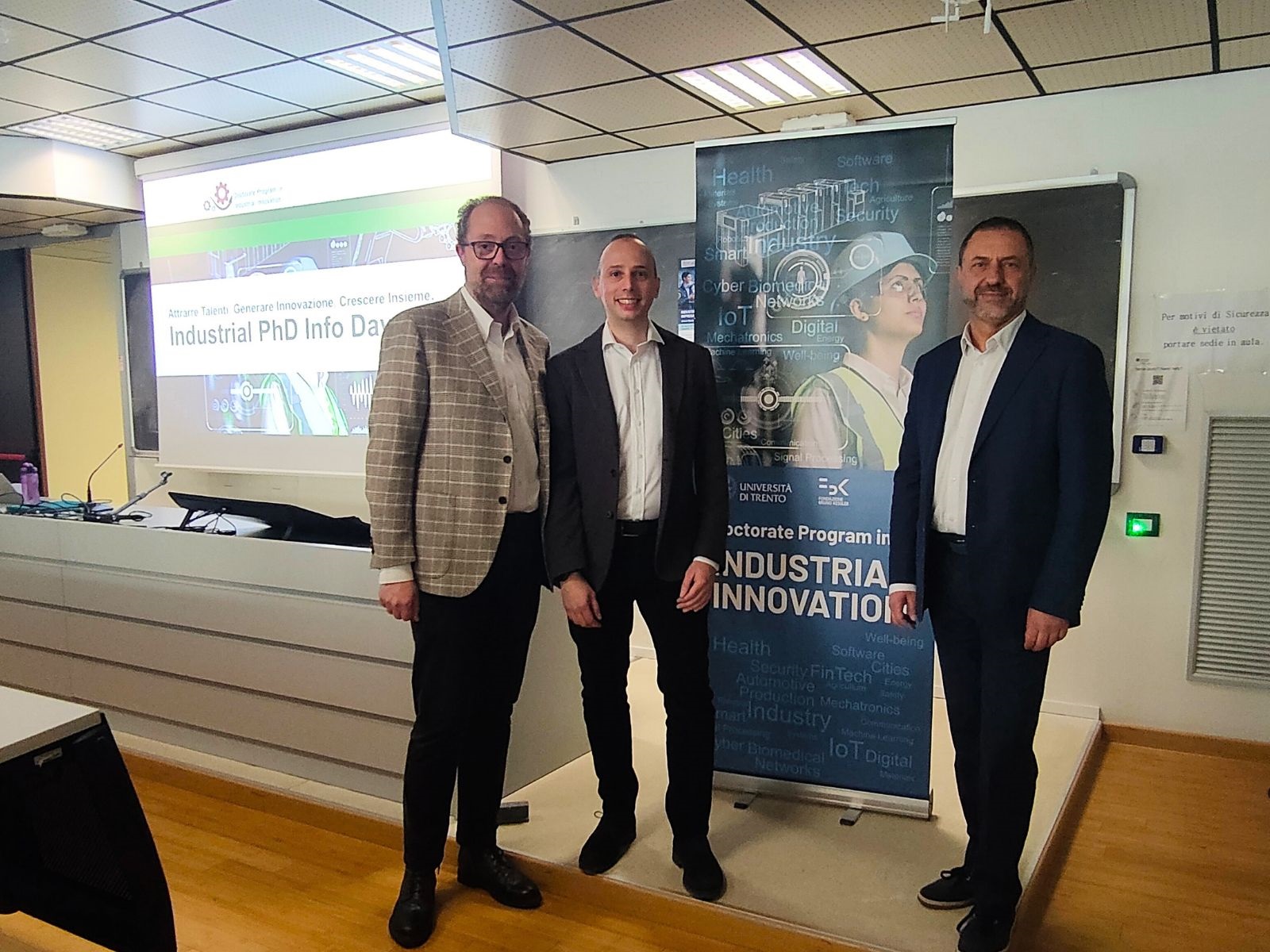
On March 25, a meeting for companies showcased in concrete terms how the Doctorate in Industrial Innovation at UNITN and FBK serves as a strategic lever for growth, innovation, and talent attraction—an increasingly critical condition for ensuring continuity and competitiveness.
The PhD student as an opportunity
The industrial PhD differs from the traditional path. It is suited for those seeking a more applied experience and who want to better understand what it means to work in a company. It focuses on applied research and is ideal for those interested in research but undecided between academia and industry. It also offers immediate job opportunities, typically leading to an R&D role within a company.
The PhD student as an agent of technology maturation
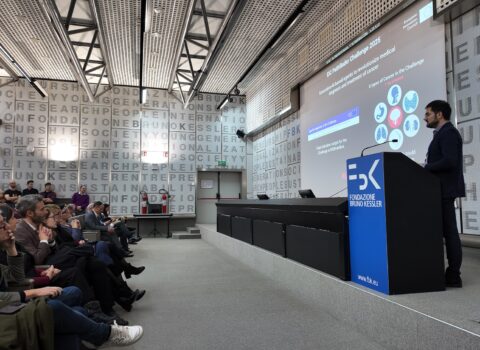
In his remarks, Alessandro Rossi, UniTN President’s Delegate for Support to the Production System, emphasized the importance of industrial PhD students as connectors between the worlds of research and industry, which often struggle to find common ground.
This connection becomes possible not only by bringing theoretical and technical skills into daily practice, but also by fostering mutual understanding and a shared vocabulary. How do businesses and universities communicate? A common language is essential because it shortens the time needed for understanding—and therefore for experimentation. Each PhD candidate acts as a bridge, performing the “translation” needed to align academic and applied perspectives on evolving problem-solving challenges
The infrastructure that make a difference
Alfredo Maglione, Vice President of Confindustria Trento, highlighted the value of technology transfer through people—individuals with diverse skills who can bridge research and industry. He also pointed to an important advantage: access to FBK and university facilities, along with the opportunity to engage directly with their experts—resources that companies do not always have in-house.
The PhD in industrial innovation retains talent within companies
Domenico Siracusa, Coordinator of the PhD in Industrial Innovation, emphasized a key aspect: the industrial PhD enables companies—such as Rovereto-based Energenius, now part of the MAPS Group—to develop talent and, in some cases, build new markets around advanced capabilities. Operating at the technological frontier is a valuable competitive asset.
Before presenting testimonials from successful former PhD students, he outlined the activation process and the two available pathways.
There are three phases in the partnership between companies and academia:
- definition of the research project based on industrial needs
- selection of the candidate, with strong company involvement
- execution of the PhD, with joint supervision and dual mentoring (industrial and academic)
Each year, timelines are predefined to ensure predictability and support business planning:
- April 15: deadline for expressions of interest
- May 15: finalization of agreements with FBK/UNITN
- May 31: publication of the call
- July 31: candidate selection
- early November: start of PhD programs
There are two ways to participate:
- Scholarship track, funded or co-funded by companies, lasting 6 to 36 months, with an annual cost of approximately €31,000—supporting company research and innovation activities.
- Executive PhD, designed to enhance the skills of current employees, with management costs starting at €3,000 per years.
Testimonials
Matteo Pedranz, after completing his industrial PhD, was hired by Fonderie Ariotti SpA, where he became a key resource for developing new research directions. He highlighted the expansion of skills and the value of high-level networking, as well as the opportunity to immerse himself in the company environment while continuously comparing academic and industrial perspectives.
Fabrizio Defant, R&D Manager at PAMA, focused on the advantages for companies. From a cost-benefit perspective, research must be targeted to be sustainable. Among the benefits—beyond knowledge generation, talent attraction, and networking with top experts—he emphasized access to funding opportunities for R&D activities aligned with company strategy. In other words, talent development enables companies to connect with scientific results and turn them into business opportunities. This process follows a logical sequence: from problem formulation to proof of concept, through modeling, analysis, and validation.
A structured investment in innovation and competitiveness
The event concluded with networking and guided visits to FBK and UNITN laboratories, offering companies direct interaction with the Industrial PhD team and insight into integrating research into their strategic development plans.
The industrial PhD can be compared to a covalent bond: sharing the “electron” represented by the PhD student creates mutual benefits and opens new possibilities—from developing highly specialized skills to launching research projects based on real industrial needs.
Thanks to hybrid professionals like these—who are neither focused solely on pure research nor exclusively on business, but instead bring a balance of hard and soft skills—direct collaboration with top-tier teams gives companies a powerful lever to retain and develop human capital. This approach delivers significant added value in the short to medium term while building competitive potential to be realized and cultivated over the long term.
While developing individuals who drive product evolution, the company stays at the technological forefront. It does not passively endure change or follow it in a limited, reactive way—that is, too little or too late—but instead understands it deeply and up close. This enables the company to make informed decisions about how far to embrace change, testing solutions through trial and error—a shared methodological foundation that helps align academic and industrial mindsets.
In addition to the industrial PhD, FBK offers companies various collaboration models, including tailored research and innovation projects and joint laboratories. To support these partnerships, FBK provides professionals with cross-disciplinary expertise who facilitate dialogue with the research community, help structure collaborations, and guide their development over time.
CORPORATE RELATIONSHIP OFFICE:
The author/s
-
 Claudia Dolci
Head of the Scholars and PhD Programm Unit
MORE INFO
Related articles