
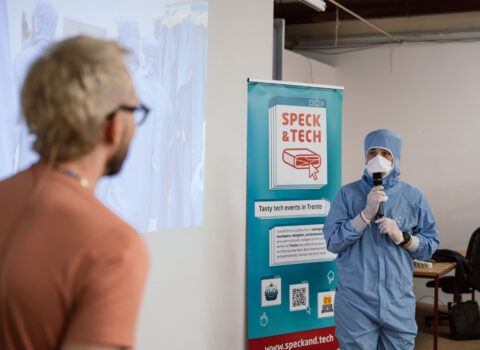
Speck&Tech visits FBK’s Clean Room
September 21, 2026
Sixty spots filled up in just a few minutes for a close-up look at one of the places where FBK research takes shape, accompanied by Science Ambassadors Alessandro Cian and Elia Scattolo
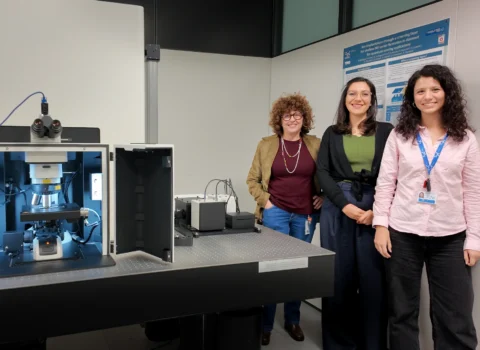
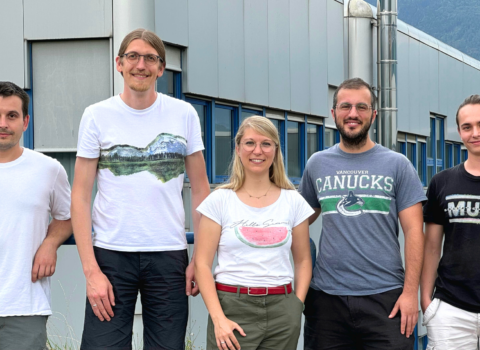
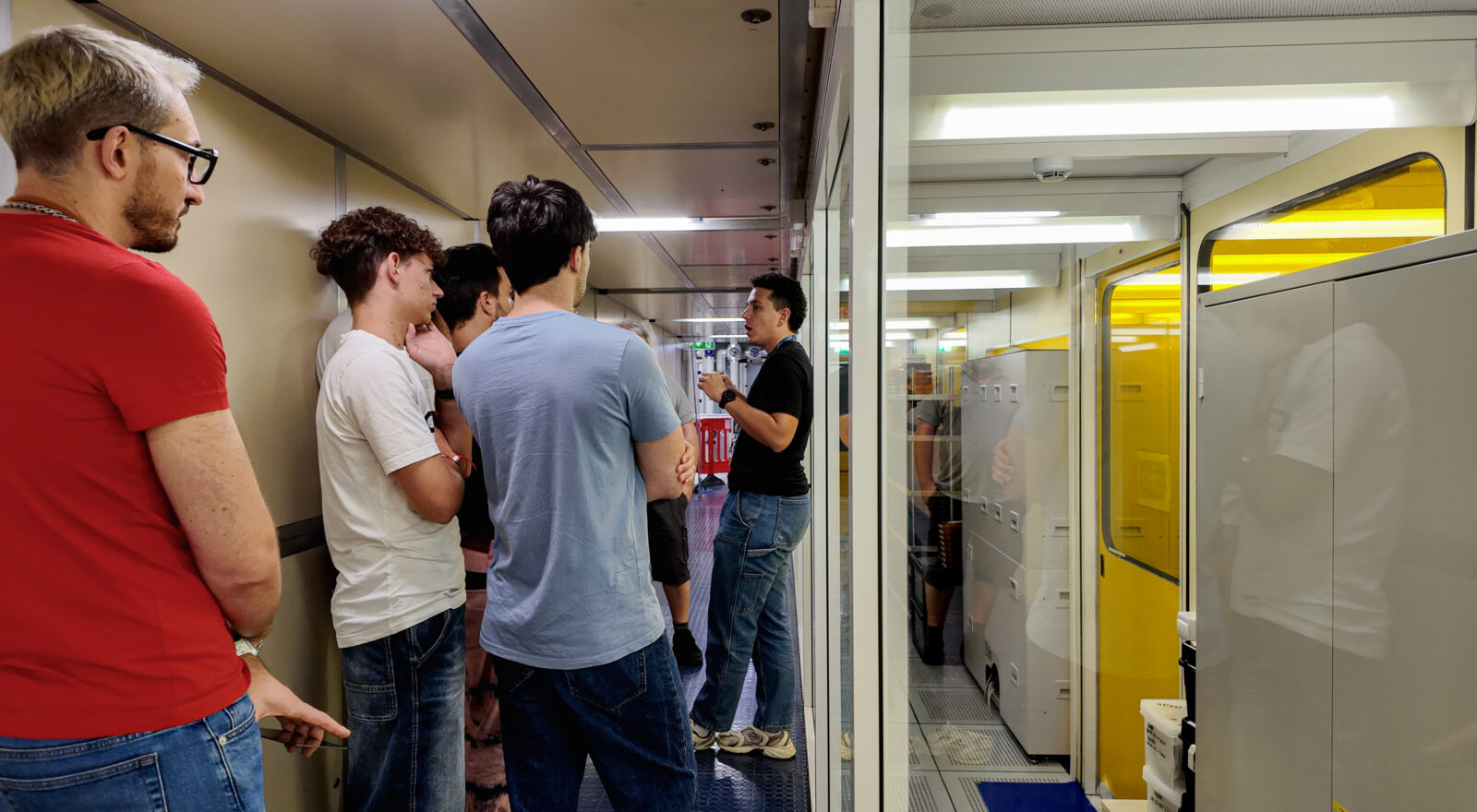
Sensors, detectors, space devices, and quantum technologies have something in common: before becoming research tools, many of them pass through a cleanroom. Last weekend, 60 people had the opportunity to get an inside look at Fondazione Bruno Kessler through Speck&Tech, accompanied by researchers and Science Ambassadors Alessandro Cian and Elia Scattolo, both from FBK’s center for Sensors & Devices. The initiative generated great interest as soon as registration opened, with all available spots filling up in just a few minutes. It fulfilled a promise made in May of last year during the event Speck&Tech #75 – Cleanroom: sooner or later, the community would get to experience firsthand what a cleanroom is. A little over a year later, that idea became a reality.
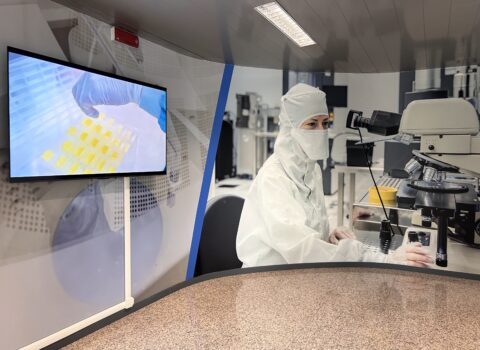
But what exactly happens in a cleanroom? It is a laboratory where the number of particles in the air is kept under strict control because, when working on micrometer- and nanometer-scale structures, even minimal contamination can compromise an entire process. At that scale, even a human hair is enormous: it would take about 1,000 50-nanometer structures placed side by side to equal its thickness. In cleanrooms, specialized expertise and dedicated infrastructure make it possible to design, develop, and manufacture advanced sensors, microsystems, and devices for research and industry. Here, technologies take shape for fields ranging from particle physics to space, environmental monitoring, and quantum technologies, in areas that FBK is continuing to expand to support the growth of research and development activities.
During the visit, participants were able to take a close look at environments, equipment, and processes that are normally hidden from public view, guided by explanations from the researchers who work in the cleanrooms every day. They stepped into one of the places where research turns ideas into devices. During the May 2025 event, Cian and Scattolo gave two presentations on Cleanroom activities and applications. With “Breathe, You’re in Trentino! Monitoring the Invisible,” Alessandro Cian demonstrated the potential of MOX sensors to detect what we cannot see, from air quality to environmental monitoring. With “Kale and Diamonds: Beyond Nanotechnology,” Elia Scattolo took the audience on a journey through natural surfaces, nanostructures, diamonds, and quantum photonics.
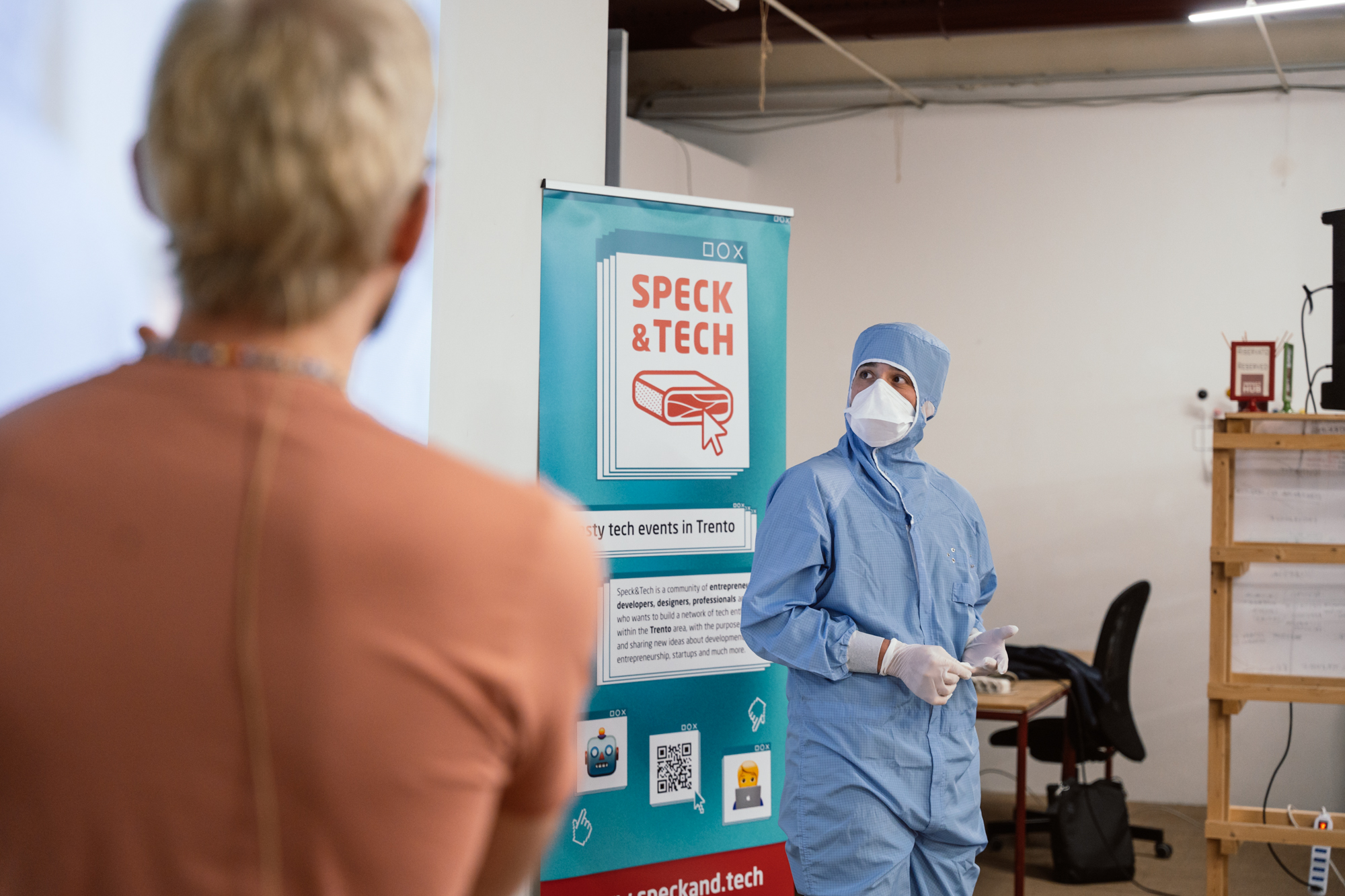
Quantum technologies also returned to the Speck&Tech stage more recently: in June 2026, during the event “Qubit or not Qubit?”, Federica Mantegazzini, head of FBK’s SQD research unit, explained in “How to Build a Quantum Computer” how a qubit is created from real physical systems and how phenomena such as superposition and entanglement can form the basis of new computing technologies.
Founded 10 years ago in Trento, Speck&Tech is a community that brings technology and innovation beyond highly specialized settings, creating informal opportunities for researchers, technology and innovation professionals, students, and people who are simply curious about what is happening locally to meet and exchange ideas. It is a way to share expertise and curiosity while fostering dialogue among research, business, and the local community. This time, however, there was no stage: the presentation gave way to direct experience, allowing participants to see up close one of the environments where FBK research takes shape.
The author/s
Related articles