A forest of knowledge to explore and share
October 27, 2025
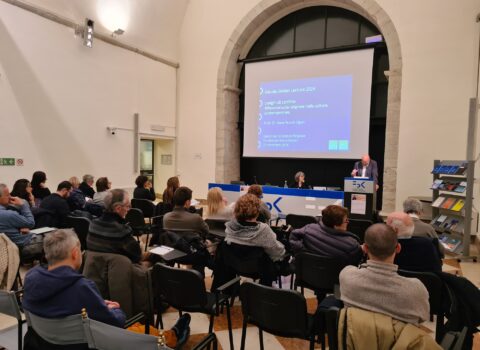
The FoReSt event, which took place at the end of October at the FBK-ISR headquarters in Trento, was dedicated to young researchers to foster interdisciplinary dialogue and the sharing of their academic work. In addition to seminar sessions and workshops, it included in its programs spaces for discussion and growth, as well as opportunities for dissemination, such as the event open to the public "Resonance Boxes", dedicated to the ways in which academic knowledge can be communicated in the contemporary digital ecosystem. On this occasion, we met with doctoral student Accursio Graffeo, who is conducting research on so-called “new religious movements” associated with artificial intelligence. We interviewed him to find out more and to inspire other young people through his journey
You are currently pursuing a Doctorate of National Interest. What are the peculiarities of this program?
I am pursuing the Doctorate of National Interest in Religious Studies (DREST) and am currently completing its second year. This type of doctorate has only been activated for a few years. Drest involves a consortium of 32 universities and research centers in Italy, of which the University of Modena and Reggio Emilia (Unimore) represents the central and administrative headquarters. Our doctorate is divided into six curricula: Buddhism, Christianity, Islam, law and religions, Judaism and transdisciplinarity. My research falls within the “Transdisciplinarity and Technological Frontier Research” curriculum, which encourages less-explored research approaches and values skills related to AI, big data, and cultural heritage. The various Italian universities where each of us is affiliated then revolve around Unimore. For example, my doctoral location is the University of Turin, which is also the university where I obtained my master’s degree in cultural anthropology. At first, it was not easy to navigate the complexities of a doctorate, especially a national one. However, I can say that I am satisfied with this experience. Our doctorate inevitably leads to having to imagine ourselves within a broader context, in a dimension of openness and interdisciplinary collaboration at national and international level.
Despite the distances and the different affiliation sites, I believe that interesting connections have also been created within Drest, with a real sense of group and a certain sense of belonging. It is always a pleasure to meet the others when the opportunity arises, to stay in touch and update each other on our research paths, or to support one another in addressing challenges by exchanging advice and suggestions. In my own experience, I have also witnessed the development of several collaborative projects, including articles, panels, and the organization of events and conferences.
What are you working on?
My research project is in the field of religious studies. Specifically, I am conducting ethnographic research following three (so-called) “new religious movements” (NRMs) related to artificial intelligence. Several clarifications would be needed regarding the definition of NRMs, but addressing them would make the discussion much longer and more complex. Over the past three years or so, these movements have received significant attention in the media—and to some extent in academia—because it was claimed that they “worshipped” artificial intelligence or were directly influenced by it in their practices. The three movements are influenced to varying degrees by transhumanist ideas, and at least two of them draw much of their aesthetic imagery from cinema, science fiction, and cyberpunk. During my research, I was able to interview not only the founders but also individuals who have been, or are, directly involved with these movements. My idea is to reconstruct these realities from within a perceived perspective, in order to understand the concrete instances of the contemporary that shaped the initial image of them in the public imagination. What I am suggesting is that perhaps we should tell a story slightly different from the one that has been presented so far, not only in the media but also academically.
What is the added value of conducting your research at the Bruno Kessler Foundation’s Center for Religious Studies?
I believe the added value of conducting my research at FBK-ISR is multifaceted. First, the high level of preparation and expertise of all colleagues at the Center for Religious Studies is remarkable. It is a privilege to have a space for discussion and exchange—during meetings, conferences, seminars, or even informal moments—with such distinguished academics and refined ways of thinking. Moreover, FBK-ISR is very open to proposals and initiatives from its members and collaborators. This openness is a strong incentive, encouraging active involvement in projects, proposals, and initiatives.
In recent years, partly thanks to DREST, a “team within a team” of researchers and doctoral students has emerged, creating further spaces for reflection and development. It is no coincidence that FoReSt originated from this subgroup, and we hope other initiatives will follow soon. FBK-ISR colleagues and fellow trainees are also conducting fascinating research. For example, those involved in FoReSt include Rebecca Sabatini, who explores intersections between religion and cultural heritage, studying the exhibition of non-religious Catholic human remains; Georgiana Diana Apostica, who investigates the tension between theological and technological dimensions of procreation within Jewish orthodoxy; and Tommaso Ropelato, who works on elaborating the Value-Sensitive Consent (VSC) model, rethinking informed consent as a relational, value-oriented practice that integrates religious and cultural perspectives into contemporary bioethics.
What was your training before your doctorate, and when did you come up with the idea of doing research?
Early in my career, I studied educational sciences and worked in the social field, particularly in child protection and social empowerment. I then earned a master’s degree in cultural anthropology and ethnology at the University of Turin, which aligned with my true passion and led me to the path I follow today. In 2022, I had the opportunity to publish my master’s thesis, revised as a monograph, with a Turin publishing house. The book, Religions and Complexity, is the first I have published in my academic career and life. It analyzes the work of the Piedmontese anthropologist Enrico Comba, who passed away during the first wave of COVID-19. Comba, who taught in Turin, worked on Native American peoples, shamanism, and human-animal relations—topics that have always fascinated me. Writing about them while reflecting on Comba’s work, who was also one of my teachers, felt natural and provided an important immersive experience. The idea of pursuing research matured during the preparation of the book. During the long editorial process, I also had the opportunity to write and publish a couple of articles in scientific journals. From the conclusions of the volume and my reflections on relationships with otherness, the idea for my doctoral project emerged. My desire to engage in research stems from the combination of the pleasure of deepening and writing, and the motivation and encouragement I received from positive feedback. I feel privileged to do what I am doing and understand that the journey will not always be easy. Is there perhaps a degree of naivety in wanting to pursue research, especially in today’s context? I cannot say for sure, but I can sense the value of what I am doing, and my constant drive is to ensure that it is genuinely effective and impactful, even beyond academia or the research field itself.
What was the objective of the Forum on Religious Studies – FoReSt 2025 event you organized in Trento, and how was the project carried out?
FoReSt originated within the group of trainees at the FBK Center for Religious Studies. The project was conceived and implemented together with colleagues Rebecca Sabatini, Georgiana Diana Apostica, and Tommaso Ropelato, who will also provide insights here. Sharing the DREST experience facilitated collaboration and revealed common needs related to our doctoral training and research paths. FoReSt emerged from the need for a dedicated space for in-depth study, exchange, and dialogue. The idea was to create a participatory space in which to discuss in detail certain topics that were of great interest to the specific research that each person was conducting, whether doctoral or related to the first steps of their career as young researchers. To achieve this, we thought it would be useful and interesting to “invert” the usual seminar format, creating an open discussion between emerging and established researchers, in which the audience could also actively contribute to the dialogue and the content being shared. We called these sessions “Chamber”. The Forum also included presentations, keynote speeches, and workshops.
Why did you decide to organize a public event dedicated to research communication?.
We wanted to emphasize the popularization and communication of research. Academic findings, no matter how important, often fail to reach the wider public, who are also stakeholders in our work. FoReSt aims to communicate research and share knowledge beyond academic walls, reaching a broader audience. This is why we organized a public event at Palazzo Benvenuti in central Trento, with support from Banca per il Trentino-Alto Adige/Bank für Trentino-Südtirol.
Once the proposal was conceived, we were fortunate to receive immediate approval and support from our director, Massimo Leone, as well as collaboration from all colleagues and senior researchers at the Center. The Bank also enthusiastically welcomed the idea of hosting a public event.
The preparation took about a year, with essential support from our administrative staff. FoReSt represents a synthesis of the needs identified by our small group, which, as seen in the positive response, resonates with young researchers more broadly. The national character of our doctorate encourages dialogue across disciplines, fostering connections with other fields and ways to disseminate and enhance research. What would you recommend to young students considering a doctoral or research path in areas covered by FBK-ISR? A doctorate that “requires” you to engage in dialogue across disciplines and to find connections with other fields of knowledge, as well as with different ways of sharing and enhancing your work.
What would you recommend to young students who are thinking of undertaking a doctoral and research path in the areas covered by the FBK-ISR Center for Religious Studies?
I would advise reflecting early on their genuine fields of interest, without closing themselves off to alternative paths. If I think back to the path that led me to enter Drest, I would never have imagined getting to deal with artificial intelligence starting from a preponderant interest in native traditions and the declinations of the human-animal, man-nature relationship. Yet, following the concept of relationships with otherness naturally led me to AI-related movements. It was a continuous flow of reasoning around the concept of relationship with otherness, which made me think that I had to deal with AI and those movements that refer to it. I believe that a lesson of this story of mine can be: leave the doors open to what is possible, also with regard to the fields of research.
To this I would add another consideration. I would also stress the importance of valuing all knowledge and experience, however small. Versatility and the ability to apply skills from other areas are personal assets. FBK-ISR encourages openness and the interchangeability of knowledge and skills, allowing researchers to contribute in multiple ways beyond their immediate field.
FBK-ISR has developed a strong culture of openness to the interchangeability of knowledge and skills. I believe, therefore, that it is valuable to challenge oneself as a researcher not only within the specifics of one’s own expertise, but also by engaging in diverse roles or participating in projects that broaden one’s contribution to the research group.
I believe that it is essential to give value not only to the results of the construction work of one’s field of competence, but also to the process through which it is outlined. I am convinced that it is important to be able to bring together different types of experiences, even those that are not strictly relevant to one’s research topics. An institution, such as FBK, is also an entity that lives a complex life, made up of many balances. I believe it is very useful to be aware of these dynamics and to set aside space to explore them, in order to understand which actors, mechanisms, and representations shape the functioning and management of a university or research center. I think it is useful to take care of the construction of one’s curriculum from this point of view as well.
inally, they will often hear that the path they are pursuing is difficult, that opportunities are scarce, and that funding is increasingly limited. What I can suggest is to go beyond all this. This is information that we already know when we get involved in a research-oriented course of study. It is already known information, so it is not information that is useful to us to plan our career path. I would try to go further, keeping the door open to the surprises that arise whenever a new opportunity presents itself—sometimes precisely because we were the ones who persistently pushed it open.
The author/s
Related articles