
AI for the future of Italy
December 22, 2025
The General Conference of the Future Artificial Intelligence Research Project (FAIR), funded with €114.5 million by the Ministry of Universities and Research (MUR) under the PNRR, was held in Rome from December 10 to 12, 2025. Launched in 2023 and coordinated by the National Research Council (CNR), the project involves 350 researchers across Italy and brings together 25 public and private partners.
Over three days of open discussion among researchers, institutions, companies, and emerging scholars, the conference clearly showed that AI today is a collective challenge—one that goes beyond technology alone.
By alternating scientific sessions with discussions involving industry, the event provided an important opportunity to take stock of completed activities and to reflect on the post-PNRR phase, with an eye toward future directions. The conference offered a concrete picture of a dynamic ecosystem that grows when diverse skills come together, research engages with society, and innovation is accompanied by responsibility.
Topics included Green and Efficient AI, Explainable AI and Human–Computer Interaction, AI for Health to Multimodal AI, themes such as sustainability, explainability, health applications, and models integrating text, images, and audio converged toward a shared vision of more useful and responsible AI. The FAIR Foundation continues its role as a national infrastructure for robust, open, and people-centric AI.
The contribution of Fondazione Bruno Kessler
“For a Human-Centered AI” is the current motto of Fondazione Bruno Kessler (FBK), where research in this field began in the 1980s, around 40 years ago.
This long-standing experience and excellence across multiple areas—such as data-driven learning techniques, model-based reasoning, and expertise in the humanities and social sciences—led FBK to assume coordination of Spoke 2, under the leadership of Paolo Traverso. The goal was to build interdisciplinary synergies to create integrated models for a new generation of AI.
Current AI research successfully addresses narrowly scoped tasks or complex problems that can be decomposed into simpler, independent subproblems. To overcome the barrier of complexity, however, a substantial shift in research is required—one that moves beyond the current approach based on vertical and isolated AI areas and adopts the integrated approach developed through the FAIR project.
During the LLM session, which also featured contributions from Bernardo Magnini for FBK, researchers presented key advances in next-generation language models, including pretraining techniques, benchmarking methodologies, and advanced technical applications. Particular attention was given to the evaluation of LLMs for the Italian language and to the development of Minerva, the first native Italian large language model.
Bruno Lepri, head of the MobS unit, presented recent contributions stemming from collaboration with Andrea Passerini (University of Trento) on algorithmic recourse. In scenarios where AI systems make decisions about issues such as credit access or hiring, it becomes essential to develop AI tools that support citizens, workers, and individuals applying for loans. These systems should suggest actions people can take to achieve positive outcomes, while accounting for their preferences and needs. Lepri also discussed the risks and benefits of groups of LLMs or LLM-based agents working together, highlighting the importance of studying their emergent behaviors and understanding how to design such agents so they remain controllable. As agents increasingly buy, sell, and negotiate on our behalf, the key question becomes how to ensure they act loyally and respect the preferences, needs, and behavioral styles of those they represent.
Paolo Traverso’s talk
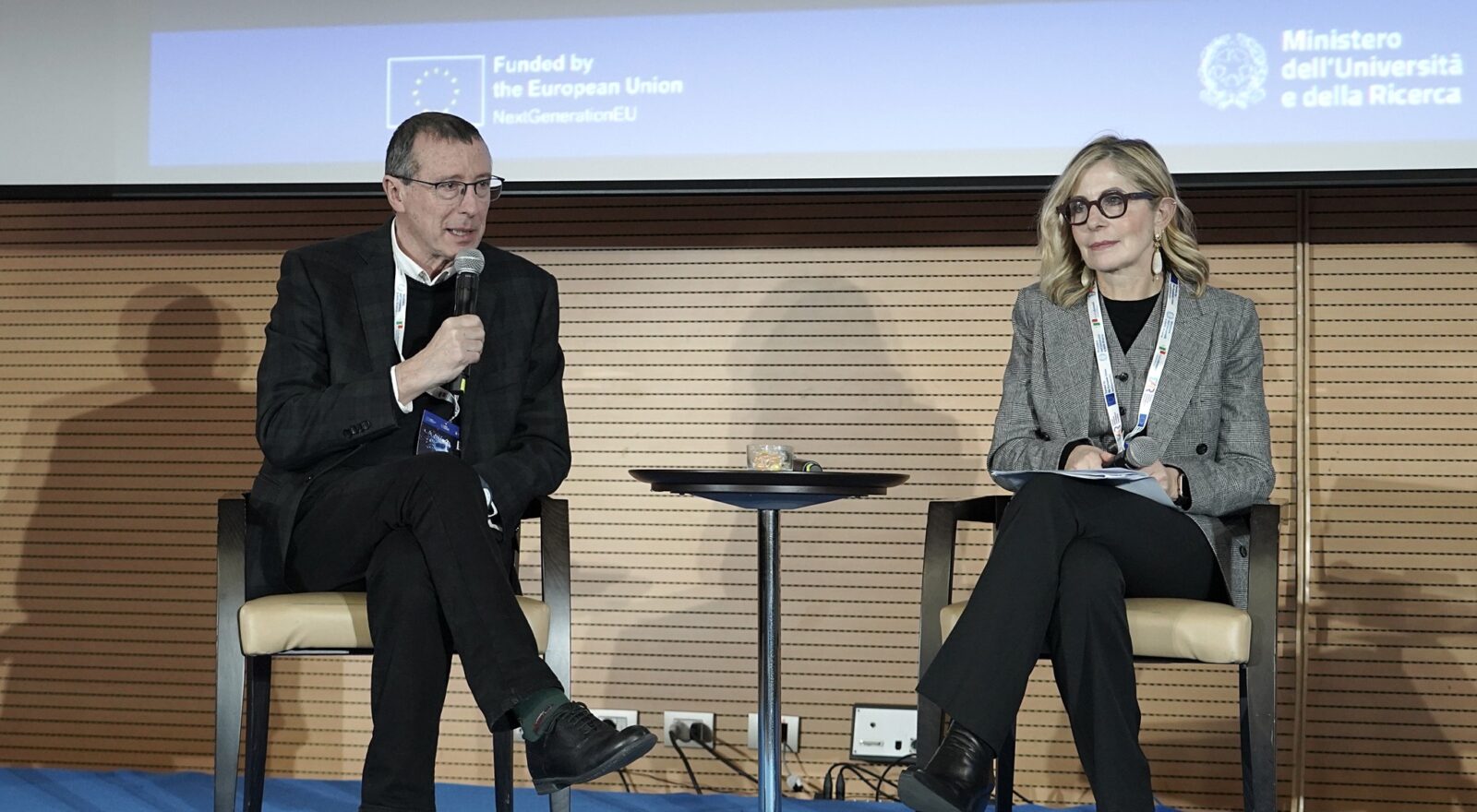
On December 10, a panel discussion was held featuring Paolo Traverso, Director of Strategic Planning at FBK and a leader in AI research, alongside magistrate Anna Giordano, moderated by ANSA journalist Alessio Jacona.
Traverso shared the experience of applying integrative AI models in the Trentino region, which hosted an experimental project whose results are now available to public administrations across Italy.
“The initial question,” Traverso explained, “came from the Autonomous Province of Trento: can AI help build better services for citizens?” Within the PA-AIxPA project, the team leveraged scientific expertise developed within FAIR to address the challenge of more sustainable tourism—for both visitors and residents—by offering operators recommendations on how to improve accommodation facilities based on tourist flows.”
“Integrative AI,” Traverso continued, “means combining machine learning—for example, to predict tourist flows from data—with ‘what-if analysis’ tools that help determine appropriate actions.” This approach can generate recommendations such as increasing parking capacity in response to emerging needs. Within FAIR, the challenge of planning to learn was addressed, requiring specific data to train systems capable of responding to concrete problems. The end result is a tool that can be used directly by local operators, and the project tested in Trento can be extended nationwide”.
Given the speed of change driven by AI—faster than any previous industrial revolution—it is crucial, Traverso emphasized, to shorten the pipeline from research to experimentation. Research can develop innovative AI solutions, public administrations can identify needs, and companies can translate those needs into business opportunities, delivering solutions with tangible social impact.
Traverso drew a parallel with the space race of the 1960s, which generated numerous research spillovers that significantly improved quality of life in subsequent decades, including advances in materials science, computing, medicine, and everyday products such as GPS and memory foam.
“Today,” Traverso warned, “there is a reluctance to move beyond experimentation. Italy is full of pilot projects. What is needed is a systemic approach, as demonstrated by the AIxPA project.” He cited collaboration with civil protection as a useful example: AI has been used to assess damage from extreme events such as fires, earthquakes, and floods. Through remote sensing, damage can be identified even in previously unknown locations. Moreover, the technologies developed help predict future extreme events and estimate their potential impact. These solutions may be less sensational than other AI systems,” Traverso concluded, “but they are undoubtedly useful.
”
The author/s
-
 Paolo Traverso
Paolo Traverso is the Director of Strategic Planning at Fondazione Bruno Kessler
MORE INFO
Related articles