From Maxwell’s intuition to modern physics
July 14, 2026
An experiment conducted by researchers at FBK and CNR confirms a historic prediction by the great Scottish physicist: a tiny levitating magnet oscillates like an invisible gyroscope
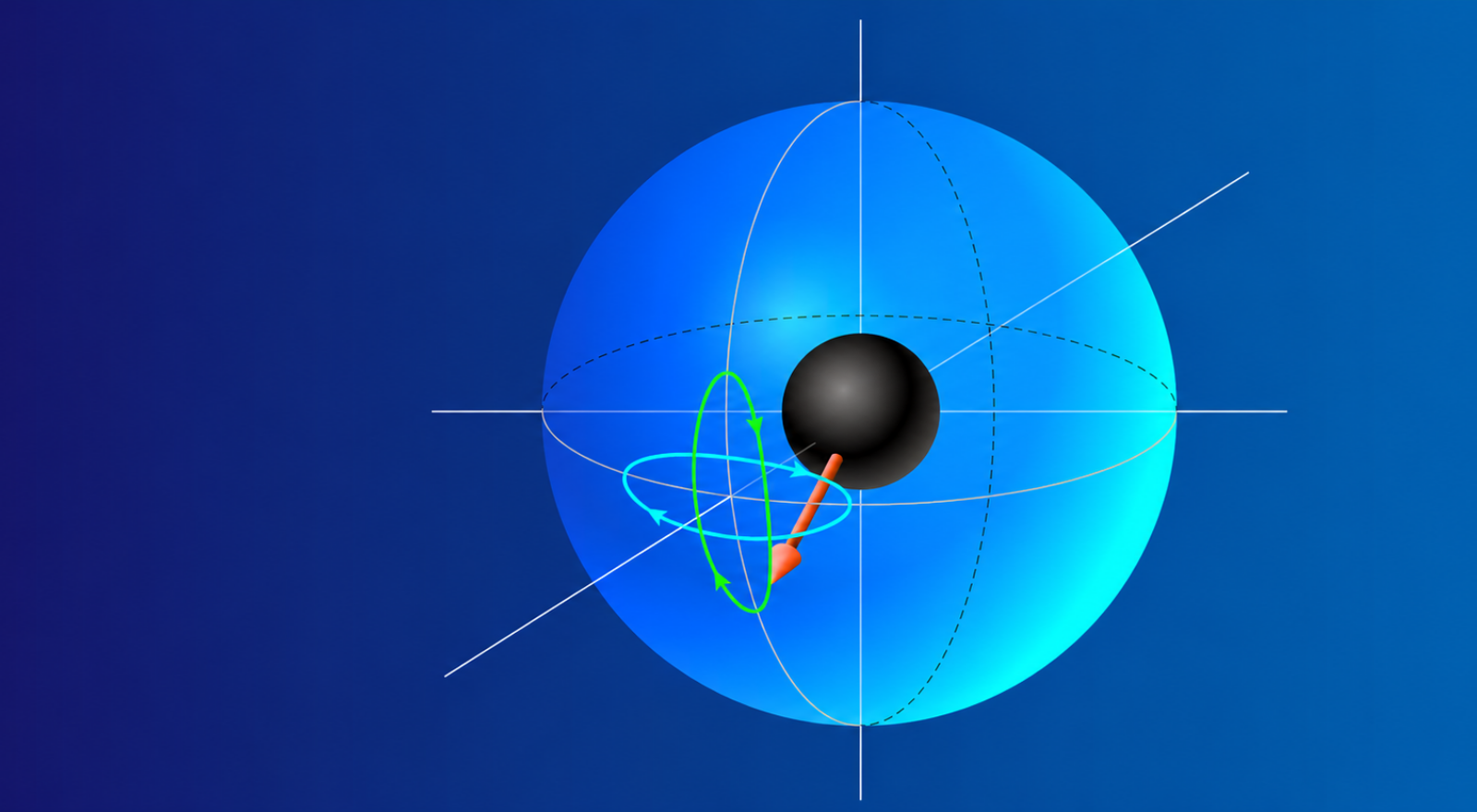
In 1861, physicist James Clerk Maxwell, driven by the idea of unifying electricity and magnetism, had a fascinating insight: a magnet, even if not physically rotating, could behave like a spinning top (or gyroscope) due to what the scientist believed to be the “motion of the electric fluid” inside the magnet (the existence of electrons was not discovered until nearly 40 years later). Maxwell decided to build a device to measure this phenomenon and thus test his insight, but the experiment failed. For over a century, therefore, his prediction remained an elegant theory, but one lacking experimental evidence. Now, researchers Andrea Vinante of the Institute of Photonics and Nanotechnology (IFN-CNR) and Felix Klaus Ahrens with Fondazione Bruno Kessler in Trento have finally succeeded in observing Maxwell’s theory in the laboratory.
Their results, published in Physical Review Letters, show how a microscopic levitating magnet oscillates like a spinning top, driven by an invisible internal force. This discovery not only resolves a long-standing question in physics but also paves the way for advances in ultra-sensitive magnetometry, quantum technologies, and even the search for dark matter.
The researchers used a magnetic microsphere (just 40–60 micrometers in diameter) made of a rare-earth alloy. They made this tiny magnet levitate inside a superconducting chamber cooled to absolute zero, where it could move freely without friction. When disturbed, the sphere did not oscillate like a pendulum, but traced delicate elliptical trajectories, as if guided by an invisible gyroscope inside it.
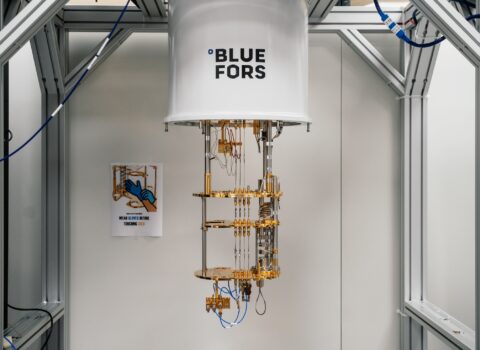
Achieving this observation involved immense technical challenges: cooling a lead chamber to -269°C and creating a nearly perfect magnetic trap where the microsphere could float frictionlessly, isolated from external noise.
The researchers then used SQUIDs (Superconducting Quantum Interference Devices) to detect the sphere’s motion, observing the tiny elliptical oscillations of the levitating magnet. Finally, the two researchers developed a mathematical formula to isolate the gyroscopic effect from background noise. By analyzing how the magnet’s movement in two different directions affects each other, they were able to distinguish the subtle signal of the hidden angular velocity.
This result is as incredible as trying to hear a whisper in a noisy room: it can only be done with highly sophisticated instruments and complex methods designed to detect the faintest sounds.
Arhens and Vinante’s experiment does more than simply confirm Maxwell’s hypothesis; it paves the way for technologies that could revolutionize magnetometry, with applications ranging from cosmology to medicine. For example, given that the human body generates tiny magnetic fields—particularly in the brain and heart—ultra-sensitive magnetometers could allow doctors to map neural activity in real time, offering new ways to diagnose and study conditions such as epilepsy or Alzheimer’s without invasive procedures. Beyond the human body and into space, this technology could help test Einstein’s theory of general relativity in new ways, by detecting, for example, frame-dragging—a phenomenon in which a massive rotating object, such as the Earth, slightly distorts the fabric of spacetime around it. A gyroscopic magnet could be sensitive enough to measure this phenomenon.
That’s why the team is already looking to the future. Felix Ahrens and Andrea Vinante explain: “Our next goal is to further reduce the size of the system, from micrometers to nanometers. At that scale, the gyroscopic effect becomes strong enough to enable the creation of quantum gyroscopes: devices that could measure rotations and magnetic fields with unprecedented precision, ultimately helping us explore the deepest mysteries of the universe, such as the nature of dark matter or the quantum behavior of macroscopic objects.”
In the meantime, this discovery stands as a testament to the power of curiosity-driven science. What began as a theoretical puzzle posed by Maxwell in the 19th century has now become a tangible phenomenon with revolutionary potential for 21st-century technology.
This reminds us that, ultimately, to quote Bernard of Chartres, we are truly “dwarfs standing on the shoulders of giants”: we can see far thanks to the knowledge of the past. But we, in turn, also become giants ourselves, ready to carry the dwarfs of the future on our shoulders.
Credits cover image: APS/Alan Stonebraker
-
 Felix Ahrens
Experimental physicist and researcher in the Superconducting Quantum Devices (SQD) at Centre for Sensors & Devices
MORE INFO
Related articles