
From research to industry: the challenge for tomorrow’s Europe
February 9, 2026
The annual meeting promoted by Fondazione Bruno Kessler to reflect on industrial policy and technology transfer was held at the Tecnopolo Dama in Bologna
Italy is marked by limited investment by manufacturing in R&D, weak open innovation, and difficulty in transforming frontier research into scalable products and technologies:
what is the recipe to compete?
Bologna, February 9, 2026 – On the eve of the new European Union Framework Programme for Research and Innovation, technological competitiveness has once again moved to the center of public debate. Hosted at the Tecnopolo in Bologna, Fondazione Bruno Kessler promoted a strategic reflection on Europe’s role in the global context and on the need to strengthen the continent’s capacity to invest in frontier technologies and translate scientific excellence into scalable industrial solutions, while safeguarding autonomy, growth, and social impact.
According to ISTAT data, around 60% of Italian manufacturing companies report that they are innovating; however, in two out of three cases this innovation is environment-related, and fewer than 20% introduce genuinely new products to the market. This is further undermined by R&D investment equal to just 0.8% of GDP—among the lowest levels in Europe—and by a limited propensity for open innovation, all of which weaken the competitiveness of the production system in high-tech markets.
These critical issues also extend to the research landscape. Analysis of projects funded under Horizon 2020 and Horizon Europe shows strong thematic fragmentation and a predominant focus on non-frontier areas. In the most technologically advanced sectors—such as neuroscience, quantum technologies, security, and space —Italy’s position remains fragile, underscoring the need to rethink strategies for participation in European programs and for technology transfer policies.
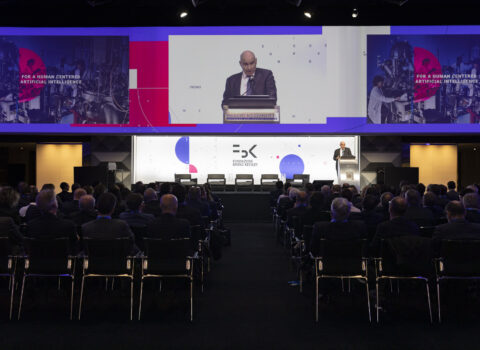
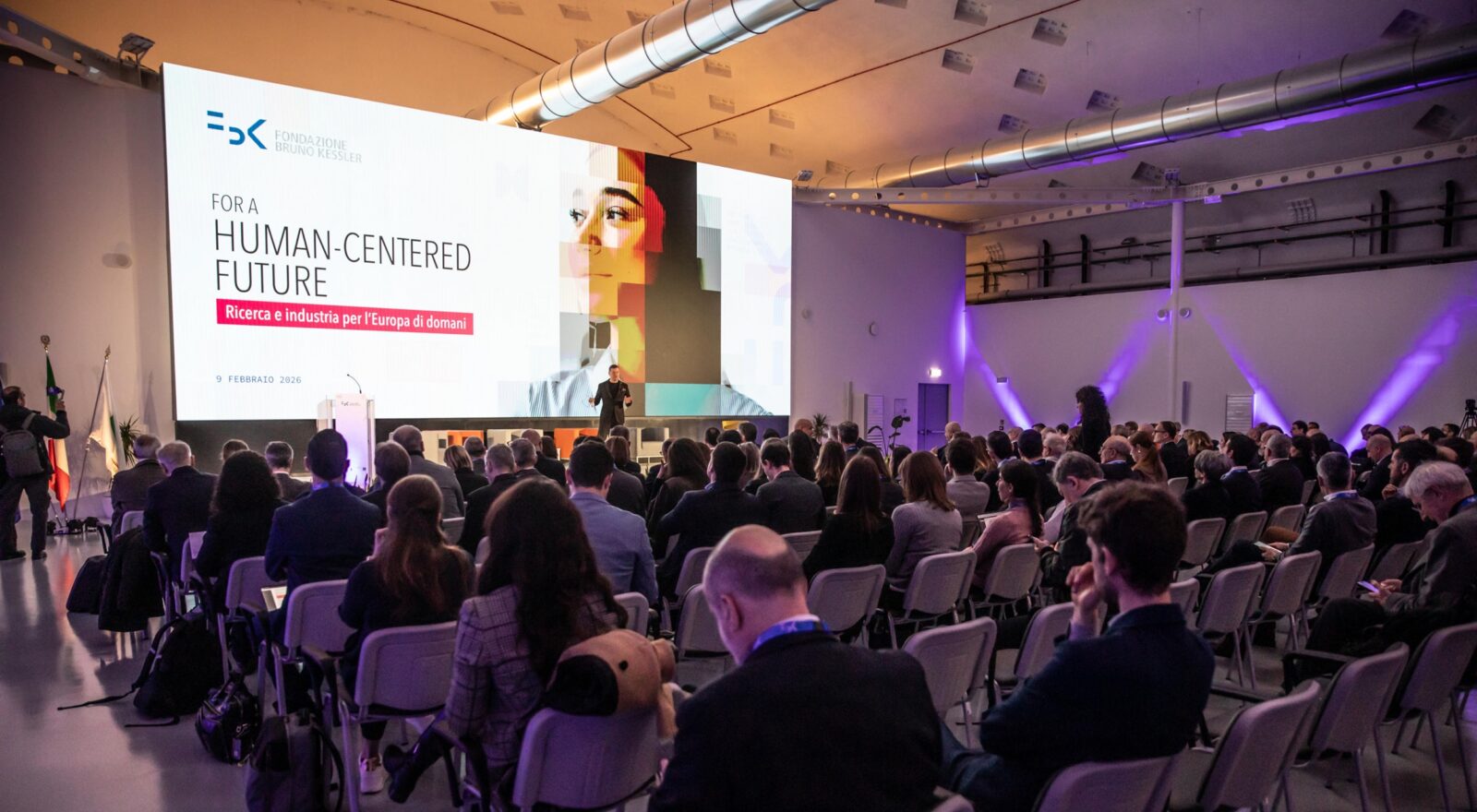
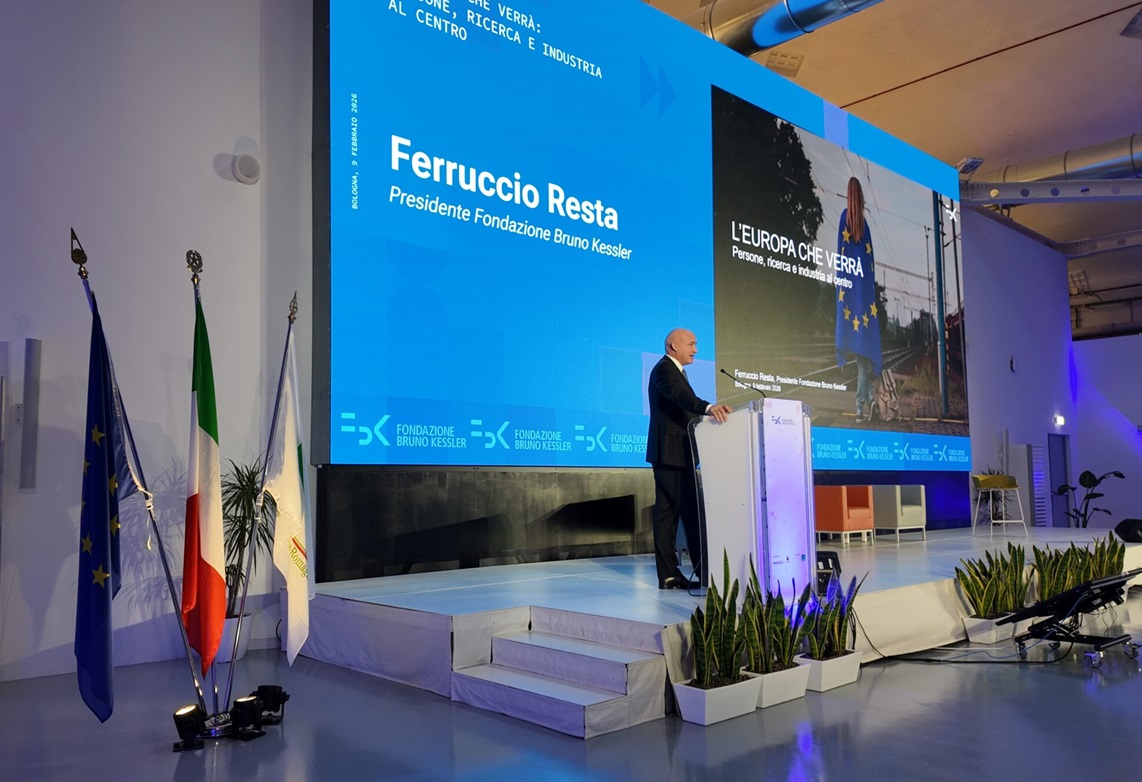
These themes emerged in the address by FBK President Ferruccio Resta during the event “For a Human-Centered Future. Research and Industry for Tomorrow’s Europe,”the third annual national event promoted by Fondazione Bruno Kessler in line with its 2024–2027 Strategic Plan. The meeting provided an analysis of the political and scientific priorities that will shape European research and their expected impact on the industrial system, with contributions from a panel of leading speakers.
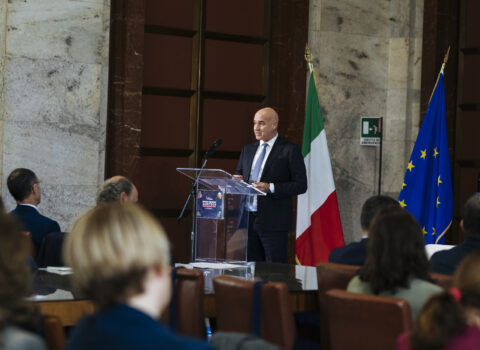
In a video message, Minister Anna Maria Bernini stated: “In a time of profound transformation, scientific research is what turns uncertainty into vision. There is no competitive industry without strong universities, no innovation without researchers, and no growth without people. This is why centers of excellence such as Fondazione Bruno Kessler are so important: because they combine frontier research with real impact. Our task is to create the conditions for talent to remain in Italy and for ideas to become quality jobs. The future is not awaited; it is planned together. ”
“The technology and production transitions underway are reshaping manufacturing, healthcare, energy, defense, and services, and industrial policy cannot afford to look elsewhere,” commented FBK President Ferruccio Resta. “Fondazione Bruno Kessler addresses this change by investing in young researchers, supporting pathways that transform research into entrepreneurial initiatives, and strengthening collaborations with industry capable of accompanying innovation from the scientific frontier to field experimentation. In a European context where no one can act alone, FBK serves as a bridge between local supply chains and European Union networks, transforming skills and knowledge into economic and social impact.”
It is within this context that Fondazione Bruno Kessler’s activities are positioned, with a focus on frontier research projects and structured engagement with the production system. Activities concentrate on strategic areas such as the development of quantum technologies, particularly superconducting qubits. In this field, the research team at the Center for Sensors & Devices has achieved a historic milestone: the first qubit entirely developed and produced in Italy, enabling more powerful technologies and laying the foundation for a national quantum innovation platform.
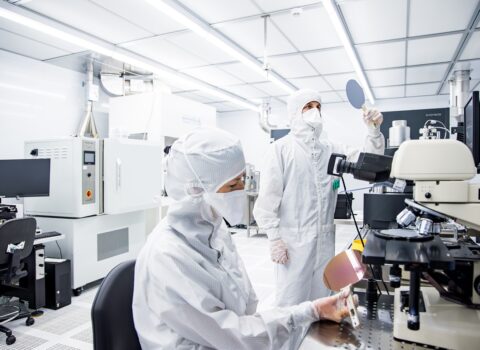
FBK’s Clean Rooms also support the development of packaging techniques and miniaturized flexible electronics with applications in the medical field, particularly precision oncology, reinforcing the Foundation’s presence in the life sciences.
FBK’s ability to translate research into business has led it to fund robotics and artificial vision research through a Proof of Concept program—recognized in international competitions—and to collaborate actively with Italian Railways Network (RFI) and with a major public transport operator such as ATM, building on the Foundation’s thirty years of experience in artificial intelligence.
The path developed by FBK demonstrates that solid innovation arises from the integration of advanced research, industry, and European networks. The Europe of tomorrow must strengthen its capacity to invest in frontier technologies, enhance scientific excellence, and transform it into scalable industrial solutions in order to regain competitiveness and play a leading role in global innovation.
“In Trentino, we believe that research creates value only if it is embedded in an ecosystem that fosters technology transfer and engagement with industry,” said Maurizio Fugatti, President of the Autonomous Province of Trento, on the sidelines of the event. “For this reason, we have built an integrated system over time that connects universities, research centers, companies, and institutions through stable relationships and a long-term vision. Trentino’s recognition as a Regional Innovation Valley confirms the strength of this approach. At its core is special autonomy, which for us is a concrete lever for development, allowing us to plan, experiment, and invest continuously in research and innovation. In this way, Trentino presents itself as a reliable partner for the national and European innovation system, contributing its own model and autonomy to the Europe of tomorrow.”
Vice President and Councilor for Economic Development, Labor, Family, University, and Research Achille Spinelli added: “The 2025 Regional Innovation Scoreboard ranks Trentino first in Italy among strong innovators and among the most dynamic areas in Europe. This reflects growing investments in R&D, a strong capacity to attract European funds, and high-quality scientific output. Today, we invest more than €400 million in research and development and employ over 5,000 people dedicated to transforming knowledge into value. Bridging the gap between research and industry, including through open innovation, is our priority. In Trentino, synergy between those who produce knowledge and those who create value is already a well-established practice.”
The event—held under the patronage of the Emilia-Romagna Region and the Autonomous Province of Trento, with media partnership from ANSA—was moderated by Massimo Sideri, correspondent and columnist for Corriere della Sera. It brought together representatives from institutions, academia, and industry. Following institutional greetings from Bologna Mayor Matteo Lepore, Emilia-Romagna Vice President Vincenzo Colla, and Autonomous Province of Trento President Maurizio Fugatti, a video address from Minister of University and Research Anna Maria Bernini was shown.
Subsequent contributions included Alessandro Perego, Vicepresident of the Politecnico di Milano. A panel dedicated to research policy in the new European Framework Programme featured Francesco Ubertini, President of CINECA; Stefano Paleari, advisor to the Minister of University and Research and President of Anthem; and Giovanni Molari, President of the University of Bologna, alongside a video interview with Roberto Viola, Director-General of DG CONNECT at the European Commission, on the importance of the European regulatory framework for competing with the United States and China. The discussion on industrial impact included contributions from Antonio Marcegaglia (Marcegaglia Steel), Enrico Resmini (Acea), Stefania Boschetti (EY Italy Consortium), Silvia Arlanch (Dolomiti Energia Group), and Stefano De Alessandri (ANSA). Conclusions were delivered by Ferruccio Resta and Achille Spinelli, Vice President of the Autonomous Province of Trento.
Fondazione Bruno Kessler
Fondazione Bruno Kessler (FBK) is a research institute specializing in technology, innovation, and the humanities and social sciences, based in Trento.
Since its establishment (1962), it has grown into a research infrastructure comprising a total of 900 researchers and support staff, 180 PhD students, 200 visiting professors and doctoral candidates, and 1000 affiliated and accredited students from Italy and abroad.
Twenty-five percent of FBK researchers are foreign nationals, originating not only from major European countries but also from non-European nations such as the United States, China, India, Brazil, Argentina, Algeria, Iran, Pakistan, Australia, and Russia, representing a total of 59 countries.
Today, the campus covers a total area of more than 40,000 square meters, including 5,000 square meters dedicated to laboratories. It is organized into two hubs: one focused on technology and innovation in Povo, on the hills overlooking Trento, and the other dedicated to the humanities and social sciences in the city center.
Together, these hubs host an ecosystem comprising 12 research centers, 7 laboratories, and 2 libraries, around which companies, joint laboratories, and spin-offs revolve.
Thanks to the contribution of almost 80 experienced researchers, FBK has directed its research to the experimentation of an integrative, widespread and reliable artificial intelligence.
Fondazione Bruno Kessler – Communication and External Relations Service
– 0461 312482
– 0461 312482
Silvia Malesardi +39 335 1900270
Giovanna Rauzi – +39 348 5891199
The author/s
-
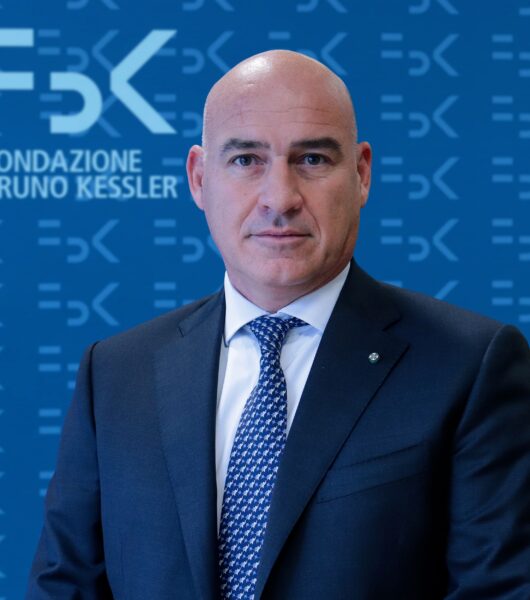 Ferruccio Resta
FBK President, appointed on April 28, 2023
MORE INFO
RELATED VIDEO
-
Event registration
Related articles