
Time, skills and the power of language at the heart of the Inspirational talk with Stefano Paleari
October 16, 2025
As part of the series of inspirational dialogues for the FBK research community, Stefano Paleari took part in an open conversation on universities, innovation, and future perspectives.
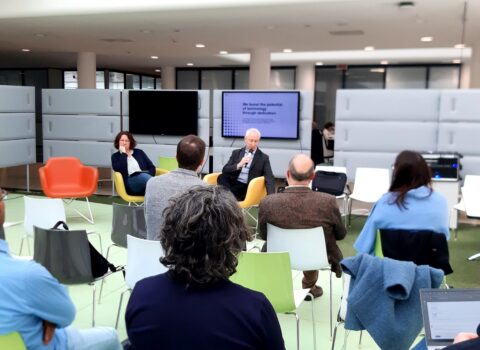
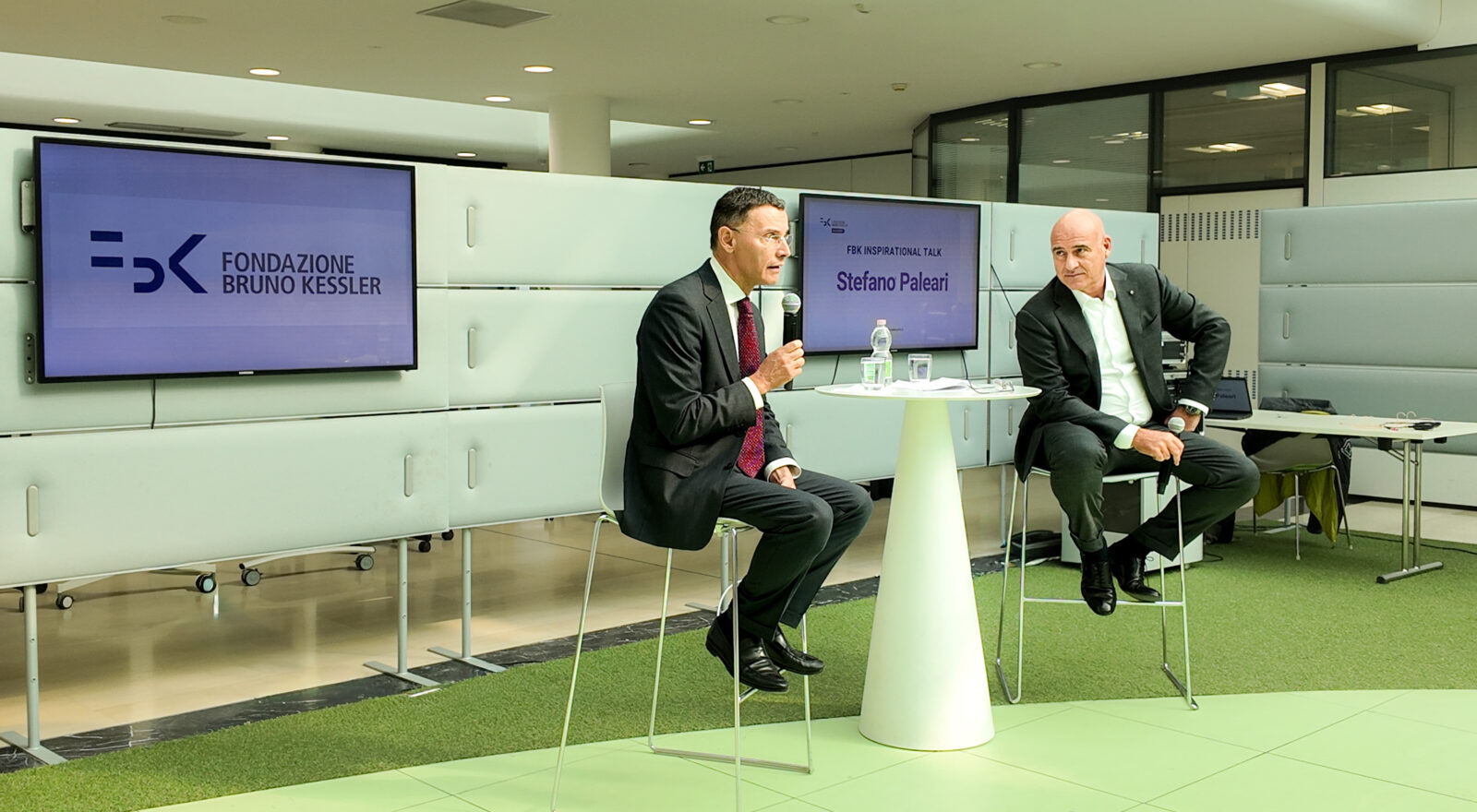
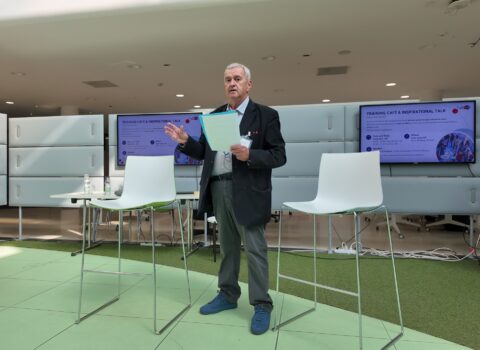
On Tuesday, October 14, the FBK Povo hub hosted a new session of the Inspirational Talk series that featured Stefano Paleari in conversation with FBK President Ferruccio Resta. The event took the form of an informal dialogue, touching on a range of timely and relevant topics. Starting from personal anecdotes that sparked lively interest among the attending research community, the discussion critically examined key contemporary issues: from the crisis of European identity to the growing importance of skills — both specialized and interdisciplinary — needed to manage today’s complex challenges.
The tone was friendly and informal, thanks to the shared background of the two speakers: both having followed long, brilliant, and unconventional academic careers, each eventually serving as President of the CRUI (Conference of Presidents of Italian Universities) and playing a key role in the creation of Human Technopole — a research hub dedicated to integrating science, innovation, and national development.
Several points of reflection emerged, the first being the role of time. Today’s issue is time. In today’s geopolitical landscape, those who fail to act promptly risk falling behind. According to Paleari, this helps explain both the shifting power dynamics between the US and China and what Draghi called the “evaporation” of Europe’s influence—because Europe remains largely unfinished, perpetually delayed, and trapped by decisions made without proper analysis. A clear example is the automotive sector guidelines, which, despite their commendable decarbonization goals, have placed our industrial systems at a significant competitive disadvantage. More broadly, we are witnessing the rapid and disruptive rise of new technologies, especially artificial intelligence, which is driving a major transformation in production processes. Some countries respond to this surge by regulating after the fact, while others, like us, regulate in advance—risking the irreversible loss of opportunities.
This cultural, rather than institutional, political approach leaves Europe unable to stand up to the major players, the US and CHINA, limiting its options to reactive and short-sighted measures. A concrete proposal to imagine the Europe of tomorrow also concerns those who do research and, in general, every high-skill worker: a European integrated social security system. On the institutional level, however, a common army and political objectives would be needed, as well as an elected president. We need a system-wide, ambitious vision.
The second aspect touched on was skills, both hard and soft. The career development path is based on a balance between specialization and frontier exploration. From specialization, we start to probe other variations of our knowledge. With the experience you accumulate, you can move from one domain to another, guided by curiosity. A journey that allows us to move from knowledge to know-how and/or to know how to manage, with paths that can even be not one-way, accumulating awareness step by step. According to this view, people who operate at the intersection of two or all three knowledge areas naturally take on a special significance, becoming connectors and key players who create synergies, drawing on a deep understanding of the underlying issues because they belong to—and actively engage with—the different knowledge communities they help interpret and integrate.
Speaking of timing and professional paths, the training of Paleari, a nuclear engineer who graduated just before the referendum that blocked the way for applications in the sector in Italy, represents the perfect synthesis of what it means to develop adaptability and work on oneself to break new ground.
Language and interdisciplinarity
One point raised was the importance of language, which can lead to a deeper and broader understanding of phenomena—or, conversely, to distortion through oversimplification. As a technician, he enriched each definition with vivid metaphors rooted in science which, though difficult to grasp out of context, entertained the audience and sparked lively discussion. Language is important because it conditions and confers or subtracts quality from thought, but we must not give in to technicalities either, because innovation is on the borders and not at the center of things. In this sense, specializations can also represent comfort zones, taking refuge in which the expression of one’s potential is limited.
On the sidelines of the talk, we asked Prof. Paleari a few questions on systemic issues close to his heart: attracting talent and competing on a global scale.
Research as an engine of attractiveness and innovation: FBK’s case
Giancarlo Sciascia (G.S.):
“In a context such as that of Fondazione Bruno Kessler, which deals with advanced research, what strategies could be adopted to enhance talents and turn them into opportunities for local development? How can technology transfer and collaboration between research and business be fostered, to create an attractive ecosystem for talent and capital?”
Stefano Paleari (S. P.):
- Attract talent with a clear vision. Advanced research
is not only an academic activity, but a strategic tool to attract the best talent. Those who choose where to invest their skills seek first of all a perspective: the possibility of contributing to concrete solutions to major global challenges, such as clean energy, artificial intelligence, or health. FBK, with its history for over half a century, shows that research can be a “generational engine,” capable of adapting to the needs of the present (from digitization to AI) and
of offering researchers an active role in shaping the future. A fundamental principle is that capital follows talent, not the other way around. An area that focuses only on economic incentives or tax breaks risks becoming a simple “tax haven,” while those who invest in the quality of research and the real impact of ideas become a true pole of innovation.
- The integration between basic and applied research: a winning synergy.
The separation between theoretical and applied research is a false problem: every innovative project is born from the meeting between scientific curiosity and practical applications. If we te think of sports: like athletes, researchers are driven by passion, competition, and the desire to overcome known limits. This integration makes the area dynamic and competitive because it transforms ideas into tangible solutions and vice
versa. FBK embodies this model: a place where research is not an end in itself, but translates into collaborations with companies, creating an ecosystem where discoveries become opportunities for the local area. Investing in this synergy is the most effective strategy for building a sustainable future.
- Research as an “insurance policy” for the future.
History teaches that dominant companies are the ones who solve the key problems of their time. Jared Diamond retraced it: health, technology, and adaptability are the pillars of prosperity. Today, research is the lever to ensure economic and social well-being. FBK, with its ability to renew itself, is an example of how an institution can be a point of reference for generations, ensuring the region not only development but also resilience in the face of global challenges. - Technology transfer and collaboration with companies: an ecosystem to be enhanced.
To transform research into concrete value, an environment is needed where universities, research centers, and companies collaborate closely, creating synergies between the public and private sectors. Italy has excellences like FBK but struggles to retain talent and capital due to:
- Fragmentation: Lack of a coordinated national strategy.
- Bureaucracy: hinders innovation and collaboration between different actors.
- Structural weaknesses: inefficient technology transfer, difficulty in scaling up startups, poor attractiveness for foreign researchers.
Yet, there are strong sectors to build on: digitization, advanced manufacturing, agri-food.
The challenge is to better link research and industry, simplify processes, and invest in digital infrastructure.
International best practices and the positioning of Italy
G.S.:
“What are the countries or regions that today manage to retain talent and attract capital? What can we learn from their best practices? How does Italy position itself on the European scene for its ability to attract and retain talent? Are there sectors where we are particularly weak or strong?”
S.P.:.
- USA and China: comparing two models
- USA: investment in research driven by a strategic vision and capitalism, with clear objectives (leadership in AI, energy, the internet).
- China: State planning for self-sufficiency in key sectors (technologies, energy).
Today, 40% of China’s GDP is driven by domestic demand, a sign of a successful transition.
- Europe and Italy: weaknesses and opportunities Europe has funded a lot of research but often without a unified strategy. Italy, in particular, has isolated organizations of excellence (such as FBK), but suffers from:
- Lack of vision: environmental choices (e.g., decarbonization) were implemented without considering the impact on industrial competitiveness.
- Fragmentation and bureaucracy: they hinder innovation and public-private collaboration.
- What to emulate: vision, self-sufficiency, collaboration To compete, Italy must:
- Set clear goals: for example, becoming a leader in AI or renewable energy.
- Reduce Technology Dependency: Investing in Semiconductors, Cloud Computing, and Other Critical Areas.
- Create an attractive ecosystem: it is not enough to be a “nice place” (like Greece), we need to offer opportunities for global impact, quality of life, and a context where talents can grow and innovate.
- Italy in the European context Italy has unique potential (culture, manufacturing, research) but lags behind Germany, France, and the Netherlands in attracting talent and capital. The challenges are clear:
- Improve the connection between research and industry.
- Simplify bureaucracy.
- Invest in digital infrastructure and advanced training.
——————————————————————————————————————————
Stefano Paleari is a Full Professor of Financial Systems Analysis and Public Management at the University of Bergamo. Advisor to the Ministry of University and Research. He has a background in nuclear engineering and extensive academic and institutional experience. His research activity has focused on financial systems, air transport, and university organization. He has held important positions in the aviation sector, including Scientific Director of ICCSAI and member of the Airneth Scientific Board, and in university he has been a lecturer at the University of Bergamo, President of the CRUI and of the Human Technopole Coordination Committee. He has been part of European and international bodies dedicated to higher education, including the Board of the EUA. He is currently a member of the Board of Directors of the Toniolo Institute, President of the Anthem Foundation, and is involved in the implementation of the PNRR on behalf of the Ministry of University and Research.
The author/s
-
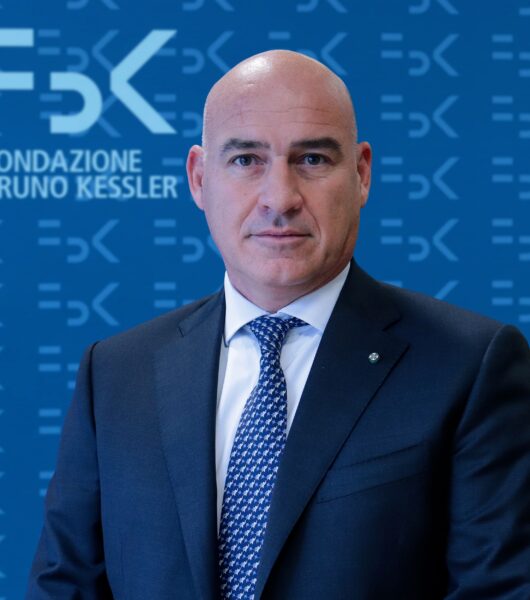 Ferruccio Resta
FBK President, appointed on April 28, 2023
MORE INFO
Related articles