

Investigating the Incredible
April 27, 2026
Elena Missale, guest of the final evening of Co.Science, on perception, mystery, and quantum research
Science can tell the incredible also through the perspective of those who study the invisible every day. The final evening of the Co.Scienza festival, held in the InCooperazione Hall, opened with a talk by Massimo Polidoro, a leading figure in Italian science communication. In his talk, “The Science of the Incredible: How our beliefs and convictions form—and Why the Most Persistent Ones Never Die,”he guided the audience through cognitive illusions, biases, and mental mechanisms that often, unconsciously, lead us to believe in phenomena that do not exist. Through concrete examples and perceptual paradoxes, he showed how easily our senses can deceive us—and how essential it is to maintain a critical perspective.
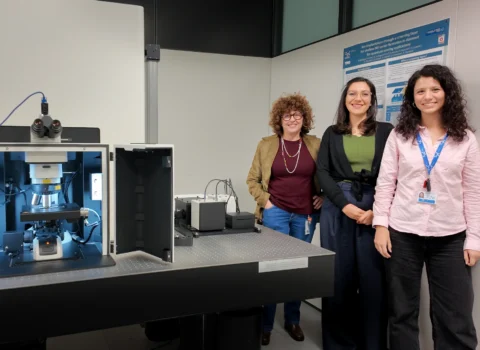
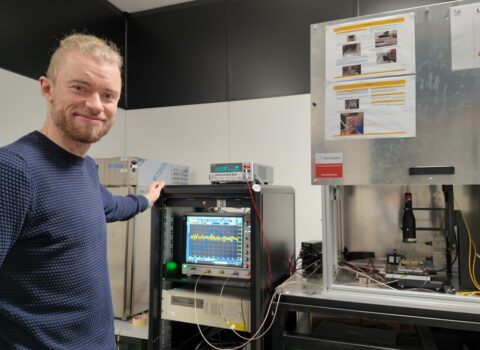
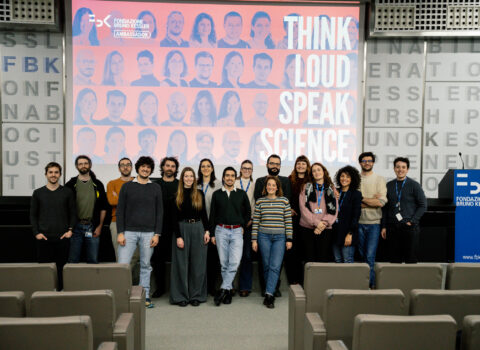
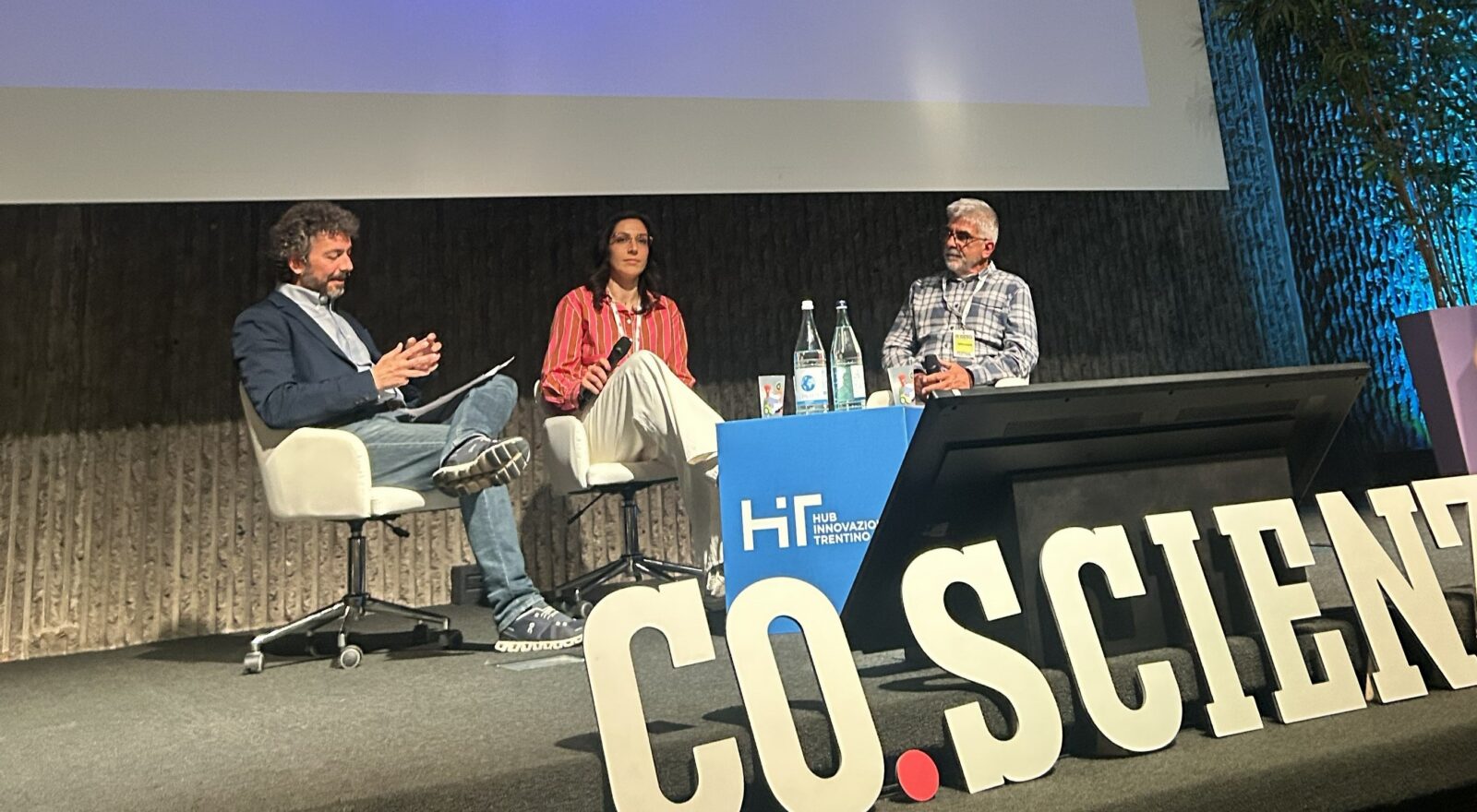
These reflections set the stage for the following discussion, also moderated by Massimo Polidoro, featuring Elena Missale—researcher and Science Ambassador at FBK—and Professor Paolo Tosi of the University of Trento. Drawing on her own experience, Missale described her work in FBK laboratories, where physics engages with phenomena that cannot be directly observed but can be studied using increasingly sophisticated instruments.
“I enrolled in physics because I wanted to study astrophysics, and although I changed direction along the way, the universe has always stayed with me. Every time I look at the night sky, I think about the light emitted by the stars: it is not instantaneous, like the light from a bulb, but a story from the past. The sunlight we see now left the Sun about eight minutes ago, while light from the nearest star beyond it travels for roughly four years before reaching us. In a sense, when we look at the sky, we are mapping the past,”said Elena Missale.
Discussing her research in more detail, she introduced the audience to a field involving light, quantum technologies, and even diamonds.
“In my work, we use extremely pure diamonds, which look like ‘ordinary’ pieces of glass, and we intentionally introduce defects. We do this using machinery at Fondazione Bruno Kessler, which allows us to position them with extreme precision, both in terms of location and quantity.”
These defects then become key tools for advanced technological applications: “We can develop, for example, thermometers capable of measuring the temperature inside cells, or technologies for quantum encryption that help increase data security.”
The discussion also touched on the role of researchers in contemporary society, where misinformation and distrust of facts make open dialogue with the public increasingly important. Communicating science means not only sharing results, but also explaining the methods, doubts, and limitations that are part of the scientific process.
Through examples, questions, and open discussion, the evening offered a concrete and accessible picture of research: a path made up of trials, errors, and gradual discoveries. It also challenged common misconceptions—such as the idea that science removes the sense of wonder from the world. On the contrary, as emphasized several times during the event, knowledge is precisely what makes reality even more surprising.
The final evening, “Investigating the Incredible,” was organized in collaboration with the HIT Foundation. The Co.Scienza Festival was founded in 2018 through a collaboration between the university associations UNITiN and OWL – Open Wet Lab, with the mission of building a bridge between the university and the broader community.
The author/s
-
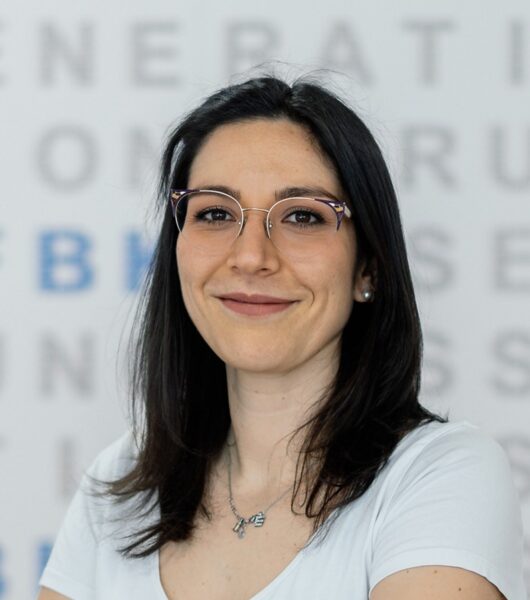 Elena Missale
Ricercatrice Centro Sensors & Devices | Unità Materials and Topologies for Sensors and Devices (MTSD)
MORE INFO
Related articles