Elisa Muratore awarded by the Prime Minister’s Office for a thesis on online disinformation
May 26, 2026
The young PhD student at the University of Trento, supported by funding from Fondazione Bruno Kessler, developed innovative mathematical models to detect coordinated campaigns on social media, combining international research, data science, and information security.
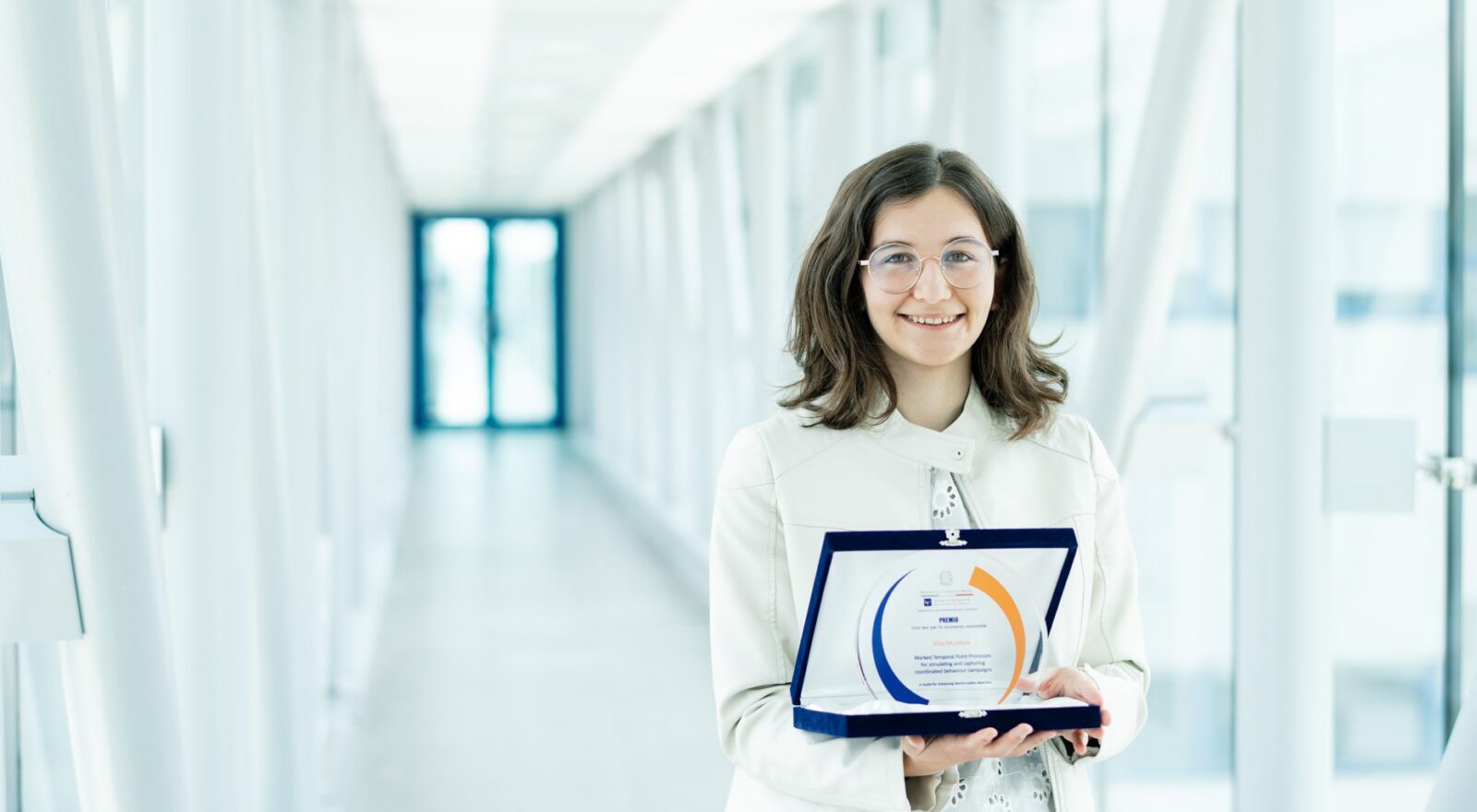
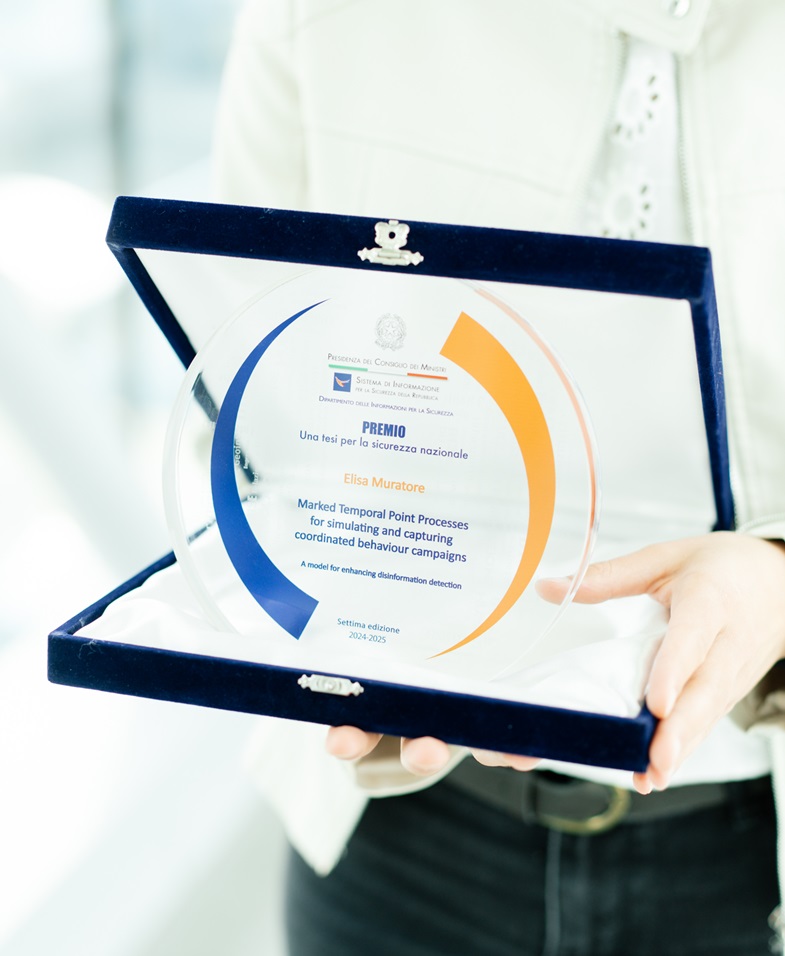 During the official ceremony on May 18, Elisa Muratore received the “A Thesis for National Security” award, promoted by the Italian Presidency of the Council of Ministers through the Department of Security Information (DIS), for her research on countering coordinated disinformation on social media. Developed as part of her Master’s degree in Mathematics at the University of Trento, the thesis was carried out in collaboration with Fondazione Bruno Kessler in Trento and Aalto University in Helsinki. The project tackles one of the most pressing challenges of today’s digital landscape: identifying coordinated online manipulation campaigns through advanced mathematical and statistical methods.
Your research focuses on a phenomenon that is becoming increasingly central in public debate. What is coordinated disinformation, and what sparked your interest in this topic for your thesis?
My journey toward this topic began almost unexpectedly. In 2023, I participated in the European Youth Event at the European Parliament, a large gathering that brought together thousands of young people from across Europe to discuss major contemporary challenges. During one of the sessions dedicated to online disinformation, I asked myself: “What can I concretely do about this issue?” That was where it all started.
I began discussing it with Professor Claudio Agostinelli from the University of Trento, who introduced me to Riccardo Gallotti, head of the CHuB Lab research unit at the FBK Center for Digital Society. Very quickly, the opportunity arose to spend a research period abroad with Professor Mikko Kivelä and Dr. Letizia Iannucci. Within a day, I received an acceptance letter from Aalto University in Helsinki for a four-month Erasmus Plus internship. It was an important experience that eventually led me to continue working at FBK.
Coordinated disinformation is a highly complex phenomenon: groups of users, or automated bots, act together to manipulate public debate, influence opinions, or even interfere with democratic processes such as elections. It is important to differentiate between disinformation, which involves deliberate intent to manipulate, and misinformation, which refers to the unintentional spread of false content.
In recent years, European and Italian institutions have devoted significant attention to these issues, also because the way we use social media has changed profoundly. Personally, this research has made me even more aware of how digital platforms are used and has shown me how important it is to discuss these topics in everyday life.
In your work, you use sophisticated mathematical and statistical tools such as marked temporal point processes and Hawkes processes. What was the greatest challenge in transforming these theoretical models into effective tools for detecting coordinated campaigns?
The main challenge was translating highly theoretical mathematical models into tools capable of describing real behavior on social media.
Coordinated campaigns often involve groups of users—real or automated—acting together over time to amplify certain content or manipulate public perception. From a mathematical perspective, the goal was to identify these forms of coordination by observing not only what is posted, but also when it is posted and how it relates to the actions of other users.
In my work, I used models based on marked temporal point processes and Hawkes processes, tools that allow us to study events that influence one another over time. An important aspect of the research was enhancing the temporal dimension, which had been considered in the literature but without a formal mathematical model.
Another challenge was the lack of adequate data for rigorously comparing existing methods. For this reason, we developed a simulation framework capable of creating controlled and realistic scenarios in which to test the ability of different models to identify coordinated behavior.
What conclusions did your work reach? Your results show that there is no universally superior method for identifying coordinated behavior: everything depends on the context and the type of campaign. What does this tell us about the complexity of online manipulation today?
One of the main findings of the research is that there is no universally superior method for identifying coordinated campaigns. The effectiveness of the models depends heavily on the context, the type of platform, and the strategies used by the actors involved.
There are, in fact, very different forms of coordination. Some are relatively easy to detect, such as spam campaigns in which multiple accounts share the same link simultaneously. Others are far more sophisticated. For example, “sockpuppets” are coordinated users who attempt to imitate spontaneous behavior in order to avoid detection.
To address this issue, we worked on improving existing models by introducing tools that are more sensitive to temporal dynamics. Moreover, thanks to the simulation framework developed during the research, it was possible to compare different approaches more precisely and efficiently.
This demonstrates that online manipulation is a constantly evolving phenomenon: those spreading misinformation continuously adapt their strategies, and detection tools must evolve accordingly.
The simulation framework you developed allows researchers to create realistic scenarios involving spammers and sockpuppets. How important is it, in disinformation research, to simulate controlled environments instead of relying solely on real-world data?
It is extremely important, especially because real-world data often have significant limitations: they may be incomplete, noisy, or difficult to interpret.
The framework we developed arose precisely from the need to create a controlled environment in which to observe model behavior under known conditions. We can simulate coordinated and uncoordinated users, spammers, bots, or accounts deliberately attempting to conceal their coordination.
This allows us to obtain a much more realistic picture and, above all, to compare different methods in a rigorous and replicable way. Simulation tools of this kind were lacking in the literature, so one of the project’s goals was to provide the scientific community with a shared basis for evaluating the effectiveness of existing approaches.
You have worked across Aalto University, FBK, and the University of Trento. How important was it for your personal and scientific growth to work in an international and interdisciplinary environment?
It was crucial for me. I have always sought international experiences because I believe it is very importantto see how different research groups operate, even when they are geographically far apart.
The experience in Finland gave me a great deal. I had the opportunity to work with highly competent people and to engage with different approaches to research. I learned enormously, both scientifically and personally. With some of the supervisors I worked with, we are also publishing a scientific paper that will be released soon.
At the same time, working in interdisciplinary environments such as the University of Trento and FBK has allowed me to combine mathematical, statistical, and computational tools to address concrete problems related to information security and social networks.
At FBK, you work on topics that combine data science, social networks, and information security. What role did the Foundation play in your journey, and what kind of environment did you find for developing your research?
FBK has played a very important role in my journey. After completing my thesis, I decided to remain as a research assistant, mainly within the HATEDEMICS and AI4TRUST projects, and later I began my PhD.
I found a highly stimulating environment, with people open to discussion and willing to help you find direction in your research. There is a constant exchange of ideas and many opportunities for collaboration, both within the Foundation and with international partners.
I also had the opportunity to continue abroad, but I chose to remain in Trento because I found a supportive and scientifically vibrant environment where I feel valued. I appreciate working on topics I am passionate about that can also have a meaningful impact on society.
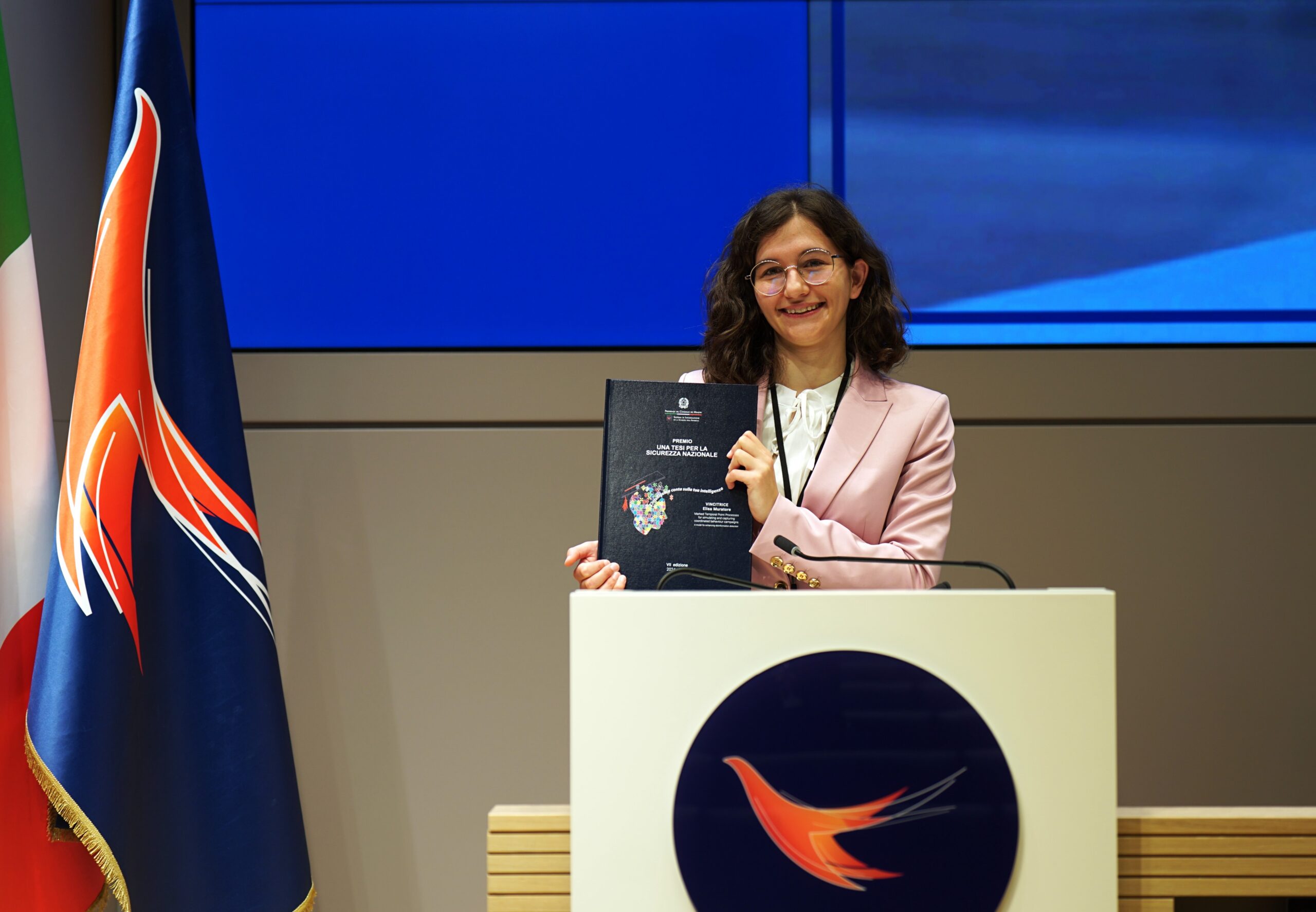
You have just received a prestigious award from the Presidency of the Council of Ministers. Looking ahead, what research questions or career goals would you like to pursue in the coming years?
I have just begun my PhD, and I would certainly like to continue working in research, further exploring issues related to disinformation, social media, and information security. It is a constantly evolving field, and I believe there is still a great deal to be done.
During a master’s thesis, there are inevitably difficult moments. I remember periods when the code simply would not work and it seemed impossible to find a solution. In those moments, discussing problems with supervisors and research group members was essential. Gradually, by working together, we always managed to overcome obstacles.
I believe it is important to choose topics you are genuinely passionate about, because that passion is what allows you to face even the most difficult phases of the journey.
You have been living in Trento for several years now. What is your relationship with the city?
I am originally from Verona, and I have lived in Trento since the beginning of my bachelor’s degree in September 2019, apart from periods spent abroad during Erasmus and internships.
I feel very comfortable here, so much so that I decided to stay for my PhD as well. It is a very livable, active, and welcoming city. I truly enjoy traveling and having international experiences, but every time I return, I appreciate the view of the Trentino mountains.
The author/s
Related articles