

First and foremost: do not discriminate
May 8, 2026
Beginning with his master’s thesis, he specialized in gender-inclusive machine translation, contributing to methodological advances in the field while pursuing his PhD at Unitrento within FBK’s Machine Translation unit. We spoke with him about his interdisciplinary journey.
Machine translation has transformed global communication, helping break down linguistic and cultural barriers. But what happens when language itself carries biases or excludes identities and perspectives? Today, the challenge is no longer just translating accurately, but doing so inclusively—moving beyond gender binaries and avoiding systematic discrimination.
Andrea Piergentili’s multi-year research has focused on inclusive translation, understood not only as a matter of gender fairness, but as a broader paradigm shift aimed at rebalancing the linguistic representation of personal identities and producing outputs that are non-discriminatory by design.
Gender binarism is not merely a linguistic simplification; it is a system that produces exclusion and has tangible negative consequences. Non-binary people living in contexts where gender is rigidly divided into male and female report higher levels of anxiety and depression due to a lack of social recognition. It’s not just about words: gender binarism translates into systemic discrimination, such as limited access to positions of power, resources, or medical care. For example, the FAO has highlighted how, in agriculture, the use of masculine terms for professions (e.g., “farmer”) can render women’s work invisible, even though women make up 60% of the workforce in many countries. Similarly, the use of male-coded language in job postings reduces female participation in those postings and puts women at a disadvantage in the selection process. In short, language does not merely describe reality, but constructs it through the influence exerted by certain linguistic choices; and if it is binary, it excludes those who do not fit into it.
Words, however, can also be a tool for change. If a culture lacks terms to describe non-binary identities, it becomes more difficult to recognize — or even imagine — them. That is why inclusive language is not a formal matter of “political correctness,” but a substantive issue of social justice.
In fields such as machine translation, the problem is amplified: systems like Google Translate, which are trained on data that may contain biases, often assign binary genders even when the context is neutral, thereby perpetuating stereotypes. This is why the sentence “The nurse is tired” is frequently translated into Italian as “L’infermiera è stanca” — where infermiera specifically refers to a female nurse — even though the subject could also be a man or a non-binary person. This is not simply a technical error, but an ethical failure that both reflects and reinforces existing inequalities.
With the AI Act, the European Union has acknowledged the need to test AI systems for gender bias, especially in sensitive contexts such as healthcare and the legal system. But real change begins with us: being mindful of our words means recognizing that inclusive language is not a mere affectation, but a right. As Judith Butler argues, gender is performative — it is not something one simply is, but something one does. And if the stage is built for only two roles, everyone else remains offstage.
The good news is that solutions do exist. The work carried out by the MT research unit at the FBK Center for Digital Industryis moving in this direction.
: “It’s fair to say that your field has attracted growing interest in recent years. What do you think are the main reasons for this?”
Andrea Piergentili: “I’ve been fortunate to dedicate my research to an emerging field and to witness its growth in both relevance and visibility within the scientific community. I believe that the contributions developed together with my group — all publicly released and openly accessible — have helped foster and support these developments.”
GS: “Can you share a particular achievement or source of satisfaction?”
AP: “There have been many rewarding moments. From a theoretical perspective, it was gratifying to see some of our linguistic and conceptual proposals replicated and applied to other languages. From a practical standpoint, seeing our datasets, models, and approaches used in further research has been both deeply satisfying and a meaningful validation of our work.”
GS: “What challenges have you faced?””
AP: “One technical challenge was the lack of data. On the one hand, artificial intelligence technologies rely on datasets that often reflect social stereotypes, meaning there is a shortage of data free from such biases. On the other hand, the demand for tools capable of recognizing and accounting for the complexity of gender identities is becoming increasingly urgent.”
GS: “Who were the people who supported you the most?”
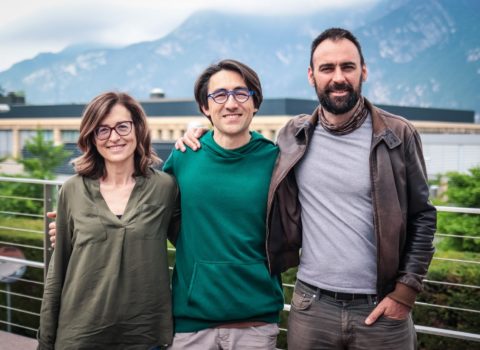
AP: “First and foremost, my colleagues Luisa Bentivogli (Unit Head) and Beatrice Savoldi who, together with Matteo Negri, encouraged me to broaden my horizons, helping me find my direction and giving my work a stronger sense of purpose. Another key factor in finding balance and renewing my enthusiasm was being part of the FBK PhD student community. Many friendships grew out of that experience, and, through one shared experience after another, they played an important role both in strengthening my resilience and in enriching my original perspective and approach with new ideas and skills. Not only did I come to understand my interests more clearly and precisely, but I also realized how much a strong community helps people in our field thrive. In a sense, it is an essential element of sustainability — the driving force that makes you genuinely happy to go to the office every day. Over time, it felt both natural and deeply rewarding to share what I had learned with those who embarked on the same journey after me, with the hope of helping them navigate this path more effectively and achieve both professional and personal fulfillment.”
The author/s
Related articles