Reaching the next level
April 23, 2026
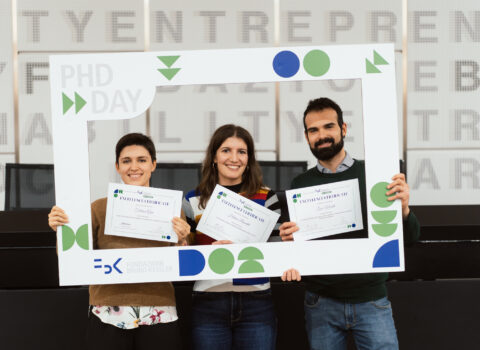
Face to face with Federica Gini: designer and UX researcher with a focus on collaboration. After completing her PhD in Cognitive Science at UNITN and FBK, she explores gamification and how game elements can encourage people to make a difference.
A UX designer and researcher interested in understanding how people experience the world and designing experiences that enrich their daily lives, Federica Gini has a strong background in motivational psychology and the design of playful, interactive systems. She is particularly drawn to projects that combine digital, tangible, and immersive technologies.
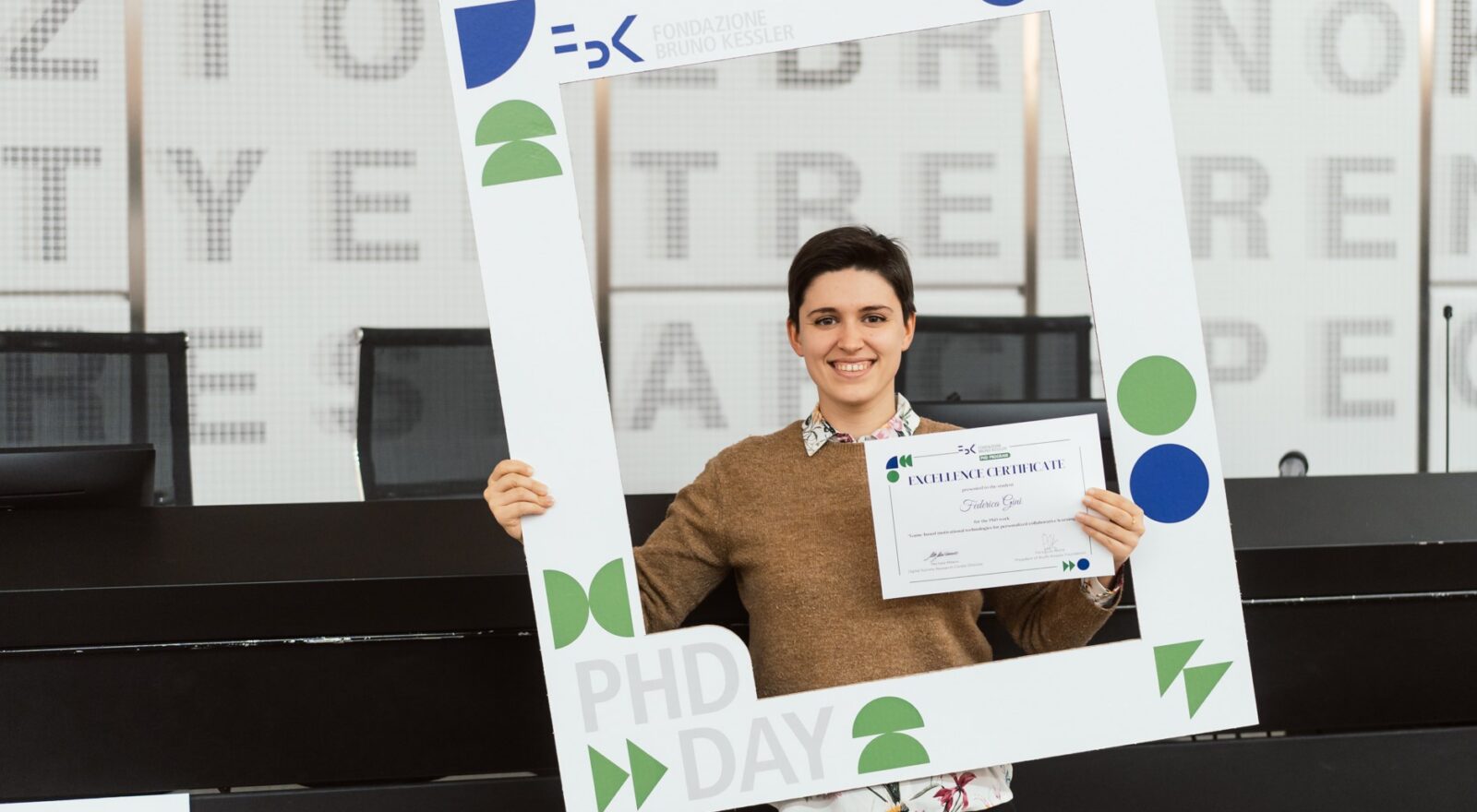
We met her after her recognition at PhD Day 2026 to learn more about her.
Giancarlo Sciascia: What is your main research objective?
Federica Gini: During my PhD, my main research focus was gamification in education and learning—sometimes with social impact, as in the StandByMe project. My first paper, presented at GamiFIN 2023, outlines the motivations behind my doctoral work.A topic I have explored less, but would like to pursue in the future, is user research in environmental sustainability, to help promote the adoption of sustainable behaviors (as can happen through gamification), allowing users to integrate new behaviors into their cognitive models. My goal is to create technologies that truly support people—tools that are clear, engaging, and based on real needs rather than trends.
GS: You work on gamification design and learning with a focus on cooperation. If your PhD were a game, what would it be?
FG: It would be Spirit Island—it’s a cooperative game with many rules and lots of details to manage, and it lasts for many hours. You have to think a lot before you can play it well. With a PhD, you sometimes feel like you’re not keeping up, like you’re behind, but in reality everything is fine—you just have to keep going and keep exploring.
GS: When or how do you realize everything is going well?
FG: In the game, it happens at a “turning point.” For me, during my PhD, it happened while writing the thesis. It felt like putting everything back in order after a chaotic path. I was able to approach that phase calmly because I already had a lot of solid content to connect. At the beginning, though, it’s normal not to have clear guidelines on what makes a “good” or “bad” PhD, and impostor syndrome inevitably shows up.
GS: What do you recommend to a new doctoral student?
FG: The most common feeling—something I noticed even when talking with many classmates—is definitely that of “feeling behind,” but it’s just a perception you have to challenge in order to better organize your work. Planning helps you experience the journey more calmly and handle inevitable setbacks. Doing a PhD means preparing for years of instability. Research often requires moving wherever it takes you, and it’s important to be aware of that.
GS: Does optimal time management exist, or is it a myth?
FG: Time management is essential. During my PhD, it was especially important because both in work and in my personal life, I like to explore different interests and topics. In my experience, giving yourself space helps you explore and better understand what you’re truly passionate about. That’s why managing your time well is crucial, so you don’t neglect any area.
Can you show me an example?
FG: During my PhD, there were times when I felt behind because I spent less time on my thesis. Better organization in those moments would have helped me realize that I actually had enough time. Looking back now, I feel much more complete as a researcher. I’ve learned many techniques, and working across different groups and topics helped me develop mental flexibility and the ability to adapt.
GS: How does serendipity work?
FG: I think it’s largely a matter of personality—balancing flexibility and curiosity. Some people prefer jumping from one thing to another and benefit from it. It also depends on your environment. Being part of an interdisciplinary research group and having access to others is essential.
GS: Is collaboration a superpower?
FG: If anything, it’s an emergent property. It depends on the people involved and on who brings structure to the group. In my case, I was lucky to have a scientific mentor like Annapaola, who was also a leader encouraging sharing. In that environment, teamwork was already a core value. She was always supportive and attentive, while giving me a lot of freedom—which I appreciated because it allowed me to manage my time independently. One of the great things about research is the ability to contribute to topics where you have little experience, invest time, and learn. One “side quest” after another, your skill set grows. There’s also a natural handoff between PhD students and master’s or undergraduate students. Over time, doctoral students become points of reference. I’ve always been the youngest, and those interactions weren’t just academic—they helped me navigate attitudes and opportunities more broadly.
GS: What opportunities did you take along the way?
FG: Encounters often turned into in-depth exploration paths. For example, with Antonio Bucchiarone I focused on the connection between gamification and learning, especially integrating AI. With Margherita Andrao from i3, we created an interdisciplinary paper that started by chance during a bus trip. With Simone Bassanelli, we worked on serious games and gamification design. And with Eugene Kukshinov—whom I met during a visiting period in Waterloo, Canada, with Lennart E. Nacke—we produced a paper on virtual reality.
GS: Let’s go back for a moment—do you remember when your passion for research began?
FG: It started in middle school, during a science lesson on the scientific method. Ever since I was a child, I wanted to be a scientist.
GS: Looking ahead, what do you see in your future?
FG: While research isn’t always tied to immediate applications, gamification offers many practical possibilities. I’d like to work in industry as a user researcher, staying connected to people’s everyday lives. As a consultant, I enjoy listening to users’ pain points and needs to shape the right features for tools.
GS: Would you recommend doing a PhD at FBK? Why?
FG: At Modis, compared to the experiences of other friends, you have the opportunity to build a very practical path that immerses you in a “grown-up” environment. You’re not stuck in an academic bubble—you engage with real work being done by others. This helps you develop sensitivity and learn a lot by listening to colleagues, even in informal settings. The biggest difference compared to academia is the greater diversity of roles and experiences, which turns out to be incredibly valuable.
GS: “Just out of curiosity—what do you do when you’re not working?”
FG: “I play Ultimate and say hello to every animal I come across.” 😊
The author/s
Related articles