Lessons in interdisciplinary
January 13, 2026
In collaboration with FBK and the University of Milan, AREA has been launched—the STEM (Science, Technology, Engineering and Mathematics) pathway for students of Chemistry and Environmental Biotechnology at the “Buonarroti” Technology High School in Trento. The initiative marks a new approach to environmental education and research
AREA is an innovative interdisciplinary teaching model that brings together technical and scientific expertise with hands-on, collaborative learning, enriched by the direct contribution of the research community.
Starting this school year, the three-year Environmental Biotechnology program introduces a new educational track designed to build practical and cross-cutting skills while fostering critical thinking, creativity, and problem-solving. The goal is to prepare students for a rapidly evolving job market in which environmental challenges play a central role. The program integrates Environmental Physics, Biology and Microbiology, Organic Chemistry, and Analytical Chemistry, moving beyond a subject-by-subject approach to help students learn how to connect disciplines and tackle complex problems.
An example? One example is the study of marine pollution: students not only examine the issue in theory but also enter the lab to learn how sensors are developed to detect microplastics with extreme precision. These particles—largely originating from synthetic fabrics, tire wear, and cosmetics—are responsible for the invisible degradation of ecosystems, entering the food chain and releasing toxins that harm marine organisms and birds, contribute to ecological imbalances, and pose risks to human health.
The origins of the project
AREA was developed in response to four key needs of the contemporary world:
Bridging theory and reality: narrowing the gap between school curricula and technological innovation by bringing micro- and nanotechnology and advanced environmental monitoring into the classroom.
Interdisciplinary thinking: environmental challenges are complex and demand dialogue among chemistry, physics, and biology; AREA serves as a training ground for this approach.
Student engagement: learners are active participants, aware of their own learning process through direct laboratory experience.
Labor market demands: the pathway responds to the growing need for flexible professionals able to work in multidisciplinary teams, aligning with the dynamics of green and digital jobs.
The project is the result of a working group held last year, which saw the course lecturers engage with the world of research and academia, involving professors Daniela Meroni, Sebastiano Campisi, and Paola Fermo from the Department of Chemistry at the University of Milan, as well as FBK researchers Cecilia Pederzolli (Microsystems Technology unit of the Center for Sensors and Devices) and Alessandra Potrich (Scholars and PhD Program).
Strength in collaboration
By integrating schools, universities, and research centers, AREA builds a bridge between education and innovation, offering a distinctive and stimulating learning experience within Trentino’s technical and scientific landscape. Through this initiative, Buonarroti High School aims to train aware, skilled, and motivated students ready to enter future scientific and industrial fields.
Teaching together, learning with curiosity
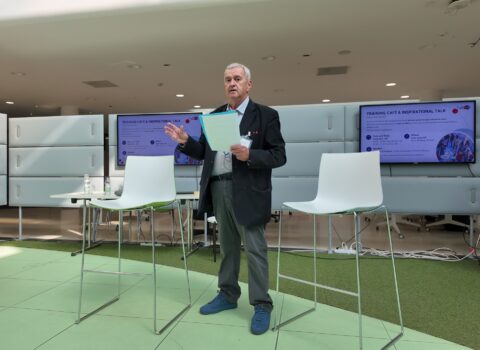
At the core of the program are interdisciplinary, co-taught lessons. Teachers no longer work in isolation but share the classroom, addressing topics simultaneously from different perspectives. As AREA coordinator , professor of Organic Chemistry, explains, this approach allows students to see how environmental problems can be analyzed at once through physics, organic chemistry, analytical precision, and biological dynamics.
From theory to practice
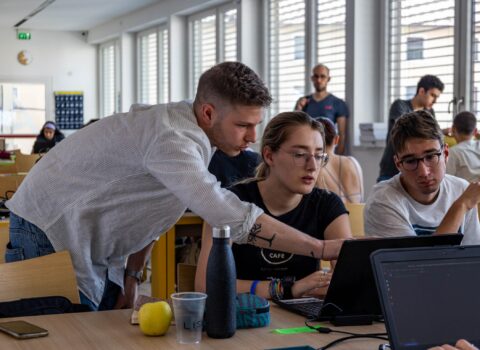
A defining feature of AREA is its strong emphasis on laboratory work. Beyond traditional lectures, students take part in experiments that allow them to apply what they learn. Thanks to collaboration with FBK and the University of Milan, theory becomes an engaging, hands-on experience in which disciplinary boundaries fade, making room for a broader understanding of major global challenges such as climate change.
“The AREA project,” says Piergiorgio Baruchelli, professor of Analytical Chemistry at Buonarroti High School, “was created to highlight the central role of chemistry in today’s ecological and digital challenges. Our aim is to make students true protagonists— not only by providing solid knowledge, but by training them to communicate with different professional figures, a crucial skill for the interdisciplinary contexts of the future.”
Following introductory lectures by researchers Cecilia Pederzolli and Leandro Lorenzelli, students move into FBK laboratories to observe advanced microfabrication processes for devices used to analyze molecules and biomolecules, such as water contaminants, engaging directly with researchers. They also read and discuss popular science articles on water and climate change.
Under the guidance of University of Milan Professor Sebastiano Campisi , students conduct hands-on experiments with eco-sustainable materials, including hydroxyapatite, charcoal, chitosan, and cellulose. A visit to the University of Milan’s Department of Chemistry labs follows, where they analyze major water pollutants, with particular attention to emerging contaminants such as pharmaceuticals, pesticides, PFAS, and antibiotics.
The working group also includes professors Donato Romito (Environmental Physics) and Federica Trona (Environmental Biology and Microbiology).