
Machines against rage
March 20, 2026
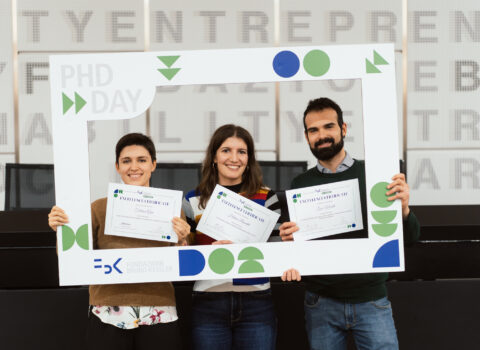
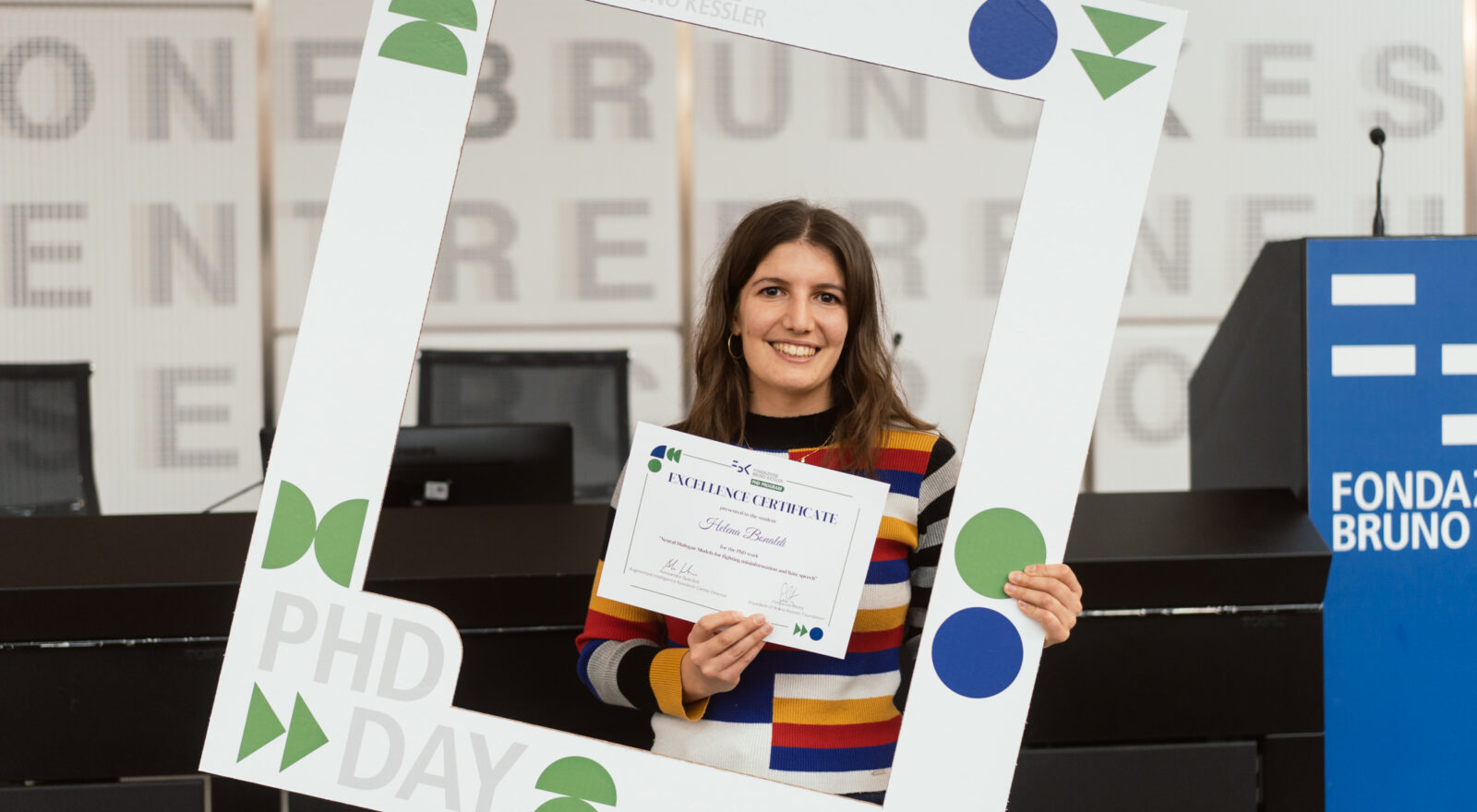
We met Helena Bonaldi, a young researcher in the field of Natural Language Processing, to hear about her experience at FBK and to explore her path, which may inspire those considering applying for a PhD.
Giancarlo Sciascia: What steps brought you here, and when did you identify your area of specialization?
Helena Bonaldi: After my bachelor’s degree in International Studies and my master’s in Data Science, I had the opportunity to do a master’s internship at FBK to define my thesis under the supervision of Marco Guerini, head of the LAND unit at the FBK Center for Augmented Intelligence. It was kind of like a pre-PhD. It was during my master’s that I started to become interested in this field, thanks to a Computational Linguistics course that I found fascinating.
GS: What did you like most, and how did you challenge yourself?
HB: I liked proceeding through trial and error, running experiments, digging deep into things, asking myself questions. I found this activity very stimulating, and so, naturally, when the opportunity came up to apply for a PhD scholarship, I thought, “I enjoy what I’m doing—why not keep going?”
GS: What did you focus on specifically?
HB: In LAND, I mainly worked on countering online hate. This involves, in particular, generating counter-narratives that, through argumentation, avoid censoring content identified and labeled as hateful, and instead offer alternative perspectives, so as to leave a mark in online conversations, engage with polarization, and rebalance its outcomes as much as possible.
GS: What tools are used to tackle this titanic challenge? Isn’t it a bit like emptying the ocean with a teaspoon?
HB: The sheer volume of content we’re dealing with and the biases underlying online behavior can indeed make the challenge seem overwhelming at first. But in reality, a lot can be done because the issue at stake is not only hate but also misinformation. Initially, we focused on automating the process to assist people—such as those working in NGOs—who respond to hateful content, aiming to reduce processing time. After my PhD, with the European project Hatedemics, we built an educational chatbot that has served as a concrete barrier to the spread of racist, xenophobic, and intolerant discourse, as well as conspiracy theories.
GS: If you had to advise prospective PhD candidates, why should they choose FBK?
HB: There are at least three good reasons.
First, its reputation: in the field of computational linguistics, FBK is recognized as a center of excellence in Italy and across Europe.
Second, something that shouldn’t be taken for granted is access to a large number of GPUs for running experiments.
Finally, mentorship is extremely important. You might end up being supervised either by someone who barely considers you or by someone who micromanages you excessively. The right balance lies in the middle. Marco was excellent—he’s a positive, good-humored leader and always managed to find time to support me. Not all PhD students get to have meaningful, high-quality discussions, which are especially important at the beginning to avoid feeling lost—even though feeling lost is part of research. It can be intimidating and challenging, but it also pushes you to do your best. As I became more independent, he stepped back to give me more freedom. And speaking of freedom, teaching is optional rather than mandatory, which makes FBK ideal for those who may not want to pursue an academic career but prefer a more applied setting.
GS: What experiences have shaped your journey?
HB: The requirement to spend at least three months and up to one and a half years abroad during the IECS computer science PhD program turned out, in hindsight, to be key for engaging with people from different backgrounds, mindsets, and cultures, which translate into different approaches and skills. I’m very happy with the people I met—I feel lucky. In our field, results are often not encouraging, and it can be hard to stay motivated. That’s why it’s essential to keep your sense of curiosity alive, not give up, and try to understand why things don’t go as expected. In those moments, you have to strike a balance between your initial goals and the energy you expend along the way. Talking with more experienced people helps you make wiser decisions in these situations.
GS: Any dreams for the future?
HB: I’ve felt good in Trento—something kept me here, and from my PhD onward I realized it was where I wanted to be. The mountains and the lake make you appreciate the landscape, and it’s easy to make friends. Of course, it doesn’t have Milan’s nightlife, but for someone like me who appreciates a smaller city, this is a place where you can feel you belong, build relationships, and grow your social network. Opportunities to meet and learn about what colleagues are working on have increased and improved in recent years: it’s important to know what other groups in our Center, in other FBK units, and also at UNITN are doing. Getting to know each other better—having points of reference and building a community—is important. I’m well aware that “there’s no certainty about tomorrow,” but I admit that after my contract ends at the end of next year, I wouldn’t mind staying and continuing in this place and with this team.
The author/s
Related articles