
Margherita Andrao: Exploring the intersection between AI and adolescents
July 9, 2026
The interdisciplinary path of a researcher advancing AI literacy through technology and cognitive science.
We met with Margherita Andrao, a researcher at FBK and co-author of studies presented at international conferences such as ACM CHI 2026.
Her career at FBK is a perfect example of interdisciplinary research. Working in the field of Human-Computer Interaction and drawing on a background in Psychology, her research focuses on the influence of cognitive processes and individual characteristics in interactions between users and technology. During her PhD at FBK, she studied the mental models of non-expert users, such as teachers and people with intellectual disabilities, as they interacted with different technologies using language-based interaction paradigms, including Large Language Models (LLMs). The objective was to observe how users without expertise in computer science or programming perceive and interact with systems such as ChatGPT or Alexa, and to provide guidelines for the design of user-centered systems.
During her PhD, she focused on how teachers, educators, and caregivers interact with these technologies in order to make them more accessible to the general public — namely, people who use technology without a technical background. After completing her PhD, her research shifted toward younger people and their interactions with Artificial Intelligence (AI), seeking to answer questions such as: What do teenagers really think about AI? What are the risks, and how can we address them?
After beginning her postdoctoral research, Andrao participated in activities involving 51 middle school classes across Veneto and Trentino, engaging nearly 900 students to investigate their beliefs and knowledge about AI, as well as the attitudes and fears of younger generations. This work is an integral part of the Sparkle (STEM Practical Activities to Raise Knowledge Learning and Exploration) project, funded by Fondo per la Repubblica Digitale (Digital Republic Fund), which aims to encourage shared reflection on the ethical aspects of technology.
The scientific arena
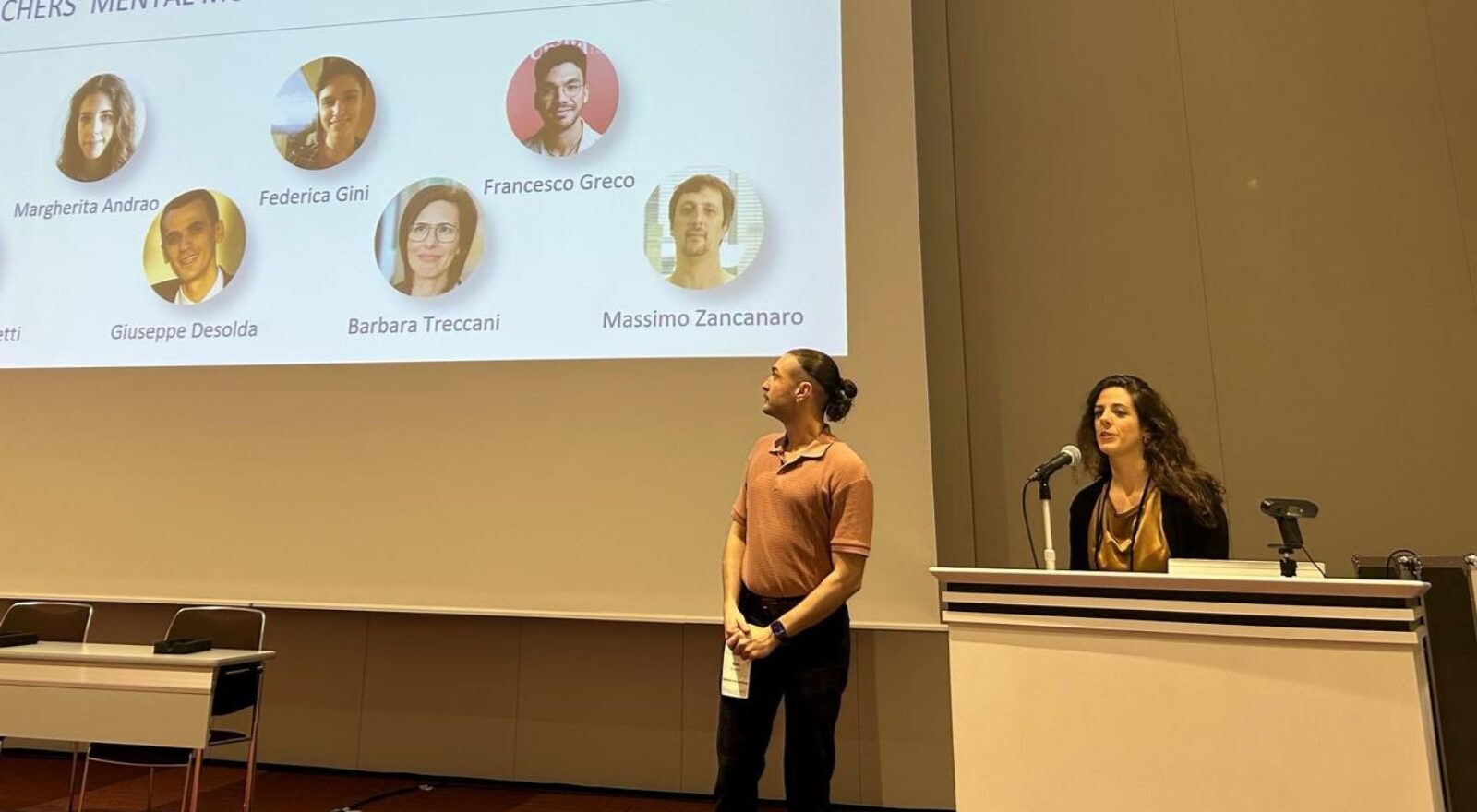
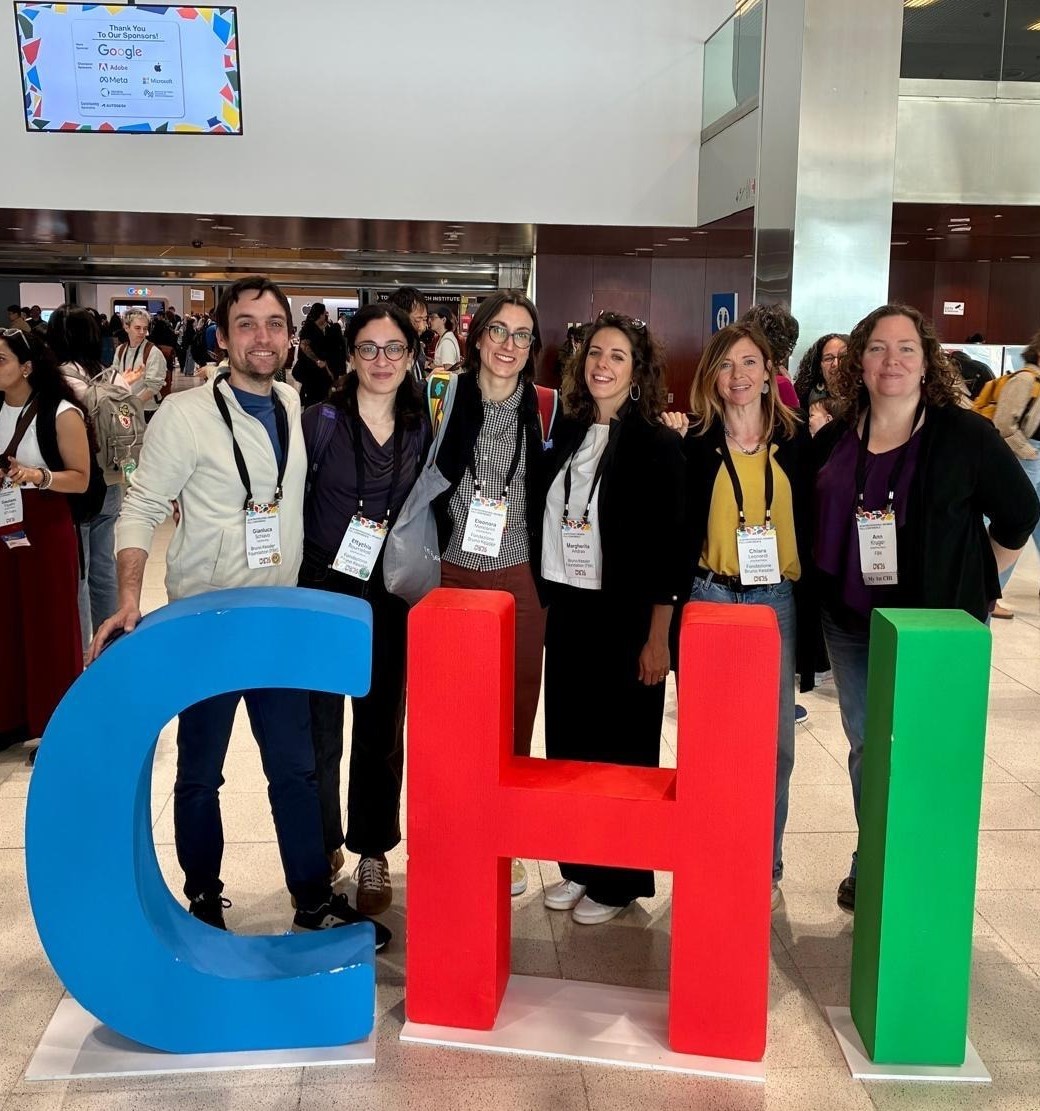
Together with Gianluca Schiavo (first author and colleague in the same research unit, i3 – Intelligence Interfaces and Interactions at the Center for Augmented Intelligence), Andrao participated in CHI 2026, a leading conference in the field of Human-Computer Interaction, held in Barcelona April 13 through 17.
Andrao took part in the workshop “The Developmentally Safe Generative AI Environment for Youth,” contributing preliminary results collected during interventions in middle schools as part of the Sparkle project. These findings were presented in the position paper “Between Competence and Naivety: Adolescents Navigating GenAI,” co-authored by Schiavo as well as FBK-ISR researchers Stefania Yapo and Valeria Fabretti.
Schiavo presented the paper “Talking About Brainrot: Youth Engagement with AI-Generated Content and the Dynamics of Intergenerational Communication,” published in the Proceedings of the 2026 CHI Conference on Human Factors in Computing Systems (Barcelona, Spain) (CHI ’26), Association for Computing Machinery, New York, NY, USA.
Growing up in a challenging environment
Giancarlo Sciascia: How would you describe your academic and professional experience at FBK during your PhD?
Margherita Andrao: “Pursuing a PhD at FBK means living in an ecosystem where theoretical research constantly meets practice. I had the opportunity to study fundamental cognitive theories, such as those related to Mental Models, within emerging technological contexts and to present my research at the CHI conference last year in Yokohama, Japan. IIn that context, I presented a study involving 28 elementary school teachers, whom we asked to use “no-code” programming—that is, using predefined language primitives—to develop a tangible tool called SMARTER, which we designed during my doctoral studies to support mathematics instruction. We sought to elicit and analyze teachers’ mental models as they programmed and tested the tool.
This was extremely important for understanding the role of language in the technologies we design and how it can foster or inhibit an effective representation of the system. At the same time, we became interested in interactions between users and LLMs. After completing my PhD, as part of the Sparkle project, I had the opportunity to enter around fifty middle school classrooms, where we discussed AI and ethics and gathered information about what adolescents know about AI — specifically Generative AI (GenAI) — the emotions they associate with it, and the aspects that attract or frighten them most. We collected data from nearly 900 students and are currently conducting the first analyses.
We found several tensions in both knowledge and attitudes toward AI. On the one hand, many students tend to overgeneralize, assuming that anything digital is AI; on the other hand, some define AI too narrowly, associating it only with tools like ChatGPT. At the same time, we observed that adolescents are quite capable of identifying GenAI-generated products. For example, there is widespread awareness that Brainrots are generated by AI. In this regard, this year we presented at the CHI Conference 2026 in Barcelona the emerging phenomenon of “Italian Brainrots,” a subgenre of AI-generated meme culture based on short videos that is reshaping the social language of younger generations. By studying these trends, we sought to understand not only what young people know, but also how they communicate information among peers rather than with adults, highlighting a generational gap that we propose to address through design guidelines and AI literacy initiatives.”
What are Italian Brainrots?
The Italian Brainrot is a memetic phenomenon that went viral at the beginning of 2025, characterized by surreal images generated by AI that portray fantastic creatures or bizarre hybrids, such as animals combined with objects or food, accompanied by pseudo-Italian names and synthetic voices.
The broader term “Brainrot” refers to alleged cognitive impairment caused by compulsive consumption of trivial online content or “slops” (low-quality mass-generated content), but in the case of the “Italian” variant, the content becomes a form of participatory digital folklore.
GS: “Why is it viral among young people?”
MA: “According to our research, which involved 87 adolescents between the ages of 11 and 14, the main reasons for its virality include:
- Absurdist humor and “Incongruity Theory“. The appeal lies in the nonsensical and surreal nature of the images and stories, which defy common logic and align closely with teenagers’ sense of humor.
- Quick and eye-catching format. The videos are ultra-short and dynamic, optimized for algorithms from platforms like TikTok, YouTube Shorts, and Instagram.
- Group dynamics and identity.It functions as a secret language or a shared symbolic repertoire that strengthens the bond between peers, sharply distinguishing young people from the world of adults (“boomers”), who often do not understand or despise the phenomenon.
- Charm for AI (novelty effect). Young people are attracted to the technological novelty of GenAI; research shows that about 92% of adolescents are aware that this content is created with AI, and this sometimes stimulates their curiosity about how such tools work.
- Language and rhymes. The use of catchy names (such as Tralalero Tralala or Ballerina Cappuccina), absurd rhymes and, in some cases, the use of vulgar or blasphemous language increases their attractiveness and ability to capture attention.
Despite the name, the Italian Brainrot is not necessarily produced in Italy or by Italians: some characters are associated with texts in other languages (one of the most famous is in Indonesian, but there are others also in Croatian and Spanish). Videos are likely to use Italian, like other languages, as an “exotic” or “arcane” language to add an extra layer of absurdity to the content.
What emerged from the analysis of 50 Italian Brainrots is that, among the most cited by the study participants, there are some contents that include vulgar language and/or that deal with sensitive issues, such as war and violence. For this reason, it is very significant, given the attraction and exposure of young and very young people to these contents, to promote dialogue between young people and adults. While 98% of the 87 adolescents interviewed specifically about Brainrot said they were familiar with it, only 11 out of 87 teachers (13%) reported knowing it.
The dialogue between teachers and students, as well as between parents and children, on AI and AI-generated content is currently characterized by a strong generational gap: research indicates that about 90% of adolescents discuss these issues only with peers, while only a minimal part (10%) discusses them with adults.
One of the reasons for this gap is adolescents’ perception of adults’ attitude towards these contents. About 60% of teens told us they don’t talk about it with adults because they would consider it a “waste of time” or something “stupid.” For young people, however, this content represents a form of entertainment, is part of the group dynamics and generates fun in 72% of cases, despite the fact that there is a minority (about 21%) who express negative feelings towards Brainrots, literally describing them as something that “eats your brain”. Interviewing teachers, we found that only 29% consider them a waste of time, while many (about 52%) expressed a desire to know more.”
GS: “To overcome this isolation and foster a constructive dialogue, what strategies can parents adopt?”
MA: “Given the need for workshops for parents and teachers, we have identified five possible approaches:
- Use viral phenomena as a “bridge”
Instead of ignoring social media trends, parents can use popular but absurd content, such as the Italian Brainrot, as a starting point for a conversation. Despite their nonsensical nature, these memes are widespread and offer an opportunity to reflect on how AI is shaping digital culture.
- Avoid dismissive attitudes
One of the main obstacles to dialogue is the perception by children that adults consider their online interests as a “waste of time”. This leads young people to close themselves off, limiting the possibility for parents to understand how their children navigate digital culture and to offer support in case of distress. An approach based on curiosity and genuine interest is essential to keep the communication channel open.
- Developing “AI literacy” together
The conversation can focus on developing a critical understanding of how technology works. Parents can encourage reflection by asking their children to identify which parts of a piece of content—such as images, voices, or texts—have been generated by AI. This can open up discussions about how algorithms drive virality and about the risks of viewing AI as a “friend” or source of emotional support without fully understanding its ethical implications.
- Addressing ethical issues and safety
Parents should openly discuss the presence of explicit language, violent or offensive themes that may appear in the content generated by AI (as in 25% of the cases analyzed in the Brainrot phenomenon). It is important to reflect together on responsibility and authorship (how human input, through prompts and creative choices, influences what AI produces), as well as on privacy and manipulation (how data is collected and how synthetic content can erode trust in information).
- Encourage collaborative exploration
Our suggestion is to move from a logic of pure control to one of involvement and co-creation. Participating together in creative activities, such as trying to generate an image or video by remixing existing elements, helps adults understand their children’s digital practices and allows young people to exercise critical judgment in a protected environment.”
The author/s
Related articles