


Neutron’s secret faces that are shaping the world
October 27, 2025
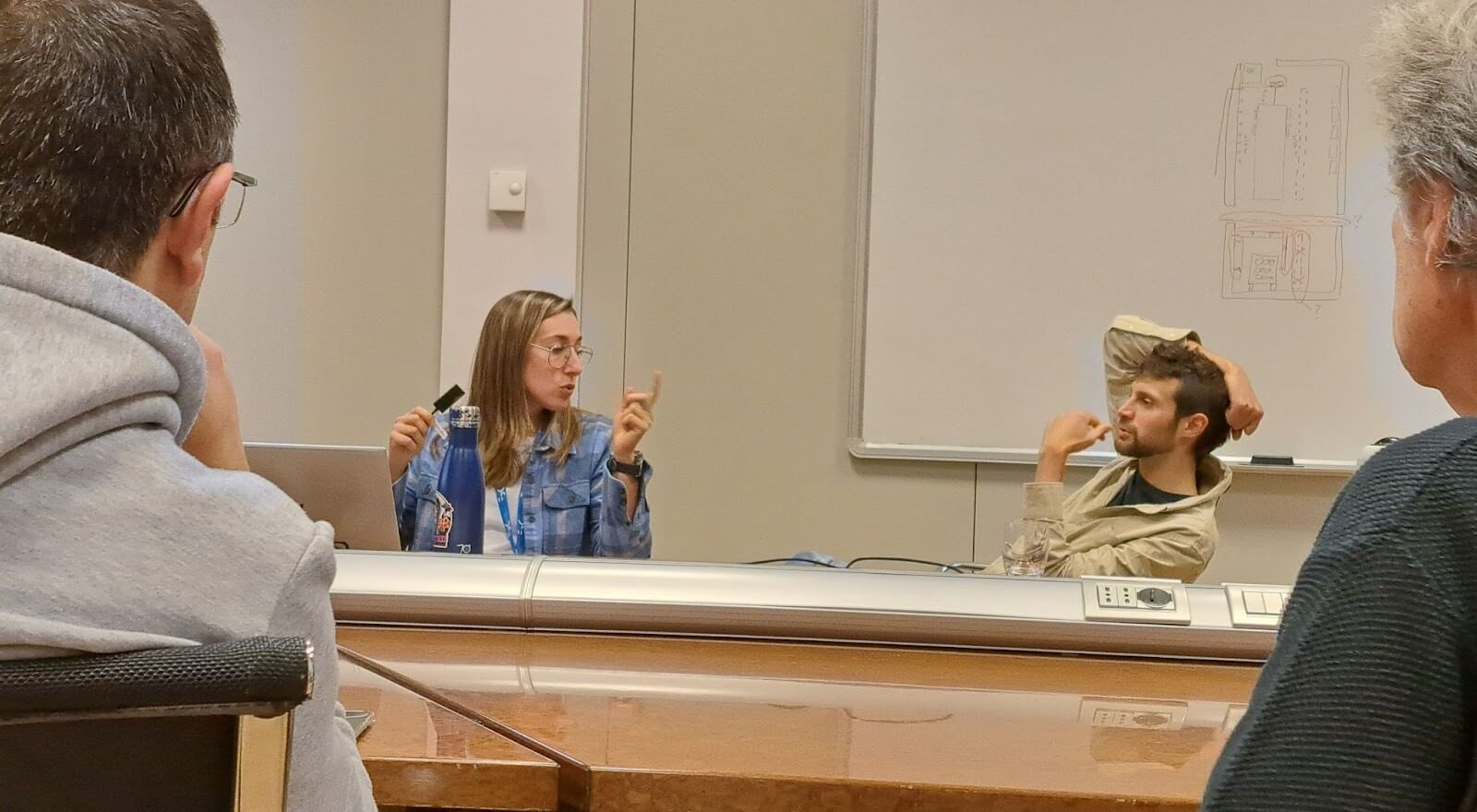
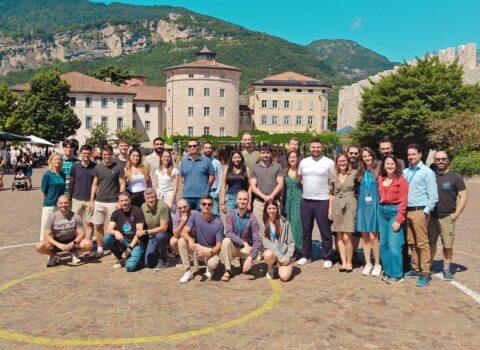
On October 8, 2025, the meetings of the Journal Club series resumed, promoted by Jacopo Dalmasson, FBK Science Ambassador. The session featured applied physics researcher Stephanie Cancelli, who shared insights from her international experience.
The Journal Club is a practice of building an academic community that thrives on informal discussions among peers, where participants can present their research findings and receive valuable feedback. This ongoing exchange fosters a continuum of sharing and critical analysis, enriched by each interaction, the observations, sensitivities, and intuitions of the participants, as well as the expertise of anyone who chooses to contribute.
The initiative has been promoted in recent months by Jacopo Dalmasson, FBK Science Ambassador, after he personally experienced it in recent years while at Stanford University for his doctoral program. The frequency may be, for example, once a month. The primary objective of this “forum” is to refine the critical analysis skills of a scientific article, offering the opportunity to read and discuss relevant scientific literature and developments. To participate in this agora of knowledge, no specific academic prerequisites are required, only curiosity for science and the desire to learn to understand specialized literature.

Low pressure,
An important characteristic is informality—the absence of judgment and a shared commitment to listen to and support others by sharing one’s perspectives, doubts, and professional experience. These meetings take place in a relaxed environment, guided by experienced scientists—such as, in this case, Richard Hall-Wilton, Director of the Center for Sensors & Devices—who serve as mentors to younger participants (doctoral students or junior researchers).
Stephanie Cancelli, the stage is yours

On October 8, the focus of the Journal Club was Stephanie Cancelli, who, in her presentation entitled ‘Neutron Detection and Related Applications at Pulsed Neutron Sources,’ discussed the latest developments in neutron research and shared her work experience, particularly at ISIS UK (Neutron and Muon Source), a world-leading research center at the STFC Rutherford Appleton Laboratory.
The neutron, much more than we imagine
Neutrons are neutral subatomic particles fundamental to nuclear physics, particularly nuclear fission and fusion, with profound geopolitical implications related to the possession of nuclear weapons and the control of energy resources. However, this association is extremely limited. In fact, the neutron is one of the most versatile and powerful tools available to modern science, with astonishing applications that are revolutionizing fields such as medicine and materials science.
Not only reactors: neutrons as a precision weapon…against cancer
In the medical field, thermal neutrons are the basis of a cutting-edge cancer therapy called Boron Neutron Capture Therapy (BNCT). The mechanism is as ingenious as it is precise: boron compounds, designed to accumulate selectively in cancer cells, are irradiated with a neutron beam. The interaction between neutrons and boron triggers the release of high-energy alpha particles, which act as micro-bombs capable of destroying diseased cells from the inside, sparing surrounding healthy tissues. Their versatility in medicine doesn’t stop there. The same unique characteristics of neutrons also enable non-destructive medical imaging techniques and the study of water content in biological tissues. A perfect example of how a fundamental particle can transform into a precision scalpel on a cellular scale. This ability of neutrons to interact so precisely with matter is not limited to medicine; it also opens the door to a world of material investigations.
Atomic detectives: how neutrons allow us to ‘see’ the invisible
Neutrons are effective investigative tools thanks to a unique combination of traits: being devoid of electric charge, they pass through matter like ghosts, reaching the hearts of atoms without being deflected. Their intrinsic magnetic moment makes them sensitive compasses, capable of mapping invisible magnetic properties. And their wavelength, comparable to the distance between atoms, makes them the perfect ruler to measure the very structure of materials on an atomic scale. However, not just any laboratory is sufficient to take advantage of these properties.
 It’s Not Garage Science: Neutron research requires colossal infrastructure
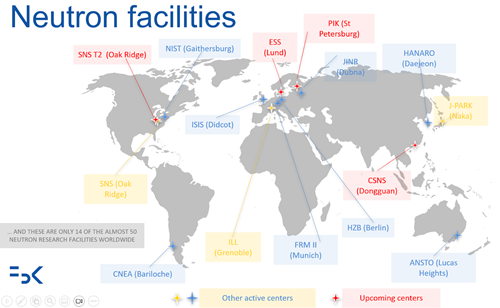
Neutron science is not something you can conduct in a small laboratory. It requires huge, complex, and expensive infrastructures, which represent real monuments to human ingenuity and international collaboration. Two examples stand out globally: the Spallation Neutron Source (SNS) in the US, a facility that provides “the world’s most intense pulsed neutron beams,” and ISIS Neutron and Muon Source in the UK.
It is precisely in centers like these that the unique properties of neutrons, described above, are exploited to provide those “unique insights into the properties of materials at the atomic scale.”
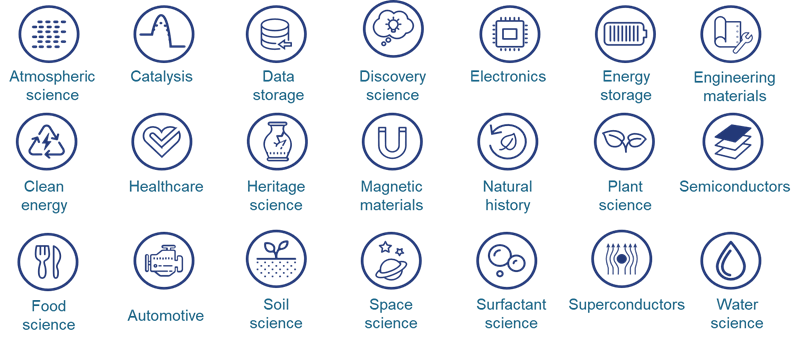
Le aree di ricerca esplorate presso ISIS UK
Research areas explored at ISIS UK
Research goes on
From cancer treatment to clean energy, through the exploration of matter, the neutron proves to be an incredibly multifaceted tool. This seemingly simple particle is already shaping our future in ways that until a few decades ago would have been unimaginable. As neutrons continue to unlock the secrets of matter and revolutionize technology, what other invisible particle could hold the key to humanity’s next great discoveries?
La bottega della ricerca | The research workshop
An important opportunity for exchange and growth for the research community of the FBK Center for Sensors & Devices, but not only that one, where knowledge and tricks of the trade learned from years of book studies as well as through countless trials and errors in the laboratory converge.
Behind the scenes of science: the ‘Journal Club’ and knowledge sharing

experiments but also through informal discussion and open sharing of ideas in a context of diversity and mutual recognition. Meetings like “Journal Clubs” are the lifeblood of this process. They provide a collaborative environment that stimulates creativity as well as the structured transmission of knowledge to new generations. Next date with the Journal Club? By the end of the year (in November or early December). Rumor has it that this time our gaze will reach toward the deepest corners of the cosmos.
Stay tuned!
The author/s
Related articles