Peering through the branches of archaeology
July 22, 2026
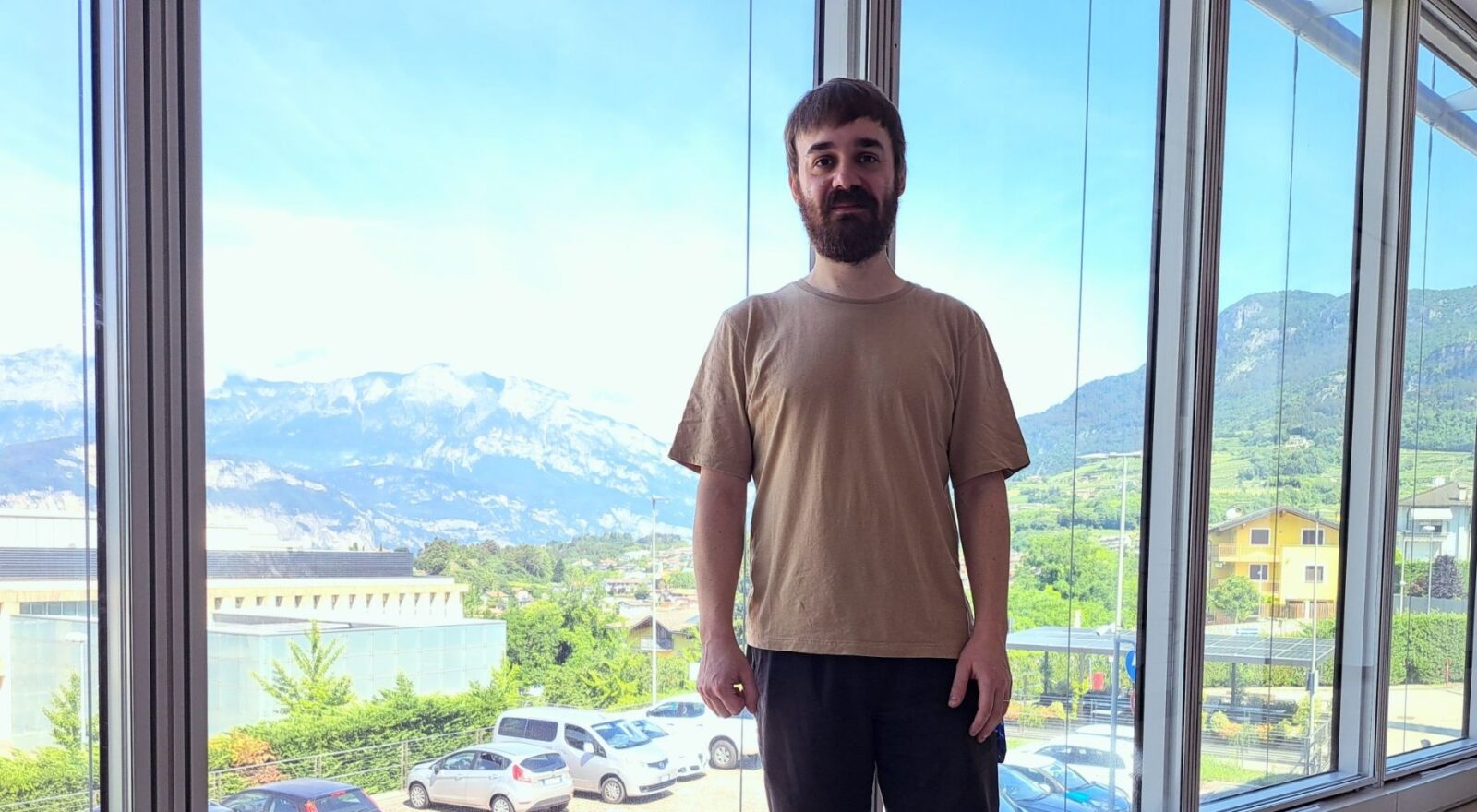
Gabriele Mazzacca is part of the 3DOM research group. He joined FBK to carry out his master's thesis in Geotechnology for Archaeology, and since 2021 has been dedicated to applying AI methods in the cultural heritage sector for the semantic segmentation of point clouds and solutions for 3D reconstruction.
Gabriele Mazzacca is part of the 3DOM research group led by Fabio Remondino.
Having joined FBK to carry out his master’s thesis at the University of Siena, since 2021 he has focused on applying AI methods to cultural heritage, particularly point cloud semantic segmentation and 3D reconstruction.
Starting from domain knowledge, AI is a tool that helps integrate information and suggest interpretive approaches, overcoming obstacles that may emerge when reading datasets related to cultural heritage.
After exploring these areas of research in greater depth during his doctorate, Mazzacca now has skills in both computer science and archaeology, which allow him, for example, to process high-resolution data (LiDAR), ensuring the highest available standards of readability and coverage for the observation and study of ancient landscapes.
The mentor
Mazzacca began his internship at FBK in 2021 under the guidance of Fabio Remondino, head of the 3DOM unit, whom he speaks of with great admiration: Remondino was an extremely present and demanding mentor, “strict but fair,” who gave him the opportunity to emerge and offered him many opportunities for growth, teaching him the importance of concrete, clearly defined work and of establishing constraints, deadlines, and responsibilities. In a nutshell, “in Remondino’s workshop,” Mazzacca learned the craft of research.
Learning by osmosis
Mazzacca explains that initially he had no expertise in the more purely technological techniques. By joining an extremely supportive and collaborative working community that helped him through every difficulty, he learned the importance of teamwork and of having a group he could rely on for help, while discovering new tools and research opportunities day after day. In this context, he was able to exchange ideas and opinions with colleagues from a variety of specializations, coming into contact with different and interesting points of view. Through ongoing exchanges, the opportunity to work in a high-level environment allowed him to develop hybrid skills.
We met him to hear his story.
Giancarlo Sciascia: Was there a turning point when you experienced a sense of difficulty but then, by interpreting it, it changed you and transformed your experience?
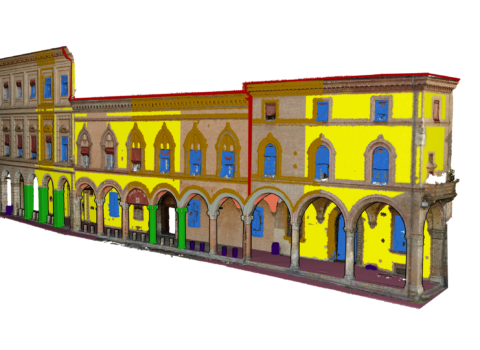
Gabriele Mazzacca: I had various experiences as a doctoral student, and I found myself collaborating on scientifically relevant projects, for example, mapping materials, construction techniques, and the state of conservation of the Colosseum, or documenting large archaeological sites hidden beneath forests. They were national projects that I would never have had the chance to contribute to without this PhD. Going to international conferences also helped me: last year I went to Korea (CIPA 2025, Seoul), where I also won the “Best Paper” award for an article on Trajan’s Column. I would say this was the crowning achievement of all my work, a great source of satisfaction.”
GS: What have you gained from these experiences, including in terms of your skills and so-called soft skills?
GM: From the conferences, I would say networking, meaning the opportunity to talk and exchange ideas with other experts in the field, as well as to create international collaborations. For me, as a private person, it was difficult at first, but then I relaxed. The same goes for public speaking: at first it scared me, then I became familiar with it and learned to feel comfortable. As for the projects, however, I was able to see how they work, especially thanks to Fabio.
I learned how to conduct myself and how to produce results in a concrete way, with an approach focused on the project’s objectives and impact. This also applies to project deadlines, which I’ve learned are very important to meet.
GS: And what about life with your other colleagues? Did you have to work on your shyness?”
GM: Yes, I can’t speak if I don’t have a solid background of expertise in the topics being discussed. I like how the work environment at FBK is a world of its own: international and full of people from different cultures. This has allowed me to gain unexpected perspectives, which I greatly appreciate, because different cultures and languages have always intrigued me. I like to see how languages influence one another and to discover the origins of words. My colleagues, on the other hand, are all very helpful, and I have always felt very comfortable in this community. There is a lot of communication, a lot of collaboration: you learn the importance of asking for help from those who are more knowledgeable in a particular area.
GS: How would you describe the relationship between archaeology and AI?
GM: AI is a useful tool for archaeology, allowing the maximum information potential to be extracted from acquired data and assisting archaeologists in interpreting the archaeological context. Although it is a great help, it should absolutely not be considered a substitute for an archaeologist’s expertise, because the interpretive component requires a very high level of expertise.
GS: Can you say a little more about the steps AI takes in providing this assistance to archaeologists, and how your work is carried out?
GM: There are three steps: acquisition, processing, and interpretation.
Data acquisition takes place through LiDAR (Light Detection and Ranging) sensors installed on drones, helicopters, or aircraft. These instruments emit up to millions of laser pulses per second that penetrate the vegetation and reach the ground below. By measuring the time it takes for each pulse to “bounce” back to the sensor, the system generates a 3D point cloud that maps both the ground surface and the vegetation profile in detail. This process is used in areas that are most difficult to capture with aerial photos, such as densely wooded areas or jungles.
Once acquisition is complete, the data processing phase begins, which is divided into two key stages: “reconstruction,” in which the 3D point cloud is generated from the information collected, and “classification,” in which vegetation points are filtered out, leaving the ground and the archaeological evidence identified by AI in the final model. Although each step is fundamental, my focus is precisely on this last phase.
Times vary depending on the size of the site. Times vary depending on the size of the site. Acquiring a small area can take one to two days, while capturing a large territory can take up to a week or more of work. Subsequent point cloud reconstruction usually takes slightly longer. Classification, on the other hand, typically takes about a week, unless you consider the previous model development and training activities, which can take months of work.
The final interpretation of the archaeological context is then up to the specialists, who usually work in a GIS environment. Archaeologists analyze the identified traces and anomalies highlighted by the prediction generated by AI, with the aim of identifying past human activities and defining their characteristics. Each step depends on the previous one, so the entire process is sequential, interconnected, and necessary.
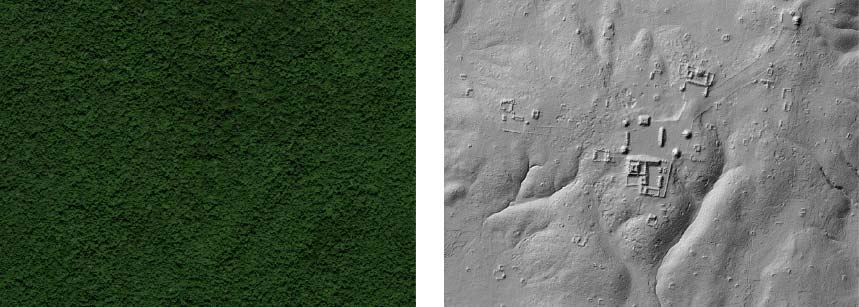
Two images of the same archaeological area located in Central America. The first is a satellite image, and the other shows the result after the vegetation has been “filtered out.”
GS: Finally, how has this journey changed you?
GM: First of all, my experience at FBK was extremely useful in gradually giving me confidence, because I found myself in a high-level environment where, however, I was provided with all the tools I needed to overcome any difficulty. I was surrounded by extremely competent people with whom I had the opportunity to exchange information every day and whom I could ask for help, thanks to whom I always understood whether I was doing my job the right way and, if so, how to improve it.
My manager was also always available and gave me both the tools for research and the opportunities to present my projects and emerge. Now that I no longer have the constraints of the doctoral program, I feel freer, and I am excited to continue the research work I started by deepening my studies in the field of AI applied to archaeology. My main desire is simply to do a good job.
GS: Simply, so to say.
—–
This article was written in collaboration with Matilda Zancanaro, a student at the “Prati” High School in Trento, as part of her school-to-work internship at FBK in June and July 2026.
The author/s
Related articles