
The AI that thinks: double international recognition for Luciano Serafini
August 20, 2026
The FBK researcher was invited to give a talk at the world’s leading scientific conference on artificial intelligence and received recognition for his pioneering contributions to neuro-symbolic AI, which combines learning from data with logical reasoning
Artificial intelligence capable not only of learning from data, but also of using rules and knowledge to reason. This is the research direction to which Luciano Serafini, Principal Researcher and head of the Data and Knowledge Management (DKM) Unit within the FBK Center for Augmented Intelligence, has dedicated the last ten years of his work.
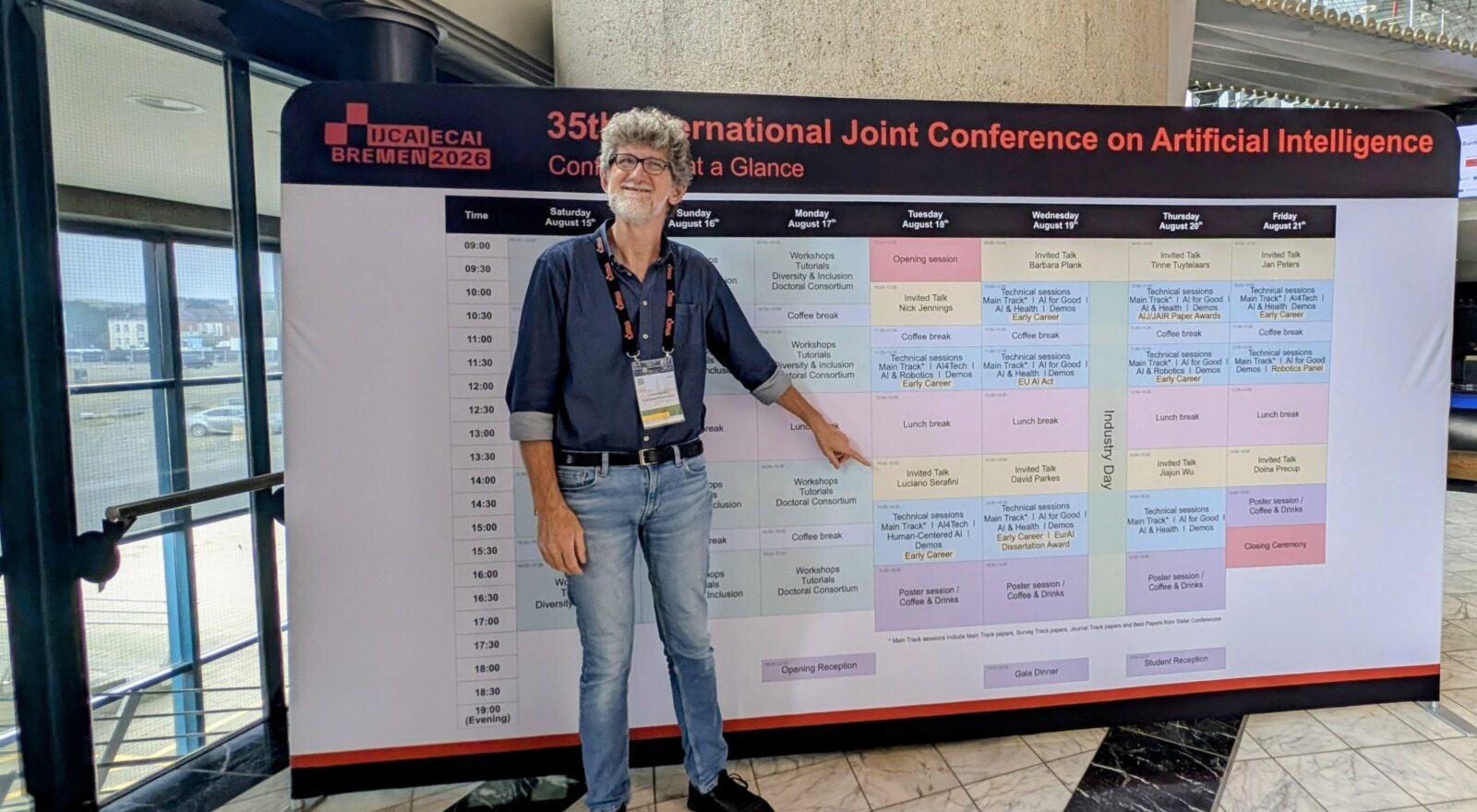
For the results he has achieved, he was invited to give a keynote lecture at IJCAI 2026 (International Joint Conference on Artificial Intelligence), the leading international scientific conference on artificial intelligence, held in Bremen from August 15 to 21. The 2026 edition brought together the international AI research community, with nearly a thousand papers presented across different research areas. Serafini delivered a keynote entitled Neuro-Symbolic AI and Logic Tensor Networks, dedicated to the integration of neural learning and symbolic reasoning and, in particular, to Logic Tensor Networks.
During the same conference, Luciano Serafini also received the prestigious AIJ Prominent Paper Award 2026, an award reserved for scientific papers that have made a lasting impact on international research in artificial intelligence. The award recognizes work that has not only advanced science, but also changed the direction of research, opening up new perspectives, inspiring entire lines of study, and helping shape the future of artificial intelligence. Serafini’s work on Logic Tensor Networks (LTN), one of the main approaches developed to integrate neural networks and logical reasoning in the field of neuro-symbolic artificial intelligence, was judged to be of this caliber.
“This double recognition awarded to Luciano Serafini takes on an even deeper meaning in an era in which investments in artificial intelligence research are measured in billions of euros and are concentrated almost exclusively in the hands of large technology companies,” Paolo Traverso, Director of Strategic Planning at FBK,noted. “Luciano Serafini is showing that there is another way.
A path based on ingenuity, scientific vision, and the courage to pursue truly cutting-edge research, rather than simply incremental advances. The courage to pursue original ideas, even when they do not follow the trends of the moment, and to invest in new directions instead of chasing the most popular ones.”
Serafini’s work therefore demonstrates that it is possible to compete in innovation without having endless amounts of data, massive computing infrastructures, or almost unlimited financial resources. It also demonstrates that progress in artificial intelligence can arise from the depth of ideas, the quality of research, and the ability to imagine new paradigms.
“Neuro-symbolic artificial intelligence arises from a fundamental scientific question: how can we integrate the ability to learn from data with the ability to reason using formalized knowledge? Neural networks and symbolic logic represent two complementary approaches, and integrating them can help develop systems that are more reliable, interpretable, and capable of addressing complex problems,”Luciano Serafini noted.
For example, a system can learn to recognize a disease by analyzing many medical images, while also taking into account existing knowledge about the disease. In this way, AI does not simply observe the data, but combines what it learns from the data with knowledge specified through rules. The neuro-symbolic artificial intelligence approach is used especially in areas where large amounts of data need to be combined with precise knowledge and clearly defined rules.
The double recognition crowns a journey that began in 2014 with research on neural networks and has included several significant milestones: in 2020, Serafini was appointed EurAI Fellow, a recognition awarded to researchers who have made significant contributions to the development of artificial intelligence in Europe. He is also an active member of the Italian Association for Artificial Intelligence (AIxIA), where he was elected to the Board of Directors. For more than thirty years, the association has been Italy’s main national reference point for the scientific community working in the field.
The author/s
-
 Luciano Serafini
Head of Data and Knowledge Management Research Unit at FBK and EURAI Fellow.
MORE INFO
Related articles