
The power behind AI
April 16, 2026
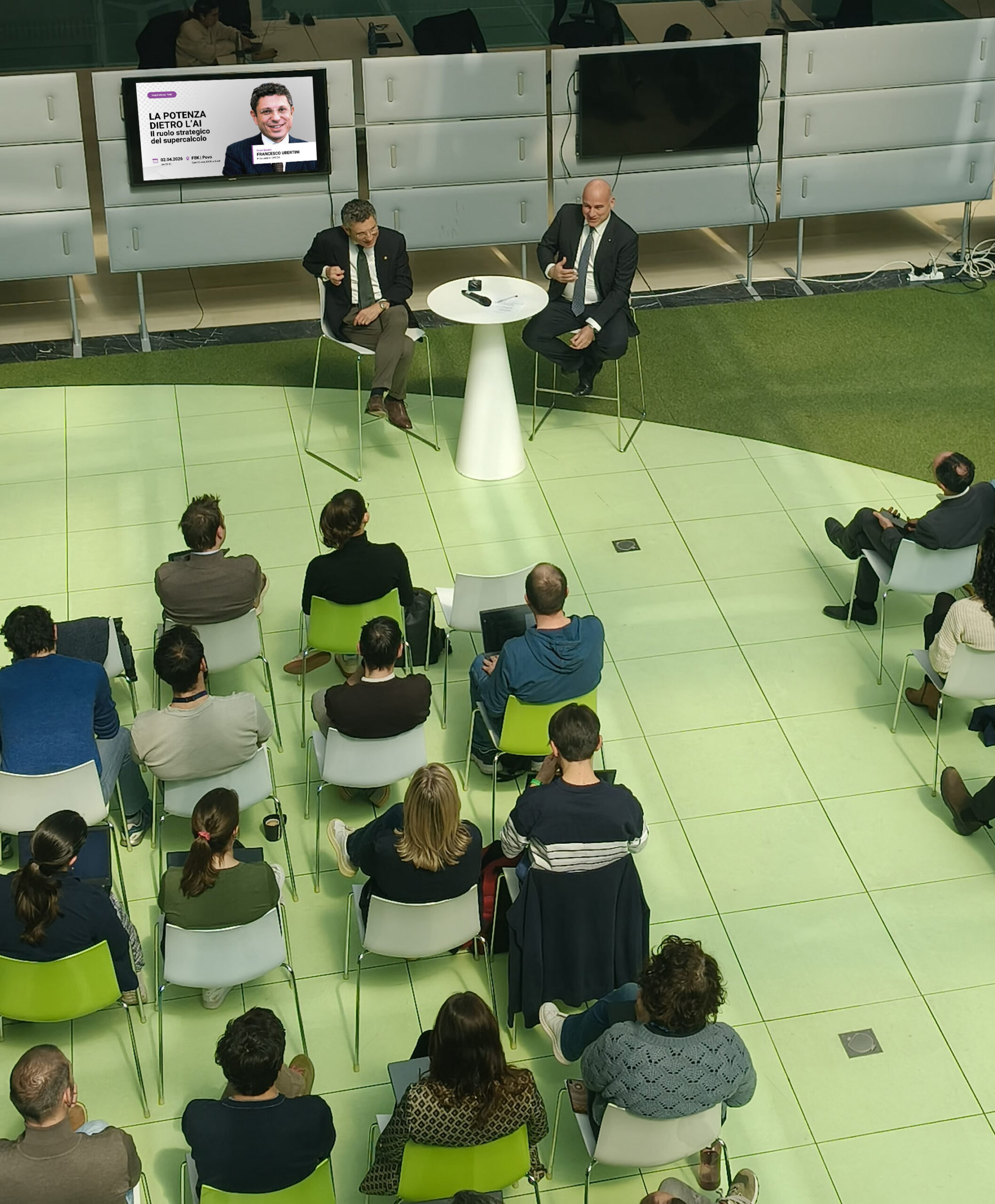
At the latest meeting of the FBK Inspirational Talks, Francesco Ubertini explored the role of HPC in European scientific and industrial competitiveness, drawing on the experience of the major supercomputing project in Bologna, developed through collaboration among universities, institutions, and Europe.
Artificial intelligence is transforming the way we produce knowledge, innovate, and make decisions. At the foundation of this revolution, however, lies an often invisible strategic infrastructure: supercomputing.
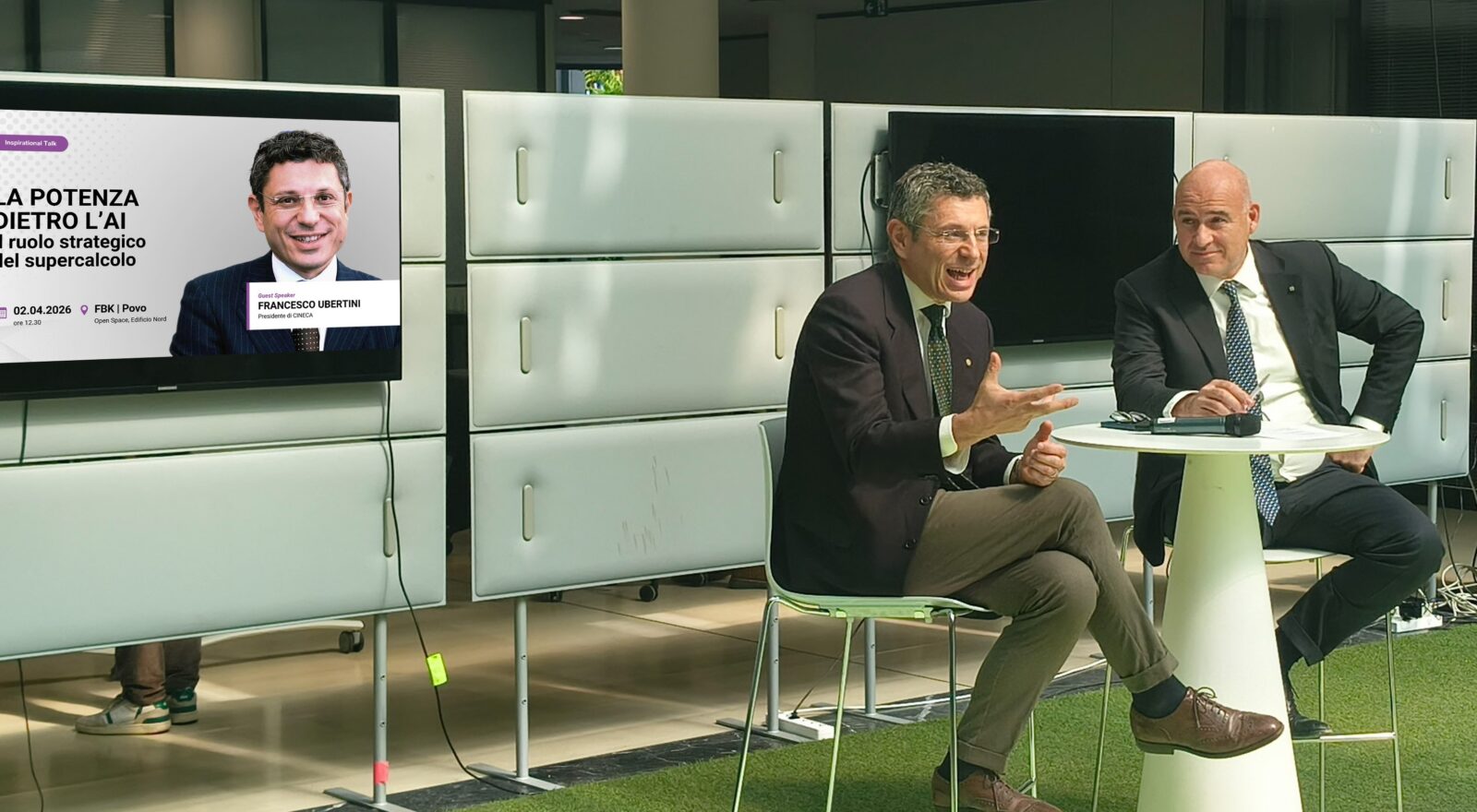
A guest of FBK for an Inspirational Talk held on Thursday, April 2, 2026, the President of Cineca combined reflections on his professional path—from engineering research to leading one of Europe’s foremost supercomputing infrastructures—with insights into the opportunities created by such systems and the impact of artificial intelligence on science, industry, and society.
The story of Francesco Ubertini, in conversation with President Ferruccio Resta, begins with an anecdote from about a decade ago. As the newly appointed President of the University of Bologna, he was tasked with reimagining the former manufacturing site in Bologna, a “vacuum to be filled” broadly intended to become a hub for innovation.
Faced with this blank slate, the idea was to interpret emerging trends—particularly the growing importance of data—and to build a cohesive system.
Several organizations were already rooted in Bologna, including CINECA, which has operated supercomputers since the late 1960s, along with other infrastructure.
From a city challenge to an opportunity for Europe
In hindsight, concentrating all this potential in one place proved to be a decisive competitive advantage, opening up unprecedented opportunities.
At the same time, the major transformation of society that we are now experiencing was already underway.
The key move—seemingly indirect—was Italy’s candidacy, along with the Bologna Technopole site, to host the data center of the European Centre for Medium-Range Weather Forecasts (now ECMWF Bologna).
“Years before the hype around AI,” Ubertini notes, “we didn’t start from scratch—we built on existing strengths.”
Following that initial step, a proposal to host the Leonardo supercomputer was submitted to European authorities.
To host it, an entire Tecnopolo structure was renovated and repurposed as a data center.
To grasp the scale of the challenge: Leonardo is ten times larger than any system CINECA had managed in the previous 50 years. The decision was far from obvious, and doubts—“Will we be able to fully utilize it?”—were inevitable.
Soon after, global acceleration unfolded as we now know it, and the many opportunities that followed were made possible by that bold decision, which has since mobilized around one billion euros in public investment.
These investments have opened national and European innovation pathways, offering the Tecnopolo di Bologna as a hub for research and industry.
A crucial factor in this process was a political decision that united rather than divided.
A few facts and figures
Leonardo is estimated to account for about 6% of the world’s computing power today.
For solving linear problems, it can perform 250 million billion operations per second (250,000,000,000,000,000).
To put it another way: one hour of Leonardo’s work is equivalent to 920 years of work on a standard laptop like the one used to type this text.
Similarly, training systems such as GPT-4 could be completed on Leonardo in approximately three to four months.
Leonardo’s research and innovation infrastructure operates at full capacity, with users from across Europe on waiting lists.
According to real-time data, 98.7% of resources were in use, with 3,915 jobs running, 1,400 queued, and 455 users logged in.
Initially, business demand was limited—the first industrial user was Mistral AI—and usage was dominated by physicists, computational chemists, and biotech researchers.
Today, the number of companies accessing the system is growing, with model training—especially for large models—among the most frequent tasks.
Currently, business users account for 15% of Leonardo’s capacity.
Current challenges
Ubertini highlighted a broader challenge: “There is a need to bridge the current gap. To improve service quality, intermediary organizations—such as FBK—must play a role, interacting both with the Leonardo infrastructure and with the needs of companies and public administrations.”
Alongside this call for collaboration, he urged national institutions: “Our country cannot afford to take the position of a passive consumer.” Approaching exponential technologies in this way risks becoming “a medicine that harms rather than heals.
We cannot give up being partners in the technology value chain.”
So, while the call is to avoid becoming completely dependent and to quickly build a vision of European technological sovereignty—in order to fully realize the benefits of innovation—it is important,” Ubertini adds, “to integrate these technologies into businesses, their production processes, and their factories.” “This is something we excel at,” Ubertini adds: using high-potential technologies and specializing them in areas where we can achieve excellence. The example of the automotive district—known as the Motor Valley—is recognized worldwide: we are outstanding technology integrators with refined customization capabilities.
Special features
In conversation with FBK President Resta, Ubertini also reflected on the most challenging moments of his career, particularly at the beginning, when during the second year of his doctorate he had not yet published any work.
It was a slow learning process that put him through a difficult test, helping him understand the balance between risk and impatience—a crucial skill, especially when investing in oneself. Overcoming that phase eventually led him to become the youngest President of the University of Bologna. Curiosity, he emphasized, remains a key resource for anyone engaged in research.
Evolution: CINECA as an enabling infrastructure in dialogue with distributed nodes
Alongside the central Bologna hub, a node in Naples is already active, and CINECA is working on additional nodes in Rome and Milan. Soon—Ubertini promises—a node will also be established in Trentino.
A significant technological gap has emerged: the transition from pre-production HPC systems to an AI cloud supermachine.
Three technological lines now coexist, each extremely costly and operating simultaneously. It will also be essential to monitor how European policies evolve around gigafactories and to develop European AI cloud providers as a guarantee of true independence. “The only way to make an impact,” Ubertini reiterates, “is to build a network for developing and delivering innovation that permeates the production ecosystem broadly. The ideal model is one in which CINECA does not interact directly with companies; to scale effectively, it requires an intermediate layer—organizations like FBK—that can bridge infrastructure and businesses or public administrations.”
—————
Francesco Ubertini is President of CINECA and former President of the University of Bologna (2015–2021). A full professor of Construction Science, he conducts research in computational mechanics.
He is also President of the IFAB Foundation, Vice President of the ICSC National Centre on HPC, Big Data and Quantum Computing, and a member of several scientific and institutional bodies, including the Scientific Committee of Nomisma.
The author/s
-
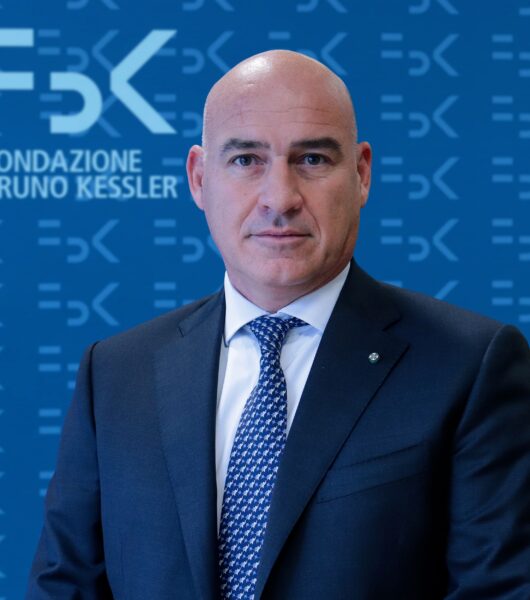 Ferruccio Resta
FBK President, appointed on April 28, 2023
MORE INFO
Related articles