
You can say it, you can do it
June 4, 2026
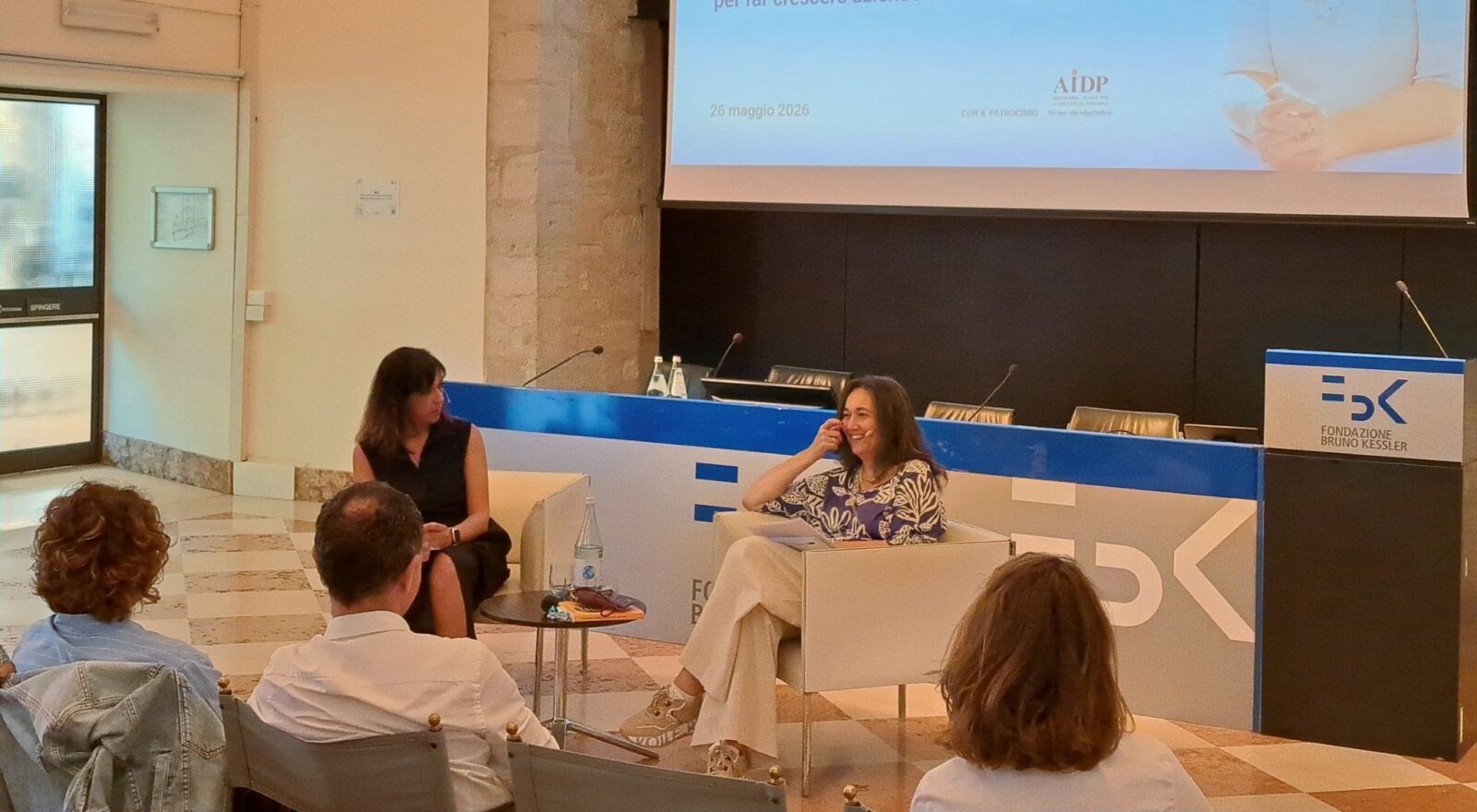
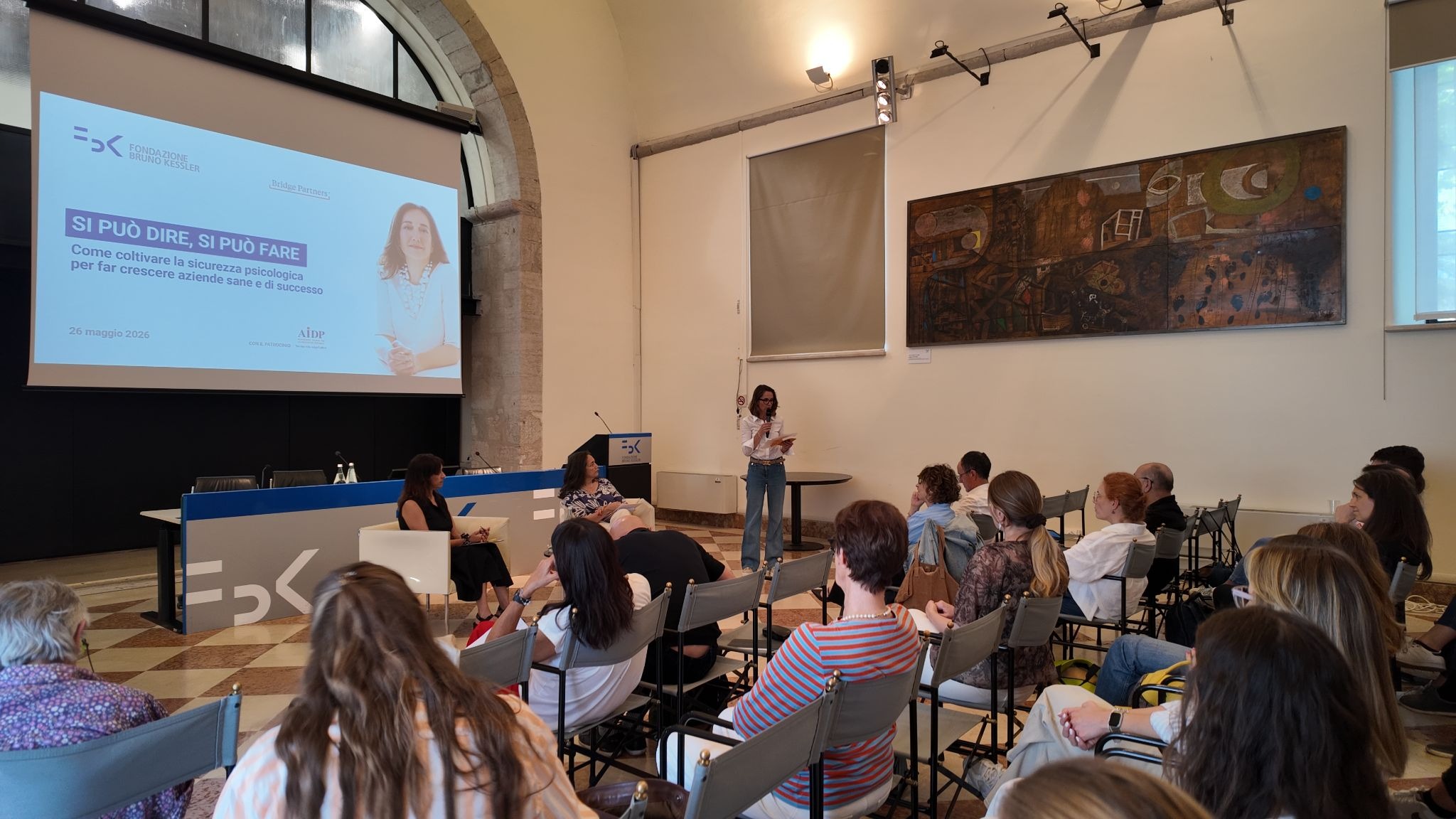
On May 26, 2026, FBK welcomed Alessandra Colonna, CEO of Bridge Partners® and a member of the Board of Directors of Fondazione Telethon. In conversation with Annalisa Morsella—trainer, counselor, and organizational consultant—she explored the topic of psychological safety and its role in building healthy, high-performing organizations.
What is psychological safety—and why does it matter
Psychological safety is the essential foundation of both individual well-being and organizational effectiveness. When it is absent, silence, conformity, and disengagement tend to prevail, with direct consequences for decision-making, innovation, and organizational health.
Some of the most significant economic, scientific, and human disasters in history—from the collapse of Lehman Brothers, which triggered the worst financial crisis since 1929, to the loss of the Space Shuttle Columbia—have been linked to environments where psychological safety was lacking. In such settings, people who identified problems were ignored, or felt it was safer to remain silent than to speak up.
Through stories, practical examples, and accessible language, Colonna illustrated how to recognize the individual and collective behaviors that either foster or undermine psychological safety, highlighting the role each of us can play in creating environments based on dialogue, trust, and mutual respect.
Why do we stay silent? At the heart of Colonna’s talk was a simple but powerful idea: organizational silence is not a moral failing—it is a rational human response. We are not silent because we are cowards. We are silent because our minds constantly weigh costs and benefits (effectiveness). Silence is often a survival strategy.”
When emotions take over, our instinct is often either to withdraw into silence or react aggressively. Learning to recognize and manage these reactions is a crucial skill—one that underpins conflict management, negotiation, trust-building, and effective leadership in complex professional environments.
Not all silence is the same
Colonna identified four forms of organizational silence: defensive silence (driven by fear of retaliation or negative consequences), acquiescent silence (rooted in resignation and the belief that speaking up will make no difference), prosocial silence (motivated by the desire to protect colleagues or the organization), suspicious silence (stemming from insecurity or a lack of confidence in one’s expertise).
What do the Andon Cord and the L’Aquila earthquake have in common?
People respond to the incentives and penalties systems. The Toyota case study is considered inspirational because it reveals and reverses the false opposition between error and performance. The company’s famous Andon cord gives every worker the authority to stop the production line if they notice—even suspect—a quality issue. By empowering employees to raise concerns, Toyota recognizes the value of distributed knowledge. The message is clear: thank you for stopping production. Paradoxically, this willingness to surface problems has been one of the foundations of the Japanese company.
People don’t just respond to facts – they also respond to the system of incentives and penalties that surrounds them. A few days before April 6, 2009, in Sulmona, a eismic tremor was interpreted, in hindsight, as a possible reminder of the tragedy of L’Aquila. Those who had reported that first phenomenon were reported as a cause for alarm. The implicit lesson was powerful: speaking up—even out of caution—could carry significant personal costs. As a result, subsequent warning signs were handled with extreme caution and, effectively, silenced. Not because there was no awareness of the risk, but because the incentive structure favored silence over raising concerns. Psychological safety means creating environments where people are not forced to choose between acting responsibly and protecting themselves from negative consequences.
The water we swim in
Psychological safety involves more than the absence of fear. It is the perception that one belongs to an environment—whether at work or in the family—where constructive dialogue is possible and where people can learn from the consequences of the positions they take. This is particularly important in research and innovation, where progress depends on challenging assumptions, asking difficult questions, and testing ideas until stronger evidence emerges.
Relationships matter
Psychological safety is built through everyday interactions. Two conditions are especially important: nonjudgmental dialogue, where leaders encourage questions and treat disagreement as an opportunity for learning; inclusion, ensuring that all voices are heard and valued, particularly those of quieter team members.
The human cost of silence can be immense. Although communication is often labeled a “soft skill,” its impact is anything but soft. Dysfunctional relationships can damage both individual well-being and organizational performance, often with remarkable speed.
Shared responsibility
The pool of shared meaning is a communication concept that describes a collective understanding that develops during a dialogue when all participants openly and safely share their opinions, feelings, and experiences, thereby creating a foundation of mutual understanding that leads to better, well-informed decisions. Creating appropriate relational settings for dialogue is therefore of the utmost importance; establishing a space where people can express themselves and understand one another without judgment is a key factor in fostering meaningful conversations. A responsibility that involves everyone, regardless of rank. We are also responsible for the psychological safety of others.
A wonderful failure
One of the most memorable stories shared during the conversation concerned the making of the animated film Ratatouille. The project did not begin as a success.
An early version was rejected outright. What helped transform it was Pixar’s famous Braintrust process: a structured, interdisciplinary discussion in which people with diverse perspectives provide candid feedback, criticism, and suggestions. The director remains free to decide what to do with that feedback, but the process creates a space where constructive disagreement can improve ideas. In psychologically safe environments, even failure can become a catalyst for excellence. In contexts that allow for structured conflict, even failure can be turned around.
Winning Synergy
In the knowledge economy, where complex challenges require broad participation and collective intelligence, feeling free to express ideas and concerns without fear of reprisal has become a competitive advantage for businesses. In the nonlinear and unpredictable BANI environment, critical thinking and problem-solving skills are essential. Organizations that foster psychological safety are better positioned to prevent burnout, improve performance, and retain talent. Colonna cited the example of Satya Nadella, who reportedly included the ability to acknowledge mistakes among performance evaluation criteria at Microsoft. During his tenure, thanks in part to these measures, the company experienced significant growth.
The FBKcare model
Corporate welfare initiatives can only be effective if they exist within a psychologically safe environment. Offering psychological support services has limited value if vulnerability remains stigmatized or if healthy work-life balance is not genuinely supported. FBK’s FBKcare program reflects this integrated approach.
Through welfare initiatives, flexible working arrangements, and goal-oriented work practices, FBK seeks to support employees throughout every stage of their personal and professional lives. FBKcare is an integrated welfare system designed to support and guide employees through every stage of their personal and professional lives, celebrating diversity and fostering an inclusive and collaborative environment through a wide range of services and benefits. It is not merely a set of measures focused on individual well-being, but an investment aimed at fostering motivation, productivity, and quality of life.
A system that directly contributes to the Foundation’s ability to attract new talent, support their growth, and foster an inclusive work environment that is mindful of and responsive to diverse needs.
The author/s
Related articles