
Cicatrici | Scars
November 4, 2025
An inter-center project exploring key sites in Trento to reconstruct the city’s multiple identities — between continuity and rupture.
Scars form when the deeper layers of the skin are affected. In FBK’s CICATRICI (SCARS) project — carried out by the Center for Religious Studies in collaboration with the Italian-German Historical Institute (ISIG) and the 3D Optical Metrology Unit (3DOM), under the scientific supervision of the Department of Humanistic Studies at Roma Tre University and with the support of Fondazione CARITRO — this metaphor was used to explore the urban fabric of Trento and its “signs”. By examining key places in the city’s history, memory, and identity, the project identified events and processes that have produced change, rupture, or wounds — sometimes superficial, sometimes deep — connected to specific sites. It also investigated how these transformations were processed or “regenerated” over time.
The project is part of the Center for Religious Studies’ research line “The Spaces of Religions and Spiritualities,” which studies religious and secular spatiality and develops analytical categories to understand how societies change. Space, in fact, is not merely the backdrop or product of social life, but an element that enables and guides it. Studying the many spatial and material dimensions of Trento is therefore both a way to understand its past and an exercise in reflecting on its future — a city increasingly shaped by mobility and globalization, which are redefining its traditional identity as an “Alpine city.”
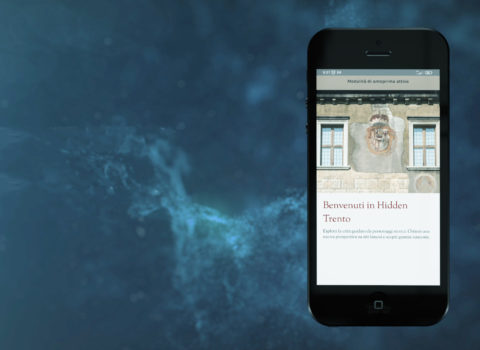
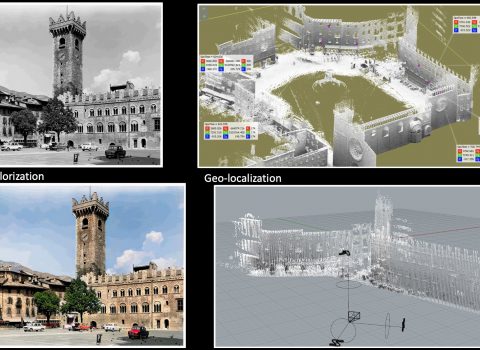
At FBK, this research relied on an interdisciplinary approach, a defining feature of studies on social spaces. Based on dialogue and collaboration between centers and units with diverse expertise, CICATRICI combined sociological, religious, and historical sciences with geomatics and digital humanities. Each participating center also contributed its own prior research experience rooted in the Trentino Region and the city of Trento. These include the Center for Religious Studies’ mapping of minority religions in the region (Guglielmi, 2021) and the exploration of spaces for worship and possible multi-religious sites (the TESEO project); ISIG’s insights into Trento’s urban history through the PUblic REnaissance and Hidden Trento public history projects; and 3DOM’s multitemporal 3D reconstructions tracing the city’s expansion and urban transformations over the past 150 years (the Totem project).
But which places did our exploration focus on? Through historical research and the creation of a StoryMap — one of the most innovative digital storytelling tools that combines geolocation with images and texts — we mapped significant sites and cases based on three identity dimensions central to the city: religious, historical-political, and urban/regional. For each, we developed a case study through qualitative sociological research, including interviews with witnesses and residents.
The religious dimension, in a city famously known as “the city of the Council,” remains central. Here, changes have affected communities and minority groups, taking shape in both old and new spaces: from the former Synagogue — tied to the persecution and dispersion of the Jewish community — to new places of worship such as the Tenryuzanji Buddhist Temple, now a well-established presence in Valle dei Mulini. The temple was established in the mid-2000s by converting two farmhouses in the municipality of Cinte Tesino — a “reconstructive scar,” where the wound caused by abandonment was “sutured” through a new religious function. Within the historical-political dimension, our analysis focused particularly on the Church of San Marco Evangelista, a former Catholic church once granted to the German community and now home to a Christian Orthodox parish. This transition, experienced “on tiptoe” by the Romanian Orthodox community, reflects a perception of the place not so much as a “home,” but as a “host space.”
As for the historical-political dimension, we examined transformations in the space linked to the experience of the great wars and the Fascist era — processes that the city has long been working to understand and reinterpret. Our case study centered on the Palazzo delle Poste, built during the Fascist period to replace a Habsburg building that itself had stood on the remains of a Renaissance building. Today, the site is undergoing a project of functional rethinking. This sequence of transitions, rather than marking a single wound, appears to have led to a gradual “atrophy” of the space — perceived by many citizens as an “alien body” within the city.
Lastly, as for the urban/regional dimension, in exploring the marks of urban development within Trento’s Alpine context, we considered the historical traces of the city’s boundaries and the ancient riverbed, as well as recent urban projects affecting social and environmental dynamics. Our focus turned to the area of the former Michelin factory, closed in 1978 after more than thirty years of activity. Today, the site is home to the Le Albere residential complex, designed by the renowned architect Renzo Piano. The study examined the social implications of the absence of tangible and intangible traces of the factory’s life and the experiences of its workers.
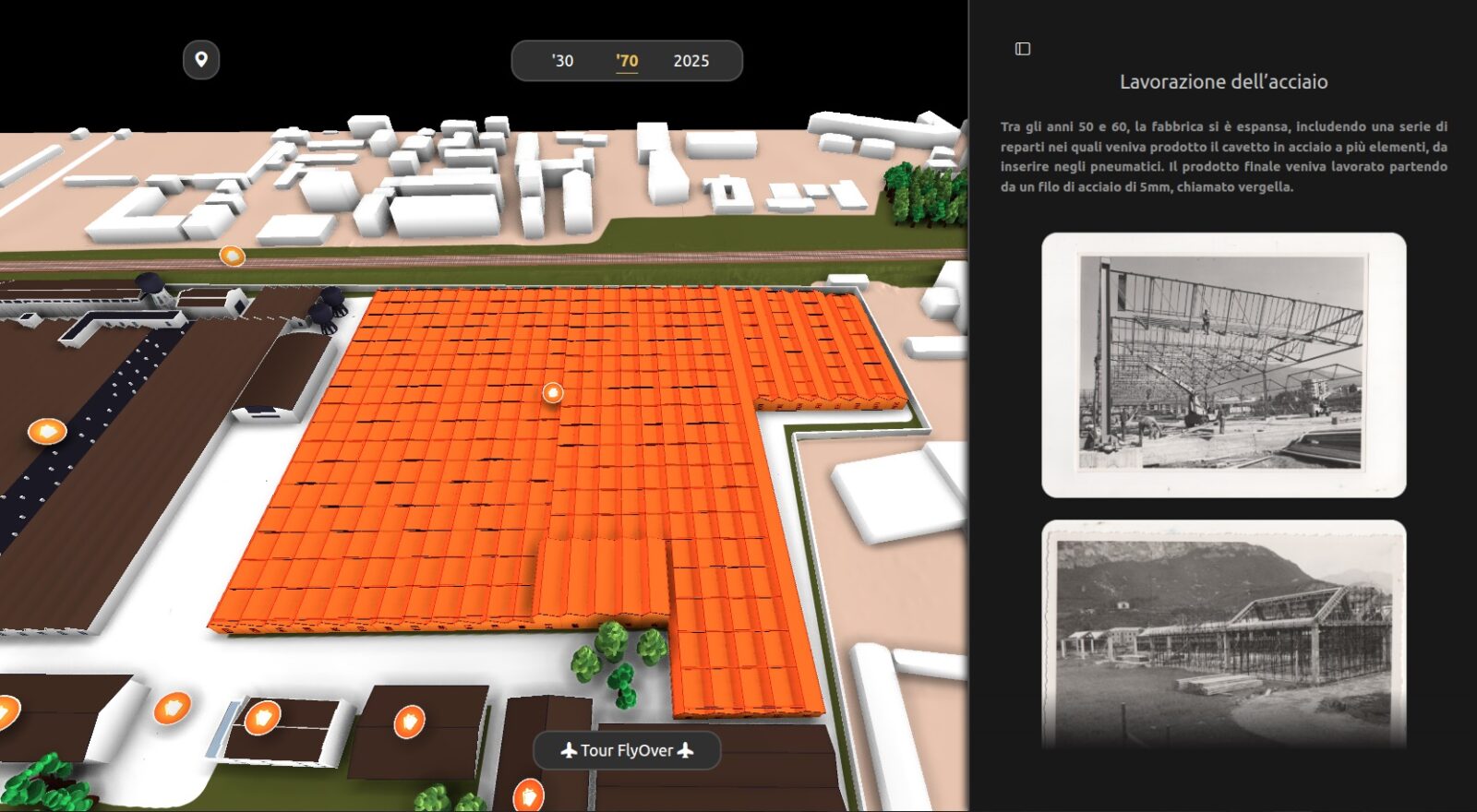
Starting from this observed “void” — only recently addressed by a few valuable artistic projects — the CICATRICI team decided to use the former Michelin site as a case study to create a digital model supporting the collective processing of this key chapter in Trento’s social and industrial history. The resulting digital product, available on the project website, combines a 3D reconstruction of the factory’s transformation from the 1930s to today with access to a digital archive of images previously held exclusively by the Anziani Michelin Group (GAMI) of Trento. Flying over the reconstruction and moving the cursor across points of the factory opens historical photos accompanied by descriptions of the context and related activities.
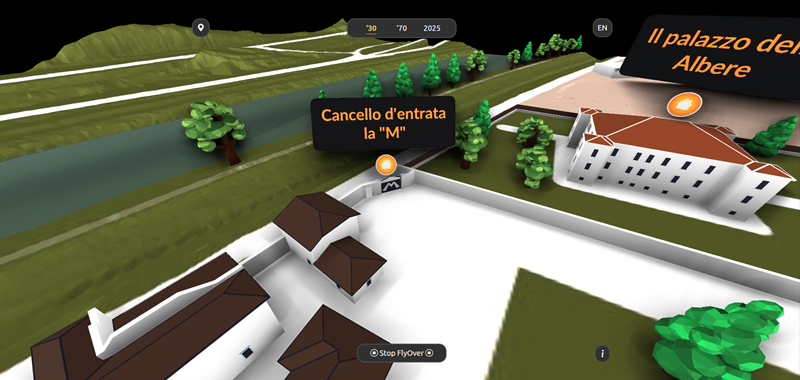
The iconic entrance gate reappears, marked with its embossed “M,” the symbol of the factory, along with the first cotton mill, where — beginning in the 1930s — cotton textile reinforcements were produced, later replaced by synthetic materials for tire carcasses. Also visible are the many workers once drawn from valleys across the province, portrayed inside the women’s dormitory that, in the early 1970s, became the headquarters of the Michelin Sports Group. Exploring this space also brings to light the bowling, tennis, basketball, and handball teams — with strong female participation — that competed successfully at the national level. Reemerging, too, are images illustrating the complex relationship between the factory and the city: Michelin floats parading in the 1930s Grape Festival — a form of civic involvement shaped by the Fascist era — alongside collective events such as Total Quality Day (1994) and Games Without Borders (1998).
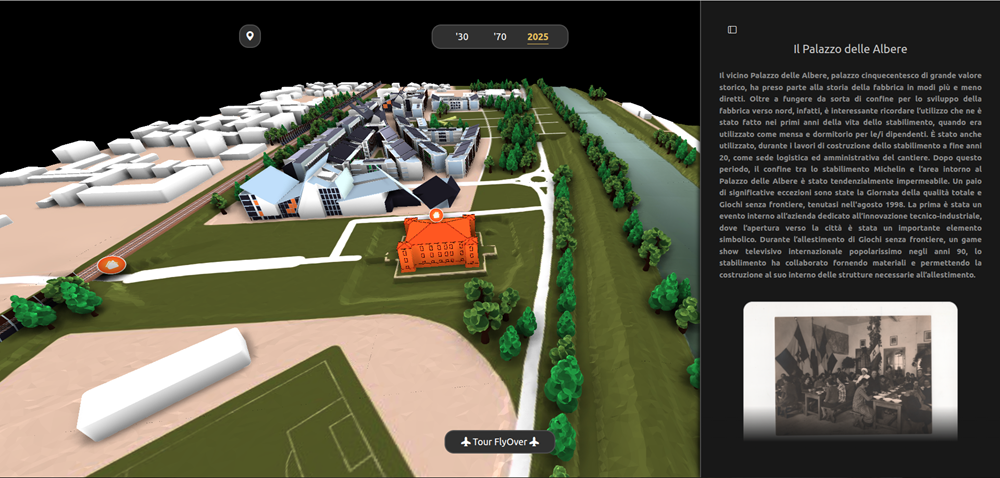
With CICATRICI, Trento’s social and industrial history comes alive once again — at least in part — in digital form. It is offered not only to those who lived it firsthand, but also to citizens of Trento (and beyond) seeking tangible and intangible traces of the connection between the city’s past, present, and future.
The images provided by GAMI, to whom we extend our sincere thanks, are used solely for the purposes of this project and for their historical value, in accordance with current data protection regulations.
The author/s
Related articles