1525, uprising in Trentino: between fear, hope and violence
January 29, 2026
The 500th anniversary of the peasant uprisings of 1525 offers an opportunity to revisit the history of Trentino and reflect on the impact these events had on society at the time.
The 500th anniversary of the peasant uprisings offers an opportunity to revisit the history of the area. In this context, the Fondazione Bruno Kessler – Italian-German Historical Institute has launched a collaboration with the MUSE – Trento Science Museum, the association Studi Trentini di Scienze Storiche, the Accademia Roveretana degli Agiati and the association Storia e Regione/Geschichte und Region to organize the international conference “1525. Rivolte. Società. Ambiente” (Uprisings. Society. Environment), held on November 27 and 28, 2025. The initiative is part of the activities of Euregio Anno dei Musei 2025 / Euregio Museum Jahr 2025 and features the exhibition promoted by MUSE, “The Power of Machines: Humanity, Environment, Technology in 16th-Century Trentino.” Conceived by Luca Ciancio, the exhibit is hosted at Palazzo delle Albere from November 22, 2025, to May 31, 2026. It is accompanied by a catalogue that includes an essay by Katia Occhi dedicated to unrest in Trentino.
From here, we can retrace a phenomenon long described by historiography as the peasant wars and now more accurately referred to as the “revolts of the common people,” a term used by historian Peter Blickle. These uprisings combined religious impulses inspired by the Gospel with political and social demands, giving rise to a movement that extended well beyond the peasantry alone. City dwellers, miners, and men and women from various imperial territories took part, united by growing discontent in which economic, political, and religious motivations overlapped.
In the princely County of Tyrol—which included parts of southern and eastern Trentino, about 30 percent of today’s province—the rapid expansion of mining at the end of the fifteenth century profoundly altered the relationship between peasants and the land. The arrival of foreign entrepreneurs and the progressive erosion of communal rights, fueled new tensions. In many areas, forests, pastures, rivers, and hunting grounds were reserved for direct exploitation by the Prince. These limitations weighed heavily on rural communities, while other groups also protested the exploitation of local resources by outside companies. Added to this were fiscal pressures linked to the reorganization of tax collection, judicial reforms, and the introduction of Roman law in place of local customs. This strengthening of central authority became even more pronounced after 1523, when Archduke Ferdinand I of Habsburg established a permanent residence in the province.
The rebels envisioned a society based on fraternity and mutual obligation, in contrast to the hierarchical logic of lords and servants. It was a predominantly male model, sustained by solidarity among armed peasants, although women were also present among the insurgents. At the core of their demands was a deep desire for change: the rejection of a society divided into rigid groups—nobility, clergy, cities, and peasants—and the call for collective management of natural resources, in keeping with God’s creation.
During the winter of 1524–1525, the conditions for revolt also took shape in Tyrol. May 9, 1525—the day of the public execution of Peter Passler—symbolically marked the beginning of the uprisings in the region. The revolt quickly spread south of the Alps: the homes of the canons of Bressanone and numerous convents and religious institutions were looted, including Stams, Wilten, Marienberg, Sonnenburg, Gries, Renon, Silandro, and Vipiteno, as well as the headquarters of the Teutonic Order in Bolzano and Lana and the abbey of Novacella. Peasants from the Burgraviato (the district of Merano) also took part in the attacks. Popular anger was directed not at the prince himself, but at the Church, the nobility, and princely officials, who were seen as responsible for social and economic injustice.
Discontent had also been building in Trentino for some time. When, in the winter of 1525, the Bauernkrieg reached the southern fringes of the Holy Roman Empire, tensions and hopes for evangelical renewal were rekindled within the bishopric. Archival sources from the episcopal principality of Trent for the years 1504–1524 point to a steady deterioration of rural living conditions, worsened by rising taxes and repeated demands for contributions, including to finance the wars of Maximilian I of Habsburg. Military taxes in particular drove many peasants into debt, often forcing them to take out heavy loans and ultimately lose free possession of their land.
During the rule of Bishop Bernardo Cles, protests intensified, especially against new customs duties, the closure of traditional transit routes, and the often arbitrary extension of customs obligations to low-value goods and basic necessities. Between May and June 1525, revolts broke out in the Noce valleys, Levico, and Castel Ivano in Valsugana, then quickly spread to many other areas of Trentino. These events are well documented in Giambattista Sardagna’s La guerra rustica nel Trentino. 1525, published in Venice in 1889, which reconstructs the days of unrest in great detail. We know that starting from May 8, 1525 a group of men from Cortaccia and Magré moved towards Mezzocorona to promote a coordinated action of the communities of the bishopric, coinciding with the revolts already underway in southern Tyrol.
A second outbreak occurred on May 15–16 in upper Val di Non, involving the lands of the parish church of Senale and the jurisdiction of Castelfondo, and soon spread to Val di Sole as well. For the Trentino insurgents, Ferdinand I of Habsburg was the only legitimate authority to whom they would appeal, while the bishop of Trent was viewed as his subordinate. As a result, the idea gained ground of abolishing the temporal power of the prince-bishop and uniting the Trentino valleys under the sovereignty of the Count of Tyrol.
Archival sources reveal two distinct strands within the movement, particularly in Val di Non: one more cautious and loyalist, and another more radical, responsible for looting and violence against local lords. At the same time, news of devastation in Bolzano, Merano, Vipiteno, Bressanone, and Novacella heightened tensions within the bishopric. When the unrest reached Appiano, Caldaro, and Termeno—just a few kilometers from Trento—panic spread among the city’s elites. On May 16, Bernardo Cles fled to the fortress of Riva del Garda, while the Cathedral Chapter sought refuge in Verona.
In the city, members of the popular classes and the German-speaking community sought to take control of the urban government, establishing a Council of Sixteen composed of four representatives from each district. However, the body’s growing radicalization led the wealthiest citizens to scale back their involvement, and within a few weeks the authority of the consuls and military lieutenants was restored. By May 28, the uprising in the city had been suppressed.
Historiography identifies the choice of the city of Trento as a turning point in the entire insurrectionary cycle: once on the borders of Italy, the great German communal revolt reached its southern limit and came to a halt.
On the other hand, the climate in the county was different. On May 30, against the will of Ferdinand I, a peasant diet met spontaneously in Merano with representatives from all the South Tyrolean and Trentino valleys. The objective was the drafting of a shared document, the so-called 64 Merano articles, which summarized the main demands of the country and proposed a new order for Tyrol.
Despite the prince’s ban, almost all the South Tyrolean and Trentino courts participated in the assembly. A complex work of mediation followed to reconcile often divergent demands. Ferdinand I initially maintained a wait-and-see attitude but, on June 27, he declared that he had no authority to approve the insurgents’ demands, making it clear that decisions in political matters were up to the emperor and religious ones to the pontiff. It was then evident that the Archduke did not intend to support the Reformation in his territories.
After the failure of the last siege of Trento August 29-31, 1525, promoted by some groups of rebels from the valleys, the revolt entered its final phase. Ill-armed and uncoordinated, the insurgents were driven back by city forces. With the arrival of Tyrolean troops in the second week of September, the definitive repression began. Members of the peasant leagues were required to dissolve all forms of organization, return looted goods, and pay back taxes. The most severe punishments hit the leaders of the revolt: between September and December 1525 there were trials and convictions that left a long trail of blood, marking the violent conclusion of one of the most significant attempts at social transformation of the early 16th century in Tyrol and Europe.
Read more:
Katia Occhi, La guerra contadina a sud delle Alpi: i focolai trentini, in L. Ciancio – M. Avanzini (publ.), Il potere delle macchine: umanità, ambiente, tecnologia nel Trentino del Cinquecento, Museo delle Scienze, Muse, 2025, pages 101-113.
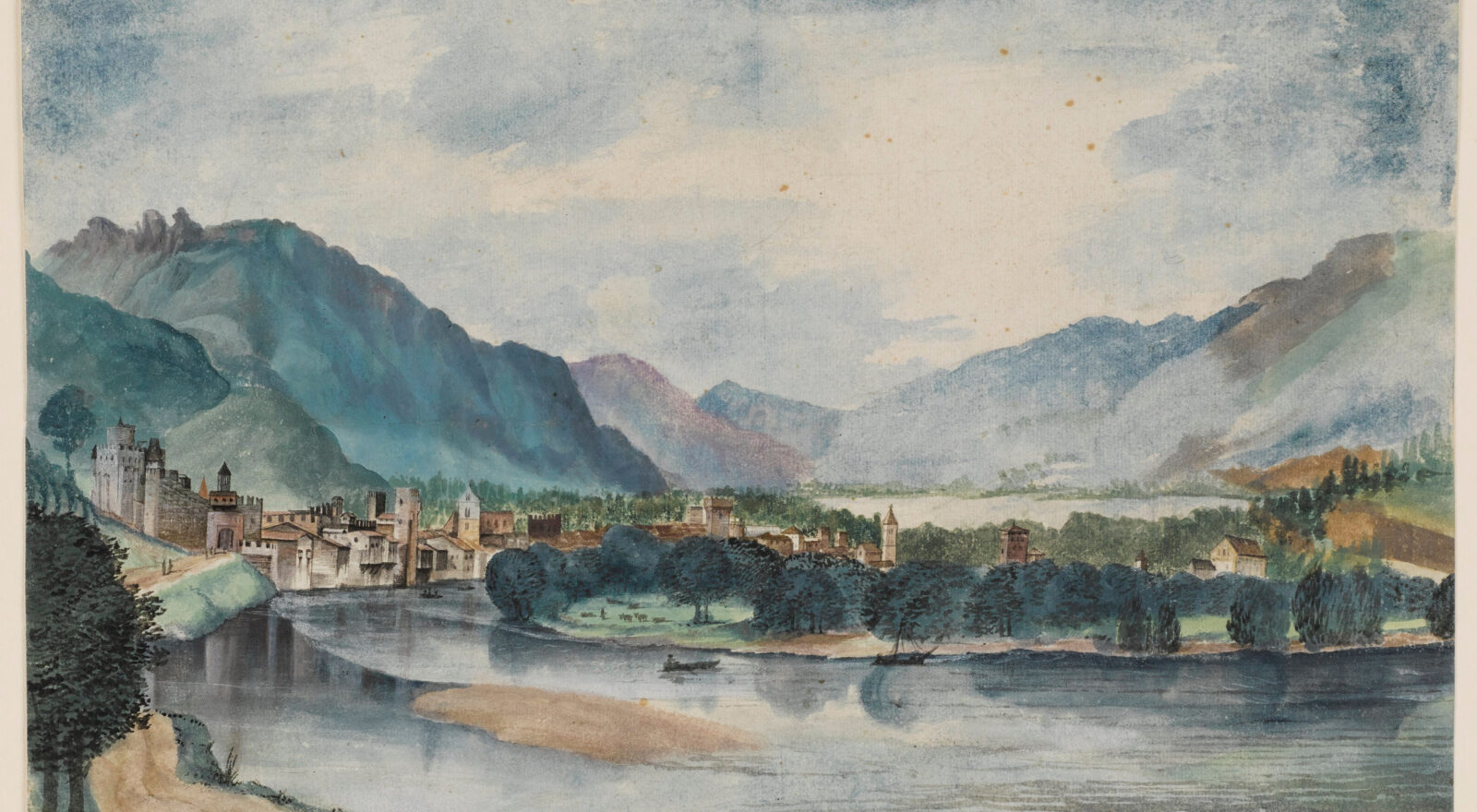
Image: Albrecht Dürer, Trento (Tryt), 1495, Kunsthalle Bremen (open access)