3DSecret: FBK is researching AI to analyze blood for early diagnosis and personalized treatment
September 28, 2026
At the project’s final meeting in Trento, FBK showed how generative AI can connect fragmented biomedical data and help build the simulation environment needed to discover new diagnostic and treatment strategies.
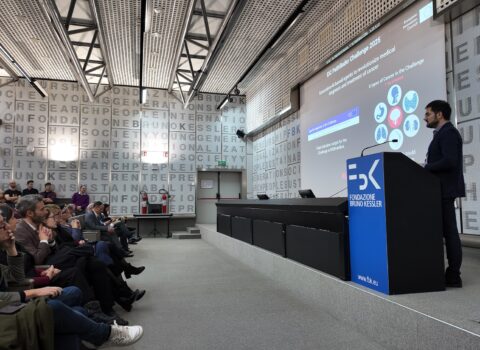
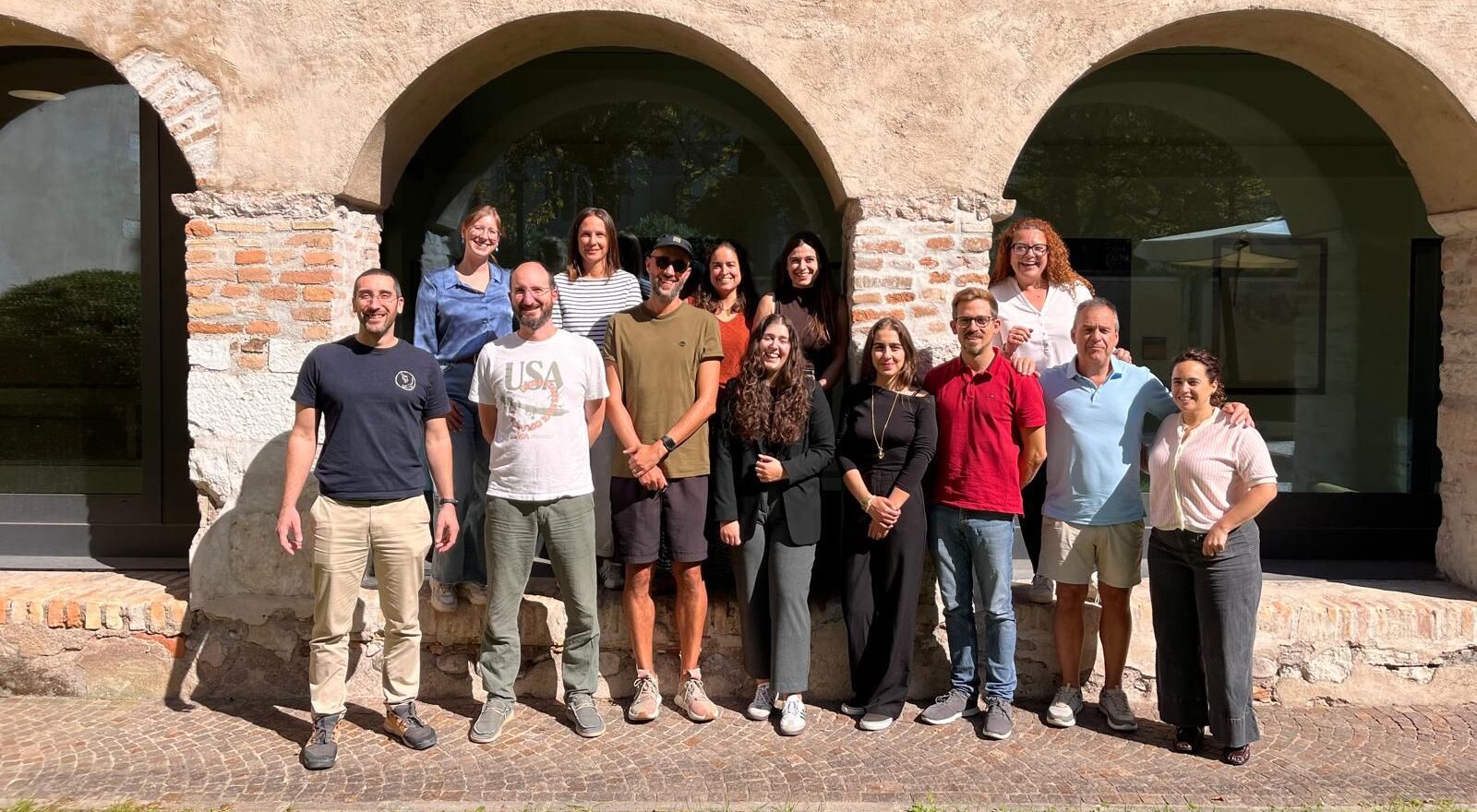
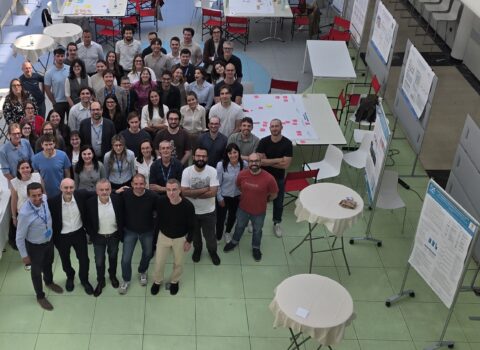
On 23 September 2026, Fondazione Bruno Kessler hosted the final meeting of 3DSecret at its headquarters in Trento. The project partners met to review the results and discuss their future applications in cancer research and healthcare.
The project addresses one of oncology’s hardest questions: how do cancer cells spread through the body and generate metastases?
3DSecret studies circulating tumour cells: individual cancer cells that leave the original tumour and enter the bloodstream. Only a fraction will survive, colonise another organ and form a secondary tumour.
The research team isolates these individual cells and grows each one into a small three-dimensional colony known as a spheroid. Sensors, genetic analysis and artificial intelligence are then combined to observe how the cells grow, how their metabolism changes and which characteristics may be associated with greater aggressiveness.
Building a single image from many views
FBK leads the project’s artificial intelligence research through its Data Science for Health Unit, led by Giuseppe Jurman, in the Center for Digital Health and Wellbeing.
Every technology used by 3DSecret describes a different aspect of the same cell and patient. Microscopic images show how a cell grows. Sensors detect changes in the metabolic activity of its surroundings. Genetic data describe its DNA, while other analyses show which genes are active. Clinical information connects these observations with the patient’s condition and disease history.
FBK developed a generative AI architecture in which specialised models learn the relationships between different kinds of biomedical data and work together to form a coherent representation of the patient. Rather than filling each gap with a single best estimate, the system represents a range of plausible patient states consistent with the available evidence. Each new observation narrows that range and reveals where relevant uncertainty remains.
“No single modality can describe a patient,” said Nicolò Lazzaro of FBK’s Data Science for Health Unit. “An X-ray, a blood panel, the tumour’s DNA and gene activity, and the patient’s treatment history all describe different parts of the same system. Our aim is to bring these signals together in a unified model of the patient.”
The approach was validated using more than 10,000 cancer samples covering 20 tumour types and published in PLOS Computational Biology. The experiments showed that the generated information preserved signals relevant to tumour classification, staging and survival analysis. The system can also estimate which additional examination would contribute the most useful information when a patient record is incomplete.
The European Commission’s Innovation Radar identified the work among 3DSecret’s key technological innovations. In 2025, the technology was selected through “PoC by FBK: Test your idea!”, an initiative aimed to move research results towards application.
With this support, FBK launched the UK Biobank project “Systemic GenAI models from peripheral samples”. The project brings the architecture to a cohort of 500,000 participants. It investigates whether signals obtainable from samples such as blood can enable earlier disease detection, and how generative AI can combine them with other patient information to complement established diagnostic workflows.
Beyond today’s standard of care
AI trained on existing examples can identify patterns and reproduce the best decisions represented in those data, but it remains bounded by what has already been observed. Discovering new diagnostic or treatment strategies requires a different approach: an AI system must test alternatives, observe their consequences and learn which sequence of decisions produces the best outcome.
Millions of diagnostic and treatment strategies cannot be tested on real patients. FBK is working to build a simulated environment: a generative model that represents the range of patient states consistent with the available evidence, quantifies the uncertainty that remains and simulates how those states may evolve under different interventions.
Running these simulations requires enormous computing resources. FBK is therefore working towards major improvements in generative AI efficiency. By enabling simulation at this scale, an AI system could evaluate how each decision shapes the entire course of care, weighing disease control against diagnostic burden, treatment invasiveness, toxicity and quality of life over time.
3DSecret is a frontier research project funded by Horizon Europe through the EIC Pathfinder Open programme, which supports high-risk scientific ideas with the potential to generate radically new technologies.
-
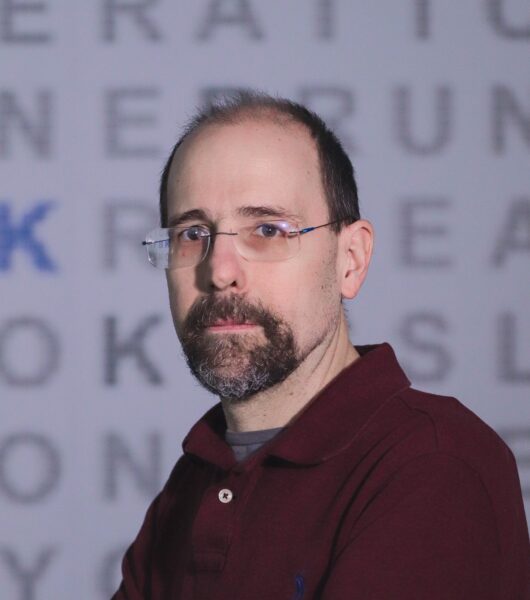 Giuseppe Jurman
Head of Unit at Data Science for Health (DSH) unit at FBK.
MORE INFO
Related articles