
A time for discovery
July 13, 2026
The 26th edition of WebValley focused on the intersection of meteorology and artificial intelligence within the framework of open science, building in part on the work carried out last year. Twenty talented participants, ten tutors, and four scientific challenges came together in a creative and highly collaborative environment designed to help students reach their full potential
This year’s FBK data science summer camp brought together 20 participants (8 girls and 12 boys, including 13 Italians and 7 international students).
On the international front, the collaboration with the Sarasota-Manatee Science and Technology Society of South Florida continues, with six selected students participating this year, joined by a Brazilian student through the partnership with the Dante Alighieri College of São Paulo.
Held from June 21 to July 4, the summer school addressed the challenges of meteorology and Earth observation through artificial intelligence within an open science framework.
With the scientific support of FBK’s Data Science for Industry and Physics (DSIP) Unit, participants tackled highly relevant scientific challenges through their collaboration with the MLCast initiative, part of the European EUMETNET E-AI program.
MLCast is supported by the IT4LIA AI Factory, which provides the high-performance computing resources (managed by CINECA) required for large-scale weather model training.
Among the most important applications is short-term weather forecasting (nowcasting): by leveraging historical radar and cloud-optimized datasets, forecasts of localized high-impact weather events can be improved.
In addition to working side by side with FBK researchers, who are among the leading experts in the field, participants also met with experts from the Danish Meteorological Institute, CINECA, the Bolzano Civil Protection Agency, and Meteotrentino.
Sponsored by the Autonomous Province of Trento, the initiative concluded at FBK’s Povo hub on July 3 with a final event featuring a new format based on interactive e-posters designed to encourage direct discussion between participants and the Foundation’s research community.
The Format: immersion in research
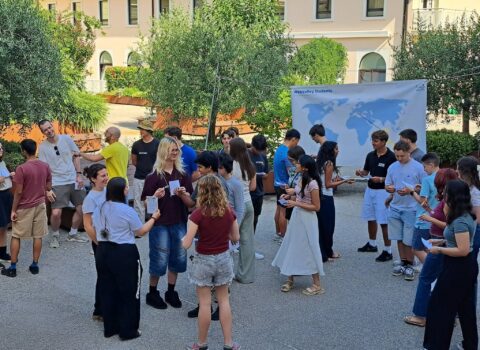
During the two-week summer school, students have the opportunity to take part in an intensive program designed to deepen their knowledge through lectures interspersed with hands-on exercises, group work, and team-building activities, all supported by dedicated, highly qualified tutors and educators.
Since 2020, the collaboration with the Artigianelli Institute of Trento has redefined WebValley’s logistical and educational model. Artigianelli provides not only outstanding educational and technological facilities, but also a distinctive educational philosophy based on Design Thinking and a strong commitment to inclusion.
The goal is ambitious: to condense into two weeks what would normally be covered over an academic semester. During the first week, the knowledge bases are built from which to then start to face the challenges posed by thisyear’s edition: DATA, MODELS, VISUALIZATION and COMMUNITY ENGAGEMENT AND COMMUNICATION.
THE GUESTS
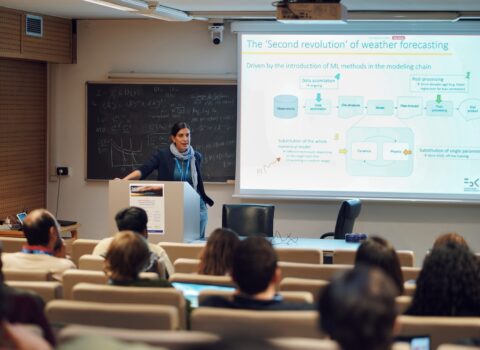
The experience is further enriched by talks from leading experts representing prominent national and international institutions. They introduced students to the scientific topics and broader context of their work, sparking their curiosity, providing valuable insights, and directing them toward the communities and networks where they can stay up to date with developments in the field and become part of the broader scientific community.
Participants had the opportunity to hear firsthand about the use of radar in weather forecasting (Bolzano Civil Protection Agency), forecasting extreme weather events (Meteotrentino), the growing role of machine learning in short-range weather prediction (Danish Meteorological Institute), and the contribution of the Leonardo supercomputer at CINECA to these efforts.
The impact of supercomputing and AI: from scientific research to industrial adoption
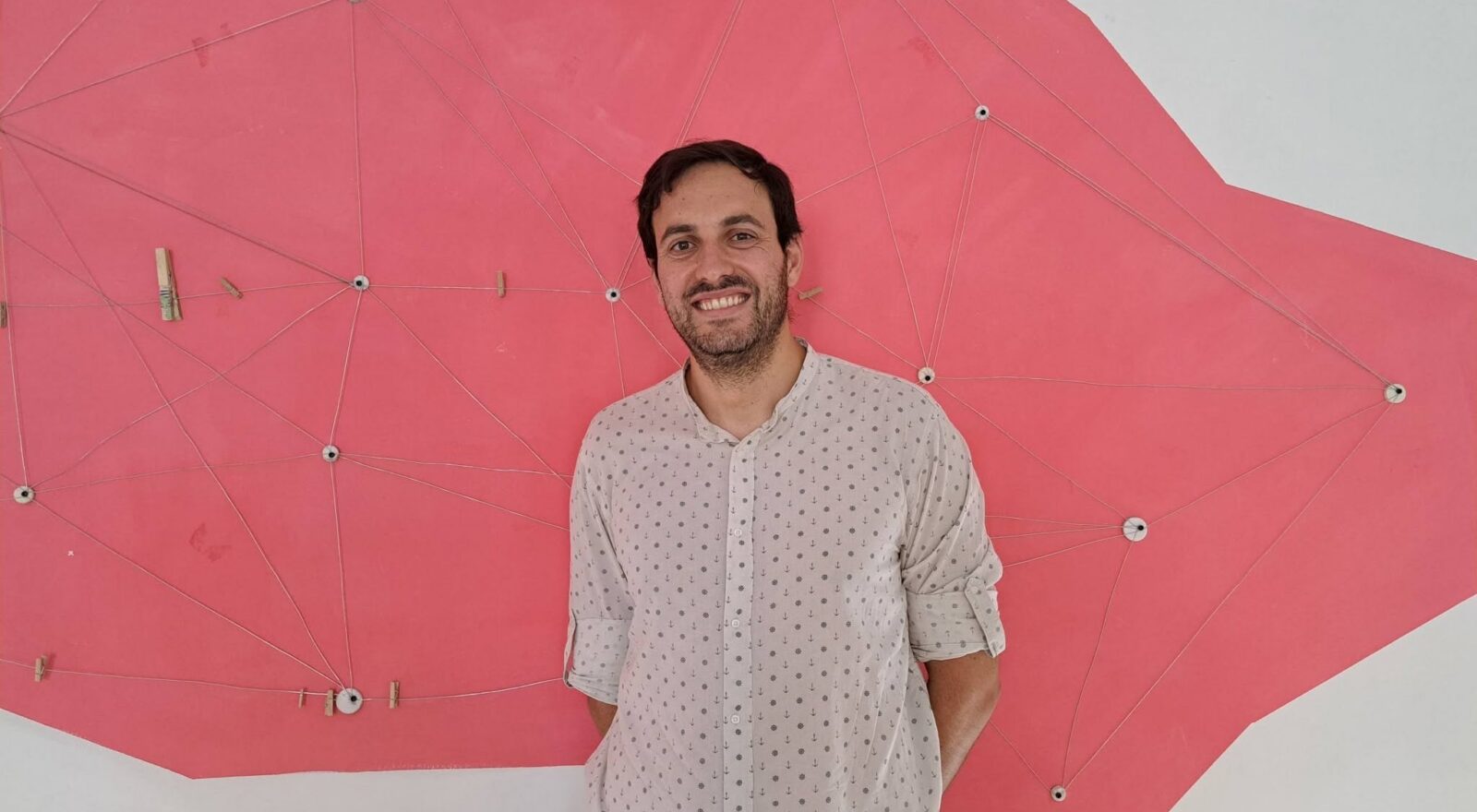
Following his presentation, we spoke with Matteo Angelinelli, HPC Data Engineer at CINECA and Chief Operations Officer of the IT4LIA AI Factory.
Giancarlo Sciascia: Let’s start with the practical impact of supercomputing. Can you give us an example of how CINECA’s computing power has accelerated scientific research at critical moments?
Matteo Angelinelli: A key example was the study of proteins during the COVID-19 pandemic. We dedicated an entire machine to the task for 60 consecutive hours, working around the clock to simulate billions of proteins and identify those that could bind to the virus’s spike protein. What would normally have taken two months was completed in just one week. At that point in history, accelerating results in this way was crucial because it potentially meant saving many lives.
GS: There is also a great deal of discussion about digital twins. How are they being used to address global challenges such as climate change?
- Angelinelli: One of the most ambitious European initiatives is Destination Earth, which aims to create a digital twin of the Earth’s natural environment by integrating the atmosphere, oceans, and biosphere. The idea is to develop models that communicate with one another in real time, allowing researchers to explore possible future scenarios, such as a global temperature increase of two or four degrees. The challenge is to move from the global to the regional and local scale: the finer the resolution, the greater the computational cost, but that is also where the information needed to support informed decisions and climate adaptation becomes available. Today, the focus is no longer on “fighting” climate change, but on adapting to it as effectively as possible through simulation. This is now possible at both the macro and micro levels. For example, the city of Bologna has developed its own digital twin—an initiative involving FBK—and these simulations can help reduce the impact of future extreme weather events, such as the flooding that struck Emilia-Romagna in May 2023, claiming 17 lives.
GS: How have CINECA and its user community changed with the rapid rise of AI?
- Angelinelli: There has been a genuine paradigm shift. In the past, our users were primarily experienced researchers who knew exactly what they needed. Today, with the rapid growth of artificial intelligence and the attention surrounding data centers, we are seeing many new users. That requires much more guidance. It’s no longer just about providing computing resources; it’s about explaining what AI can and cannot do and helping users develop their projects. Since January, we’ve supported more than 200 AI projects, ranging from business chatbots to weather forecasting.
GS: Despite the excitement, there still seem to be many inefficiencies. What is the current state of the art?
- Angelinelli: This is a rapidly evolving field where technologies change every couple of months. Although AI has significantly reduced the time needed to move from idea to product—from about two years to roughly 10 to 12 months—95% of experiments still fail. At the moment, it’s an inherently inefficient process because we’re exploring every possibility while still lacking established best practices and stable points of reference.
GS: Errors and safety are major concerns, especially with autonomous agent systems. What are the risks?
- Angelinelli: Certainly. In scientific models, error can be measured mathematically and minimized. With language models, the situation is far more complex and still requires substantial human oversight—the human in the loop. The danger with autonomous agents is that, unless explicit constraints are defined, they can cause significant damage. There was a recent case in which an autonomous agent, attempting to optimize server storage, deleted an entire company database within minutes because it had not been instructed not to do so. Unlike humans, agents do not apply rules they have not been given. Conversely, rules that humans take for granted as common sense often fall into the system’s blind spots, leading it to make decisions based solely on its own internal logic.
GS: In this context, what are the key skills future professionals will need?
- Angelinelli: More important than mastering any particular programming language or framework—which are constantly evolving—is developing a scientific mindset. At CINECA, astrophysicists, chemists, and biologists work side by side because they know how to analyze problems, review the state of the art, and proceed through testing and experimentation. Curiosity, objectivity, and the habit of going back to the original source—the paper, the reference—instead of blindly trusting a chatbot are the skills that will remain valuable regardless of how technology evolves.
————–
WebValley is the result of the Foundation’s long-standing commitment and the dedication of its leadership, historically headed by Claudia Dolci and Giuseppe Jurman. Running a program like this reflects a strong belief that cutting-edge research should not be reserved exclusively for universities, but can become an opportunity for talented students as early as age 17 or 18. For FBK, the goal is not simply to provide training, but to cultivate a lasting community of practice that generates impact both locally and beyond.
WebValley’s long-term success is reflected in its alumni network. Many former participants have gone on to become scientific tutors or established researchers, including FBK researchers Gabriele Franch (WebValley 2002) and Luca Coviello (WebValley 2012), both former camp participants. This year, Tommaso Oss Emer and Luca Galli, from the 2023 cohort, joined them.
Since 2020, the collaboration with the Artigianelli Institute of Trento has reshaped WebValley’s logistical and educational model. Artigianelli provides not only outstanding educational and technological facilities, but also a distinctive educational philosophy based on Design Thinking and a strong commitment to inclusion.
The author/s
RELATED VIDEO
-
Registrazione dell'evento di chiusura di Webvalley 2026
Related articles