
Energy transition: diversification supports resilience
April 9, 2026
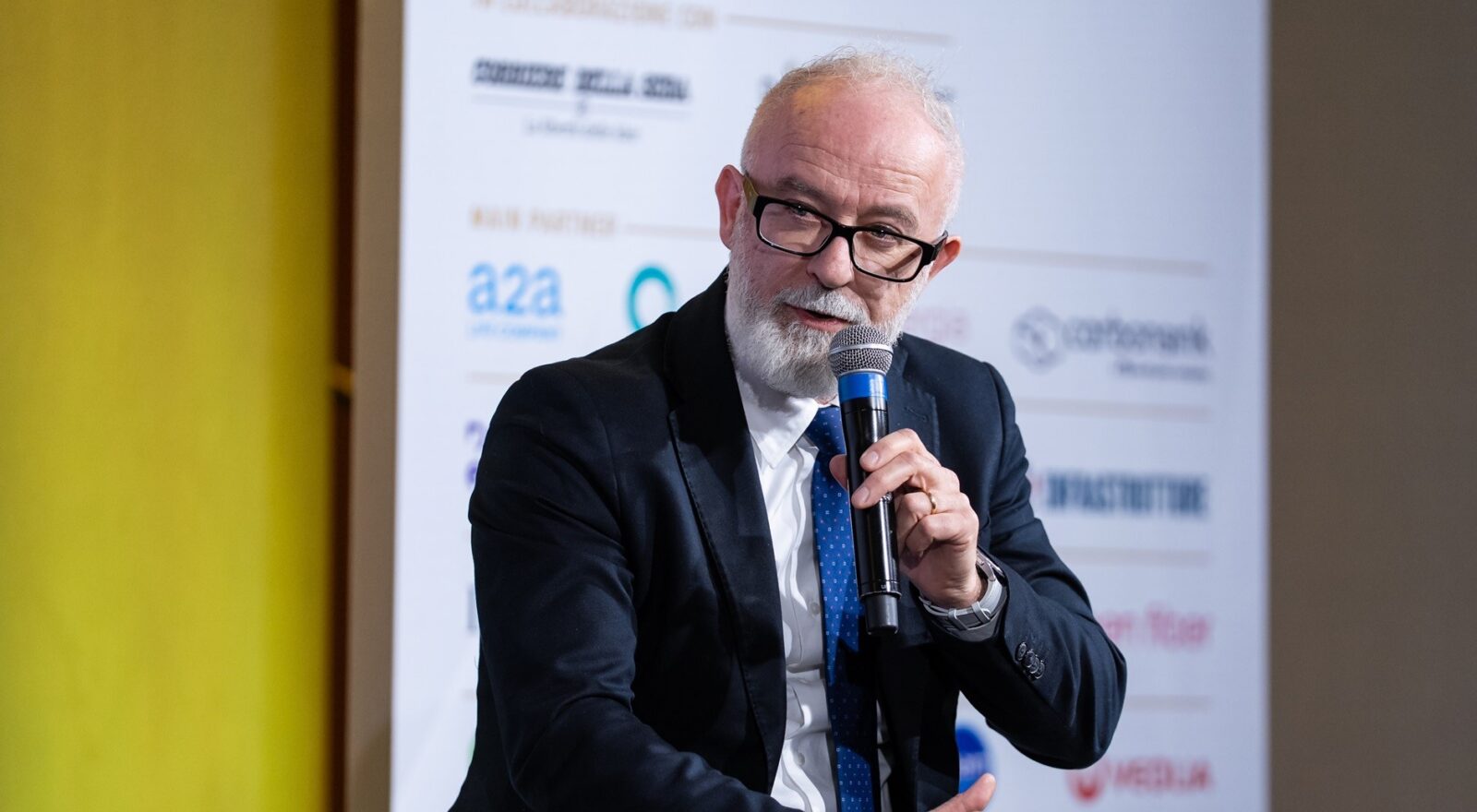
At the RCS Energy Talk, Luigi Crema (FBK) highlighted the need to combine the energy mix with a strategy for technology supply chains. Hydrogen and batteries were identified as key levers to reduce dependencies and support European industrial development.
The discussion on energy transition pathways promoted by RCS with the Energy Talk “Alternative Sources and Energy Security,” saw the participation, for FBK, of Luigi Crema, director of the Center for Sustainable Energy. His role embodies a strong European perspective: he serves as President of Hydrogen Europe Research, the leading continental organization for hydrogen research, and as Vice President of the Italian Hydrogen Association (H2IT).
FBK’s contribution was part of a high-level discussion that brought together institutional representatives, industry leaders, and major energy players. The session opened with a virtual address by Minister of the Environment and Energy Security Gilberto Pichetto Fratin, interviewed by Corriere della Sera director Luciano Fontana. From a European perspective, Gelsomina Vigliotti, Vice President of the European Investment Bank, also contributed. The program featured numerous CEOs and top managers, including Nicola Monti (Edison), Fabrizio Fabbri (Ansaldo Energia), Giuseppe Gola (Open Fiber), Monica Iacono (ENGIE Italia), Emanuela Trentin (Veolia Italia), Stefano Granella (Dolomiti Energia), and Ugo Salerno (RINA), along with representatives from A2A, Italgas, Snam, and other major utilities. In this context, the Energy Talk served as a structured platform for dialogue between industrial policy and business strategy, with more than twenty speakers addressing energy security, the technological mix, and national competitiveness.
Within a leading panel alongside Lidia Armelao, full professor of general and inorganic chemistry at the University of Padua, Crema focused on a critical step in the transition: the risk of shifting from dependence on fossil fuels to dependence on critical raw materials, highlighting the need to rethink the entire energy technology cycle.
The issue is not only energy production but also the sustainability of supply chains.
From enhancing sources such as solar and wave energy—which reduce pressure on critical materials—to designing components for reuse or recycling, the focus shifts to industrial design. “Eco-design and sustainable by design must become structural criteria,” Crema emphasized, pointing to a paradigm shift involving research, industry, and policy.
The main technological challenges addressed by the FBK Center for Sustainable Energy include, first, developing a European supply chain for energy storage with alternatives to conventional batteries, such as salt or flow batteries, to reduce reliance on non-European supply chains; second, advancing hydrogen within a European industrial framework aimed at building a market, not just advancing technology.
“The challenge today is to connect the emergence of new markets with the adoption of new technologies, also through European industrial policy tools aimed at strengthening ‘Made in Europe.’ In this perspective, the energy transition assumes a system-wide dimension: it is not only about innovation, but about the capacity to scale technologies industrially and develop competitive supply chains. “
This is the context in which FBK’s work is positioned: an activity explicitly aimed at industrial scaling, also through dedicated research and technological infrastructure. Among these, the Hydrogen and Batteries Hub under development in Rovereto will feature a power line of up to 10 megawatts, designed as a platform for testing, integration, and technology transfer.
“We operate as a one-stop shop, working in both push and pull with industry,” Crema concluded, “bringing research and innovation into a real industrial dimension and closer to application. Building the transition means designing technologies, supply chains, and markets coherently, avoiding new vulnerabilities in the European energy system.”
The author/s
-
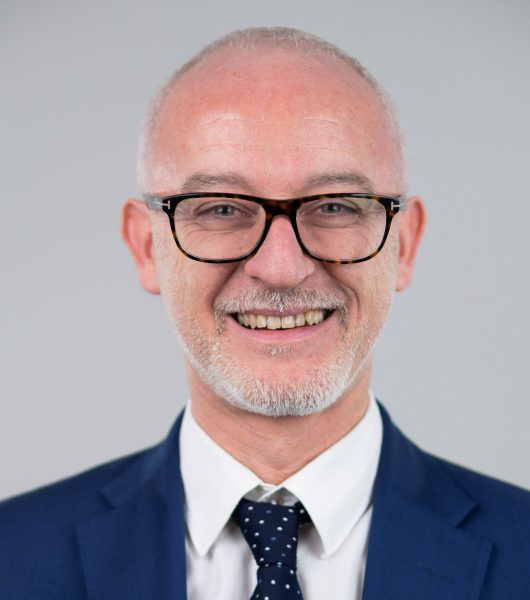 Luigi Crema
Director Center for Sustainable Energy, FBK
MORE INFO
Related articles