
FBK and the major AI compliance challenge
May 5, 2026
In recent years, artificial intelligence has transformed key sectors such as healthcare, mobility, education, and public administration. However, its growing pervasiveness raises crucial questions: how can AI systems be made reliable, ethical, and compliant with regulations?
To address these questions, FBK’s research community hosted an event bringing together leading researchers in the field to present innovative solutions for AI compliance, from design and verification to practical implementation.
Following the first event on the same topic organized last year, which was mainly exploratory in nature, the Center for Digital Society held a technical workshop for the entire FBK community on April 22 dedicated to advancing discussion on compliance in the digital society. The event focused in particular on the impact of AI compliance on robustness, security, fairness, reliability, contextual constraints, and emerging regulations.
The initiative was promoted with the aim of mapping and connecting the research activities already underway within FBK, while encouraging an open and multidisciplinary discussion on how FBK approaches, models, and applies the concept of compliance across different projects.
The workshop included participation from the People Innovation for Research Service, with a focus on privacy, and representatives from half of the Foundation’s research centers: Center for Digital Society, Center for Cybersecurity, Center for Digital Industry, Cenetr for Digital Health Wellbeing, Center for Augmented Intelligence, and the Institute for Evaluation Research on Public Policies.
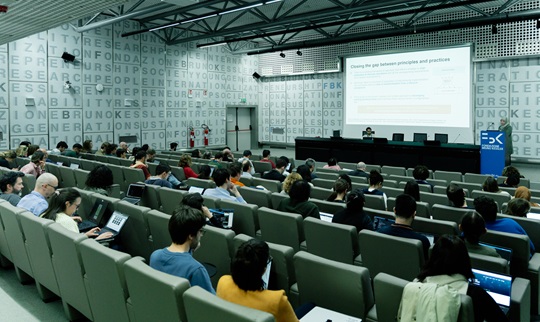
Open to the entire FBK community, the meeting brought together more than 100 experts, particularly those working in AI and machine learning, data governance and quality, cybersecurity, privacy and data protection, digital law, policy and regulatory models, human-computer interaction and socio-technical aspects, complex digital systems and software compliance, trust analysis, fairness and transparency, and the responsible digital society.
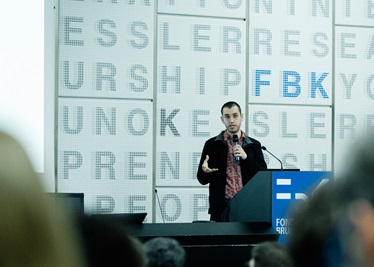
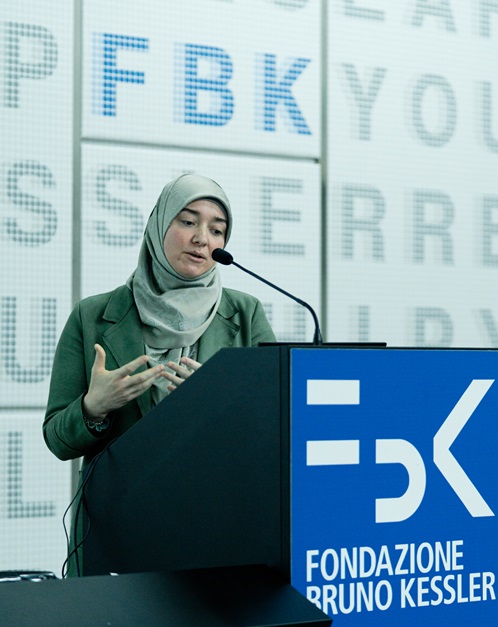
Around fifteen experts presented the latest developments emerging in their respective fields of specialization, gathering feedback from colleagues and participants.
The European framework
The AI Act roadmap remains the main regulatory reference framework, although its implementation is evolving and has fallen behind the timeline originally established two years ago. In fact, the entry into force of the rules has been postponed from August of this year to the end of next year.
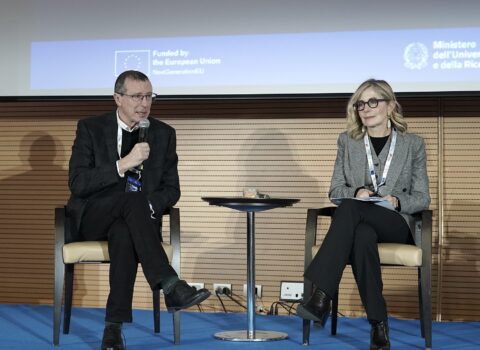
“The related problems,” FBK Center for Digital Society Director Michela Milano commented, “are twofold. The first is the need to improve AI regulation, making it less burdensome and, above all, simpler for companies, in order to encourage the broadest possible adoption of new systems in production processes, improve productivity, and generate impact. The second is that large American technology companies have often preferred to absorb the cost of sanctions for violations — for example, of intellectual property rights — as a predictable budget item, rather than bear the economic and operational costs of full regulatory compliance. We are moving toward simplification, but we will need tools.”
GS: “What do the thematic areas under development at FBK have in common?”
MM: “These are almost always applications related to society, public administration, and industry.
There are also space-related applications, which are especially important in terms of the safety, robustness, and reliability of models. The contribution also extends to the effects of AI within schools and educational systems, where many studies have yet to be carried out. This represents an opportunity to gather useful evidence on how AI is being used in schools, understand emerging training and support needs, and inform future sector policies.”
An interdisciplinary laboratory
GS: “Can it be said that this focus on AI compliance represents an unprecedented resource at the national level?”
MM: “In terms of both scale and quality, our work represents a major concentration of expertise capable of supporting the evolution of technologies affected by the ongoing transformation. The experience we have gained — for example in formal methods, as well as in the urban digital twin of the city of Bologna and, more broadly, in the development of so-called integrative AI — makes us fully aware both of the opportunities opening up and of the critical issues that still need to be addressed.”
GS: “What are the first results achieved?”
MM: “One example is the agreement signed by the Center for Cybersecurity with Synapsed.ai, mentioned by Director Silvio Ranise during the opening session. In recent days, we have also started important discussions with Confartigianato on establishing ethical AI guidelines for companies in the sector, including businesses working in communication, graphics, advertising, and media. In addition, the Evelyn project, focused on the robustness of models for pollution reduction, will begin in October.”
FBK as a compliance lab for responsible AI
What are the main areas in which research will have an impact in the coming years?
From theory to practice: standards, checklists — such as those in the healthcare sector mentioned by Leonardo Sanna during the workshop — and processes for compliant AI will ensure compliance by design through operational procedures capable of implementing principles at the design stage, in line with requirements for fairness, transparency, and accountability. In addition to increasing safety, these models will help ensure that AI behaves as intended and operates within the boundaries established by current regulations — an increasingly strict requirement in safety-critical sectors. Presentations from the Formal Methods unit of the Center for Digital Industry highlighted significant results in the verification of these systems.
Equity, privacy, and trust: cross-cutting challenges for inclusive AI
Fairness is another key pillar of compliance. Marco Pistore illustrated how to ensure fairness and robustness in urban digital twins, systems that are becoming central to smart city planning. Camilla Casula highlighted hidden fairness issues in advanced language models such as GPT-4, while Riccardo Gallotti showed how these systems can influence conversational persuasion and the representation of minorities.
Co-design and collaboration: toward regulated AI serving society
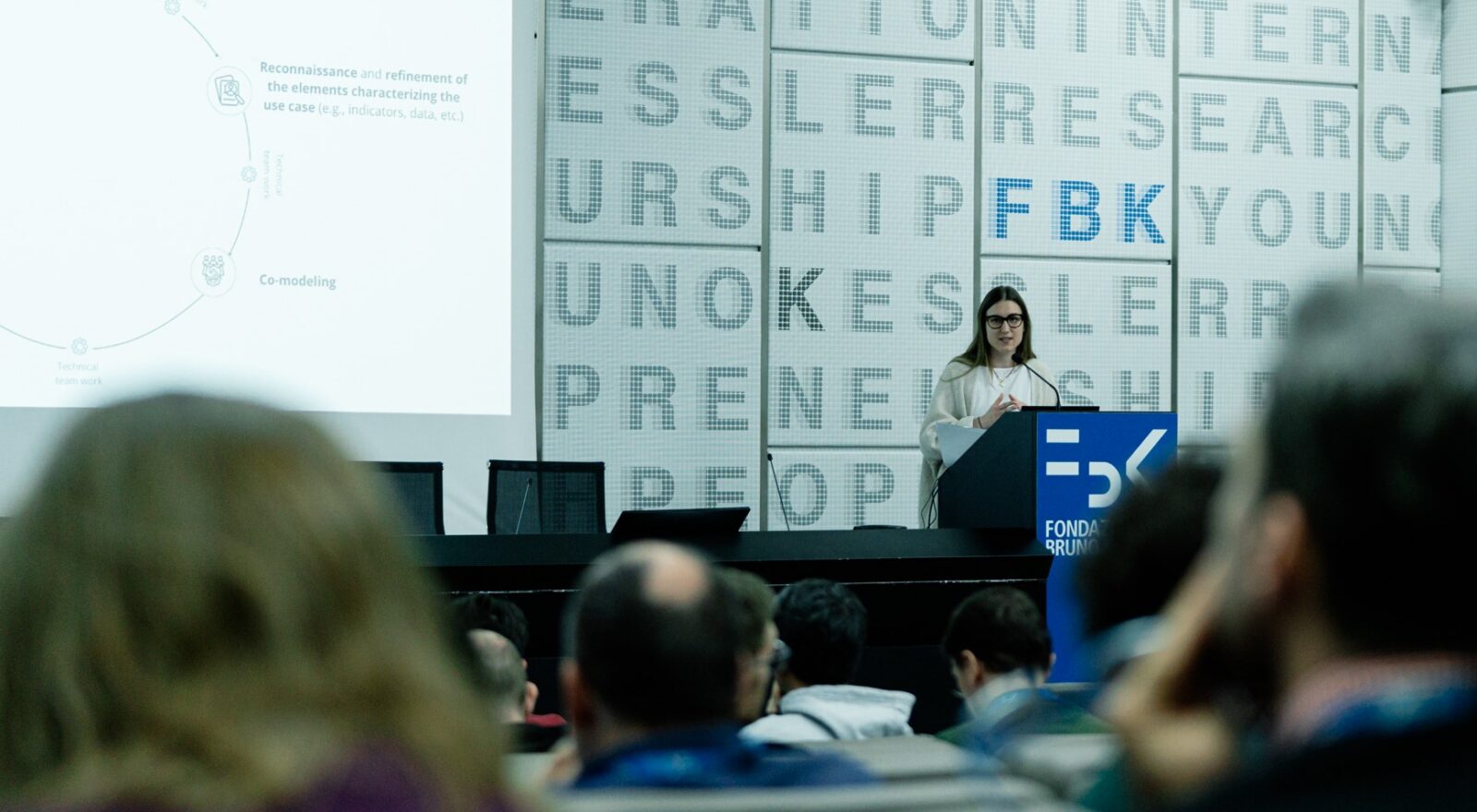
An AI system is only as reliable as its development process is inclusive. Giulia Deppieri presented a co-design framework involving different stakeholders to ensure that compliance requirements are addressed from the earliest design stages.
Thanks to the workshop, it was possible to highlight and share scientific expertise and results related to the regulatory, technical, and ethical dimensions of AI compliance; showcase approaches linked to AI trustworthiness, digital system robustness, fairness, accountability, and transparency assessment; offer researchers the opportunity to present use cases, methodologies, datasets, tools, and interdisciplinary perspectives in detail; and foster cross-disciplinary collaboration among the different units at the Center for Digital Society, as well as with other FBK centers and research lines.
This process promises important new applications in the near future — and one that will continue to remain in the spotlight.
The author/s
-
 Michela Milano
Director Center for Digital Society, Fondazione Bruno Kessler
MORE INFO
Related articles