
FBK-IRVAPP Award named after Beniamino Andreatta – Federica Meluzzi wins 2026 Edition
May 23, 2026
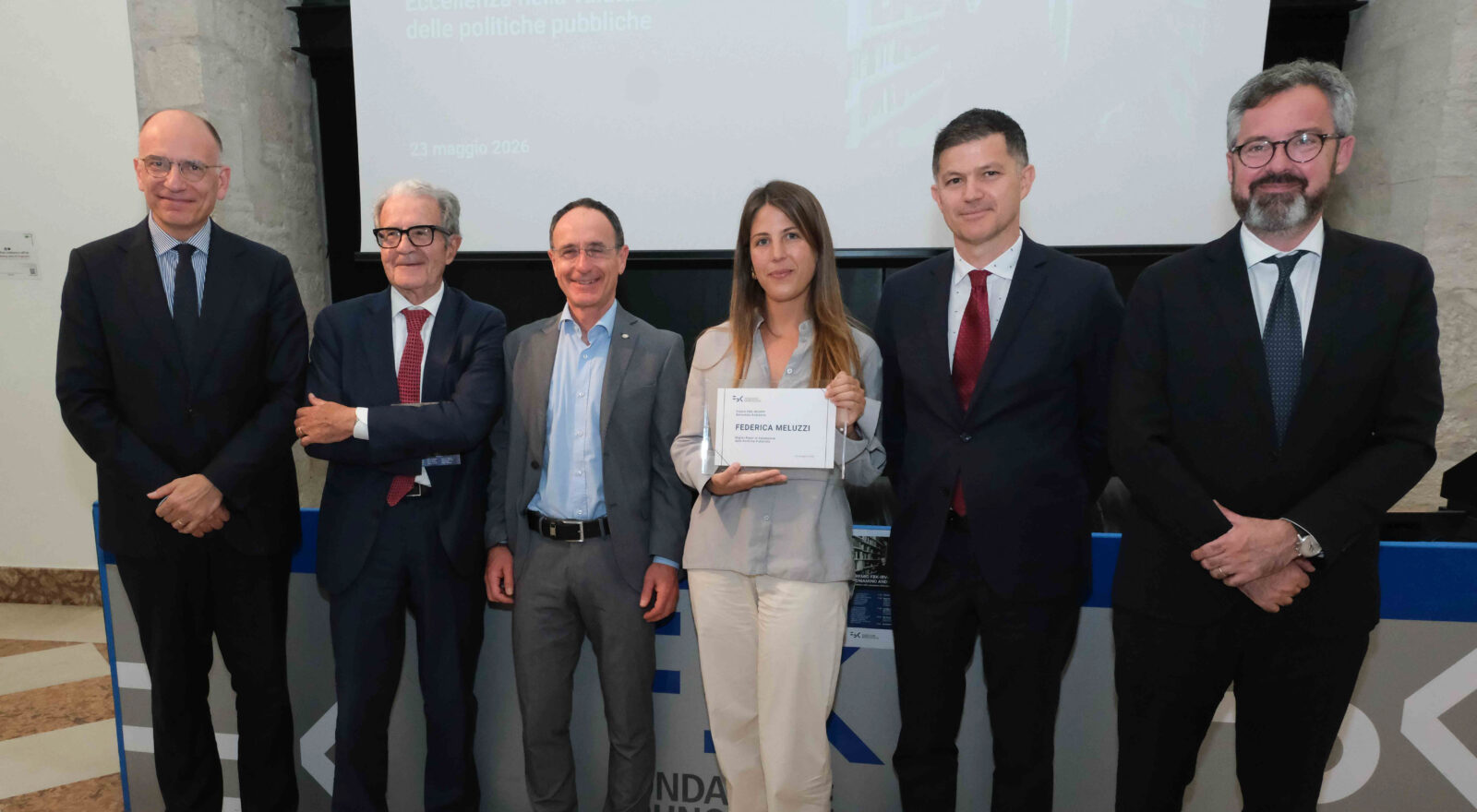
Enrico Letta and Romano Prodi attended the award ceremony at Fondazione Bruno Kessler in Trento to present the recognition established by the Institute for Evaluation Research on Public Policies (FBK-IRVAPP), directed by Mirco Tonin
Federica Meluzzi, a researcher at Bocconi University in Milan, is the winner of the 2026 FBK-IRVAPP “Beniamino Andreatta” Award for the best study on public policy evaluation.
The ceremony took place at Fondazione Bruno Kessler in Trento and featured Enrico Letta, President of AREL – Agency for Research and Legislation, and Romano Prodi, President of Fondazione per la Collaborazione tra i Popoli.
The event, organized by the Institute for Evaluative Research on Public Policy (FBK-IRVAPP) of the Bruno Kessler Foundation, directed by Mirco Tonin, took place in the Aula Grande on Via S. Croce.Following opening remarks by FBK Secretary General Andrea Simoni and Trento Mayor Franco Ianeselli, Romano Prodi delivered a keynote address titled “Beniamino Andreatta: The scholar and the politician,” followed by Enrico Letta’s talk, “The legacy of Beniamino Andreatta and the challenges of the European project.”
Mirco Tonin then presented the FBK-IRVAPP Award dedicated to Beniamino Andreatta, describing it as a recognition of academic rigor and commitment to the public interest — values that guide the work of FBK’s Institute for Evaluation Research on Public Policies.
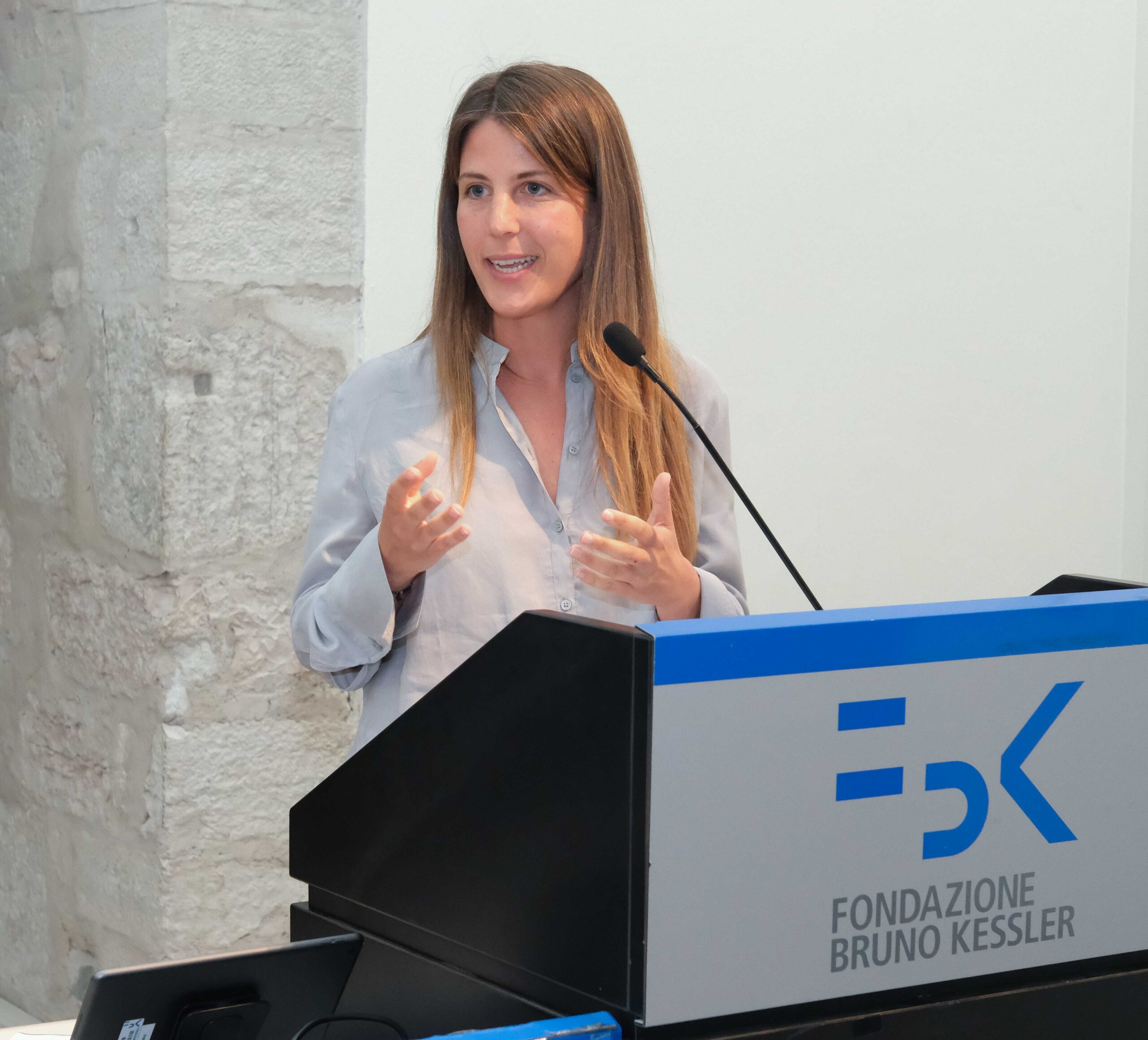
Federica MELUZZI
© FEDERICO NARDELLI
The winner of the 2026 edition, Federica Meluzzi, carried out the study titled “The College Melting Pot: Peers, Culture and Women’s Job Search,” which examines gender inequalities at the beginning of professional careers. The research focuses in particular on how interaction during university studies with classmates from areas characterized by greater gender equality can positively influence female students’ expectations and job choices.
“This year,” said FBK-IRVAPP Director Mirco Tonin, “we received more than fifty submissions from researchers at universities across the United States, Europe, and Italy. The winning study uses AlmaLaurea data in a scientifically rigorous way to analyze women’s lower participation in the labor market — a pressing issue in Italy — and highlights the role of cultural factors. The award aims to promote a stronger culture of public policy evaluation in order to make policies increasingly effective, and this year’s winning study is an excellent example of the knowledge and insight from which society can greatly benefit.”
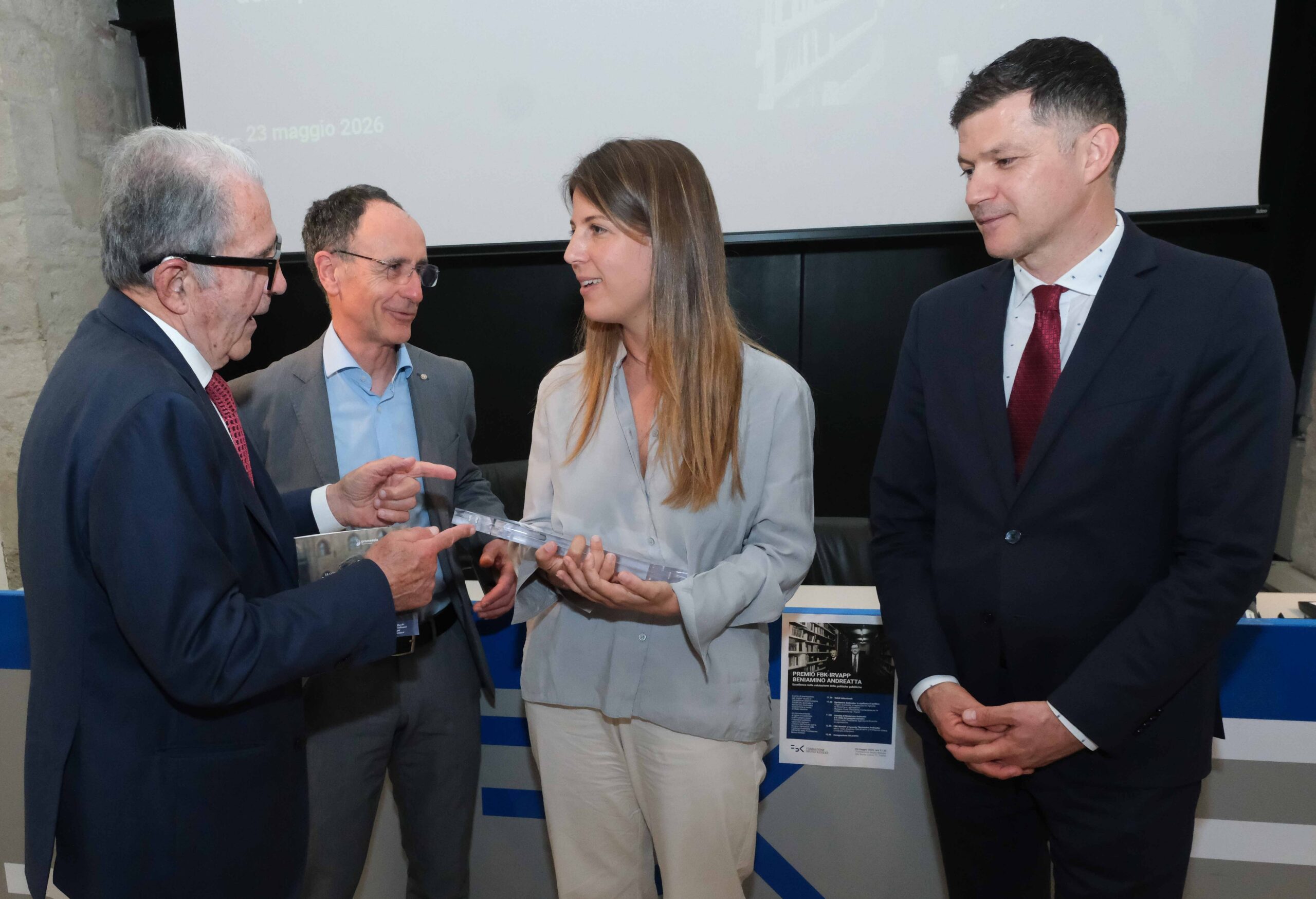
Romano PRODI , Andrea SIMONI, Federica MELUZZI and Mirco TONIN
© FEDERICO NARDELLI
Federica Meluzzi will present her research during “Panel Data for Causal Research Designs,” an advanced summer school on public policy evaluation for PhD students, researchers, and professionals organized by FBK-IRVAPP in collaboration with the Italian Econometric Association (SIdE-IEA). The program will take place from June 29 to July 3, 2026, at the University Residential Center of Bertinoro (FC).
The award
The FBK-IRVAPP Award — presented by the judging panel composed of Mirco Tonin, Erich Battistin, and Enrico Rettore — is granted to the best unpublished study among those submitted by PhD candidates and researchers distinguished by methodological rigor, innovative approaches, and the ability to contribute to debate on a specific public policy issue.
Last year, the award was won by Felix Rusche, a Ph.D. candidate in Economics at the University of Mannheim (Germany), for his paper “Broadcasting Change: India’s Community Radio Policy and Women’s Empowerment”; in 2024, the winner was Lorenzo Incoronato for the article “Place-Based Industrial Policies and Local Agglomeration in the Long Run,” while in 2023, Francesco Filippucci won for the study conducted with Salvatore Lattanzio titled “What Do NEETs Need?” The Joint Effect of Active and Passive Labor Market Policies”.
Since the 2026 edition, the FBK-IRVAPP award has been named after the economist and politician Beniamino Andreatta.
For more information:
- FBK-IRVAPP event: https://irvapp.fbk.eu/it/events/detail/30237/premio-fbk-irvapp-beniamino-andreatta-eccellenza-nella-valutazione-delle-politiche-pubbliche-2026/
- Fondazione Bruno Kessler’s Institute for Evaluative Research on Public Policies (FBK-IRVAPP): https://irvapp.fbk.eu/it/
- Federica Meluzzi (Bocconi University): https://sites.google.com/site/federicameluzzi1
Abstract of the study “The College Melting Pot: Peers, Culture and Women’s Job Search”. Gender inequalities in the labor market emerge as early as the transition from university to work. One year after graduation, women earn on average 11% less than male classmates enrolled in the same degree program, largely because they are more likely to accept part-time contracts. The research shows that these differences are partly rooted in social and cultural patterns developed during childhood. In Italy, female participation in the workforce varies significantly across provinces, and women raised in areas with lower female employment tend to develop more pessimistic expectations and a stronger preference for part-time work.
Universities can help reduce these disparities. Master’s programs bring together students from diverse geographical and cultural backgrounds, creating what the research describes as a true “melting pot.” The study shows that when female students are exposed to classmates raised in provinces with high female labor-force participation, they change both their expectations and their job-search behavior. The effect is especially strong for students coming from less gender-equal environments, and the initial disparities can be reduced by 20% to 40%. Promoting geographic diversity within university programs may therefore play a significant role in reducing gender inequalities from the very start of labor-market participation.
The author/s
Related articles