
Geometries of public opinion
September 4, 2026
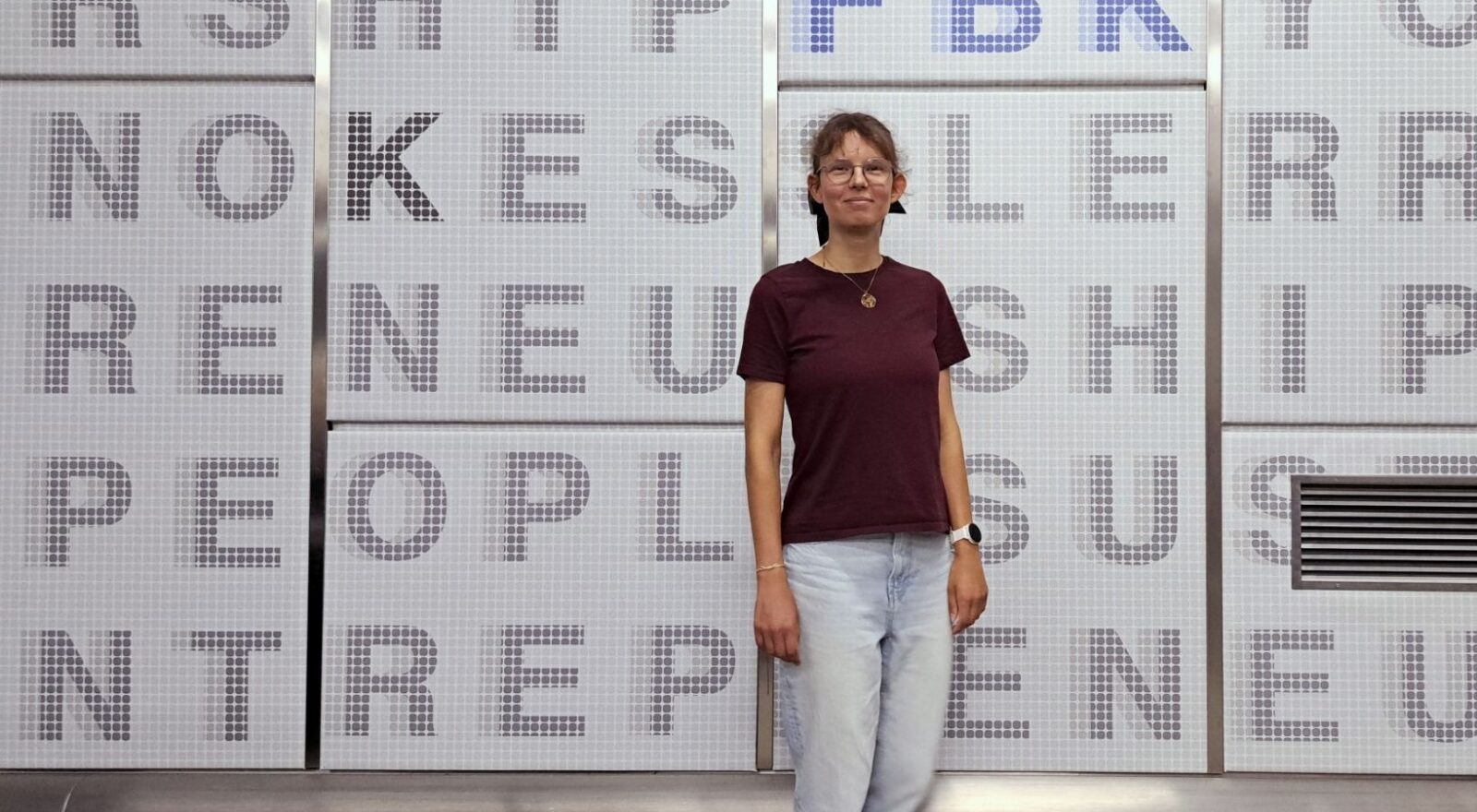
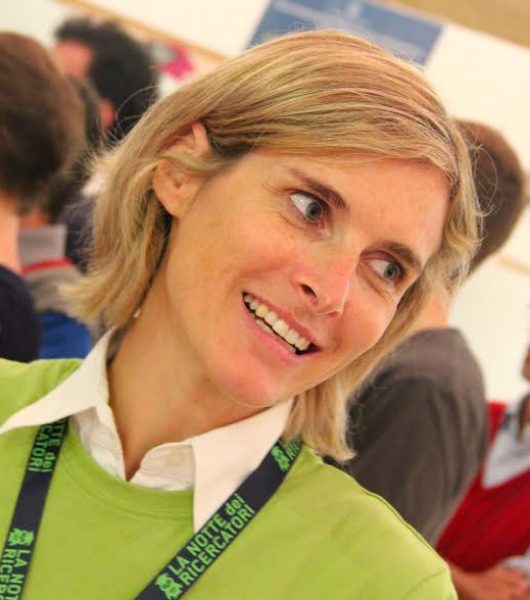
Katarina Laken is a Dutch researcher completing a Marie Skłodowska-Curie Actions PhD within the European Hybrids network at FBK's Digital Humanities Unit. Her deeply interdisciplinary work focuses on hate speech, disinformation, and the narrative structure of conspiracy theories.
Katarina Laken’s path is an exemplary case of how international mobility is at the heart of excellent scientific training.
As part of the prestigious Marie Skłodowska-Curie Actions “Hybrids“ program, she embodies the essence of “academic nomadism”: from her roots in the Netherlands to formative experiences in Estonia, Russia, and Barcelona, all the way to Trento in 2023. This dynamism coincides with the development of a fluid research identity, capable of navigating diverse institutional and cultural systems to tackle one of the most complex challenges of our era: understanding the underlying mechanisms of disinformation.
Narrative structures and vector spaces
In the era of Large Language Models (LLMs), the study of conspiracy theories pushes the boundaries of sociology, becoming a technical challenge of data interpretation.
One of the research projects Katarina Laken is focusing on analyzes what AI generates and investigates, in particular, the so-called activation space, or the vector space in which the model processes and organizes concepts. While the scientific literature has already explored how models internally represent concepts such as truthfulness or the refusal of harmful content, the innovative contribution of Laken’s study lies in applying this methodology to the narrative structure of conspiracy theories.
Through the analysis of “linear directions” within vector space, her research suggests that conspiracy theories can be identified as a specific coordinate in a multidimensional space; there is a plane (understood as a locus) capable of separating conspiracy narratives from those based on verified facts. It is essential to clarify that this three-dimensional plane is a conceptual simplification necessary to visualize a vector space with very high dimensionality, otherwise inaccessible to human perception; the models’ internal representations are often richer and more layered than their textual output. A model can internally “recognize” a conspiracy structure even when its surface-level response does not reveal it.
This distinction between internal and external representation is crucial for AI interpretability. Understanding how artificial intelligence “maps” conspiracy theory allows us to intervene in security and the mitigation of disinformation at a structural level, even before the content is generated.
The FBK ecosystem and the strength of the wider community
In describing her work environment at FBK, Katarina Laken highlights two fundamental levels of support.
Formal supervision
Laken describes her supervisor, Sara Tonelli, head of the DH research unit at the Center for Digital Society (DIGIS), as very competent and responsive, particularly appreciating the autonomy she is given in her research.
Peer mentorship
For Laken, the Hybrids network was crucial because it gave her the opportunity to engage constantly with 10 other brilliant PhD students from different countries. This peer network is essential both professionally (for brainstorming and collaborating on scientific articles) and personally, allowing them to face common challenges together. Her main advice for those starting a PhD is this: “You have to try to do it together… it’s really important to have people you can exchange ideas with.”
The network serves as a platform for academic collaboration but also as a source of mutual support: a spontaneous phone call between colleagues can resolve a technical question or provide useful information to help someone find their bearings and make the most of a new start in an unfamiliar city. It is an experience of self-discovery accompanied by collective growth.
Finding order in chaos
Katarina Laken faces the future one step at a time. She admits that she does not yet have a definite postdoctoral path, but she is aware that she has a solid method for navigating uncertainty with a reasonably optimistic mindset.
She encourages future researchers to take a courageous approach: ask questions without being afraid of sounding “stupid,” and actively seek out a peer network that fosters open exchange.
The young researcher’s mental balance is rooted in trail running. Running on the trails of the Trentino mountains is her hobby, an ideal continuation of her scientific activity. Just as in research she explores phenomena and analyzes data to identify narrative patterns beneath the surface of language, while running she observes the trails to find her way.
The world beyond the laboratory
Regarding the future, although she does not yet have a clear “vocation,” she expresses a desire to continue describing reality systematically while remaining open to new professional directions, both in academia and elsewhere.
————-
This article was written in collaboration with Matilda Zancanaro, a student at the “Prati” High School in Trento, as part of her school-to-work internship at FBK in June and July 2026.
The author/s
Related articles