
Seeking polyphony
February 9, 2026
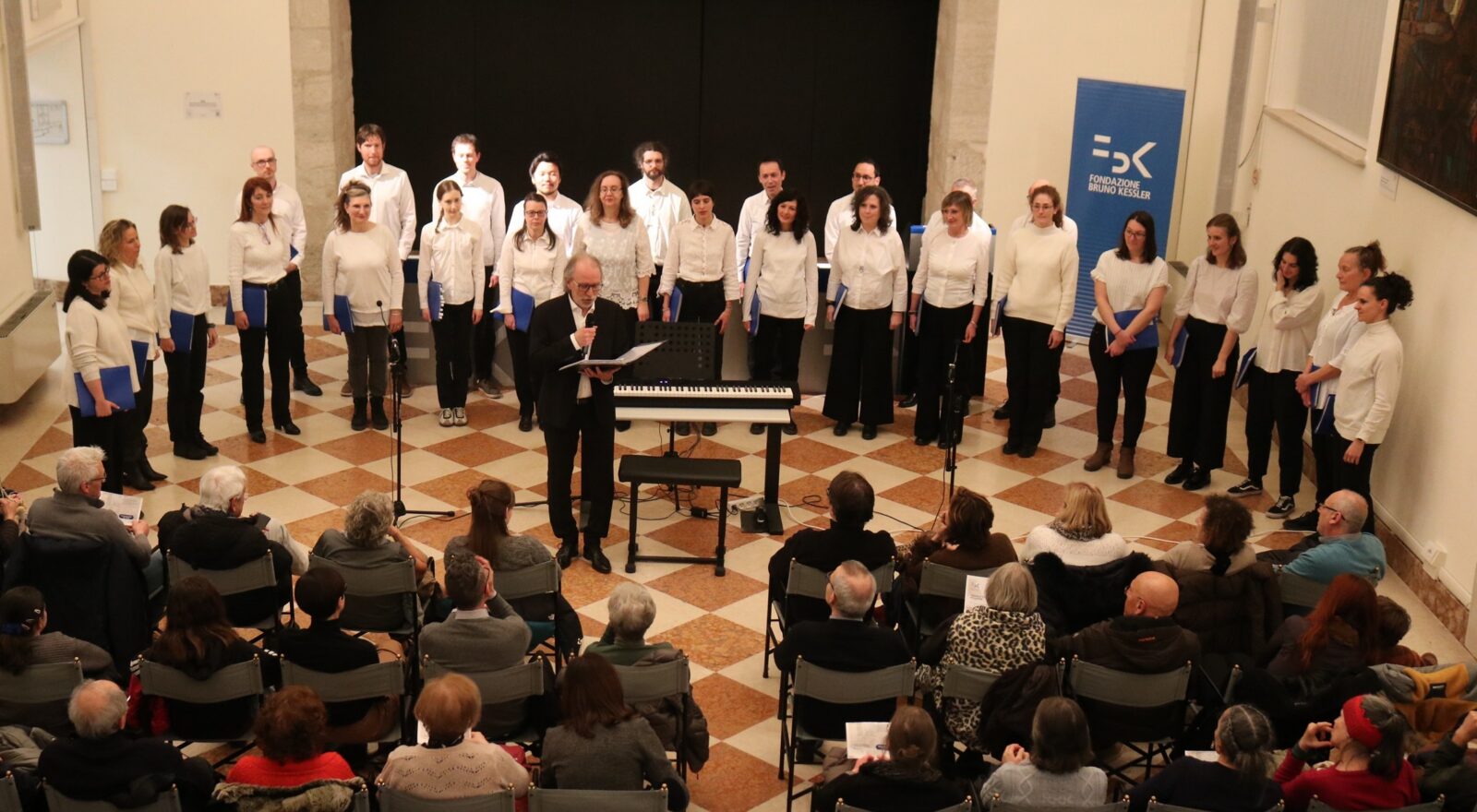
The first concert of the FBK Choir—led by Maestro Eduardo Bochicchio—drew an audience of more than one hundred people. The event is part of the FBK Sound project, carried out in collaboration with the Centro Didattico MusicaTeatroDanza (CDM) in Rovereto, which offers a space for connection and shared growth, designed to strengthen organizational identity and a sense of community.
On Friday, January 30, at 6:00 p.m., the headquarters of Fondazione Bruno Kessler on Via Santa Croce 77, hosted the Foundation Choir’s debut performance. The event was marked by the enthusiasm of colleagues dressed in concert attire and the
curiosity of family members, relatives, friends, and members of the public who attended to listen. A very different audience from the usual one—intergenerational and united by emotional ties rather than disciplinary interests. A special occasion, in the spirit of cultural participation that becomes corporate welfare and promotes personal and organizational well-being one song at a time—singing together, learning to manage one’s breath, and let one’s voice be heard.
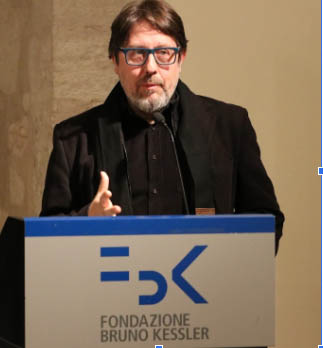
“The practice of singing in the workplace is widespread in other countries and cultures, though less so in Italy,” said Corrado Bungaro, director of CDM and active in artistic and cultural production for over 20 years. “We are pleased to have launched the company choir experience at FBK, fully aware of the strength that collective singing can bring to its participants and to the entire work environment.”
“Organizations like Fondazione Bruno Kessler are constantly searching for something special. In this case, research seeks to activate and connect people’s well-being and happiness with the corporate mission,”said Alessandro Dalla Torre, Head of People Innovation for Research. He continued: “Through music, we want to open the Foundation’s organizational space to an extraordinary experience—one that generates well-being and creativity. In this sense, I like to think of our choir as colleagues who, united by a shared passion, become the sounding board of that extraordinary human adventure of study and research that reflects FBK’s mission.”
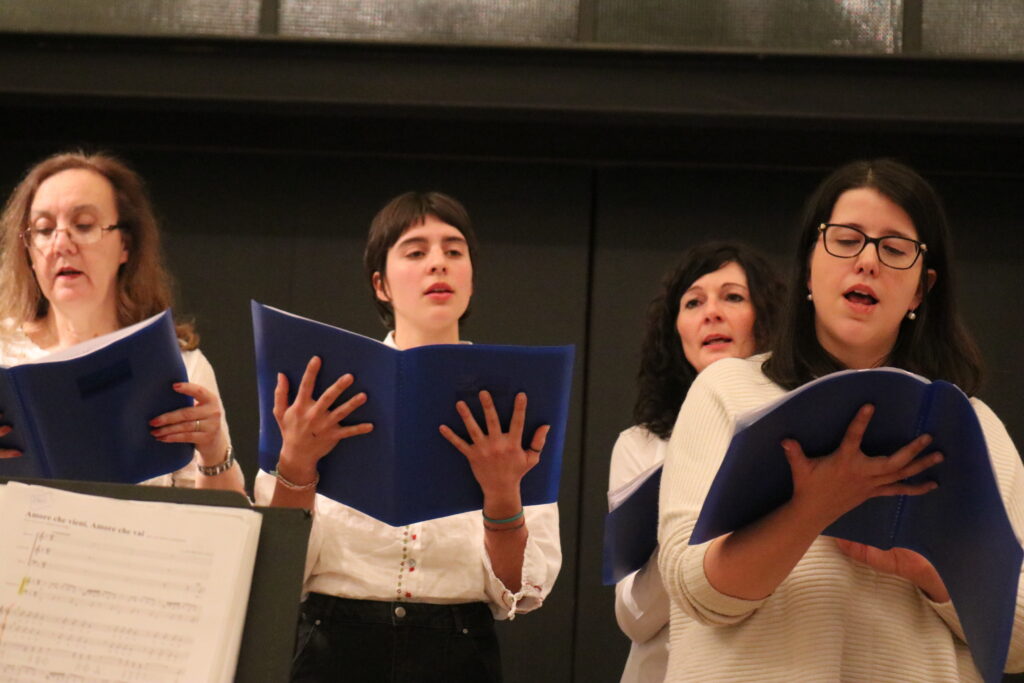
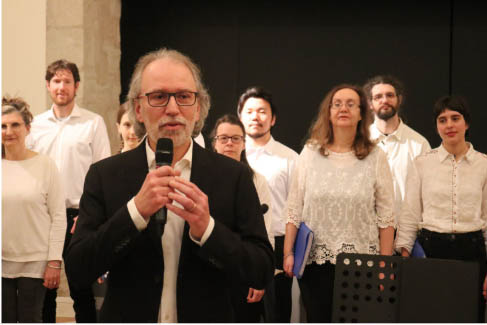
The Foundation Choir—led by Maestro Eduardo Bochicchio—arises from this conviction: it is not only a pleasant moment to share, which can ease the tension of a period particularly full of deadlines or professional challenges until we smile, but it is also a concrete tool for building new bonds within a multicultural and intergenerational community that goes beyond individual roles, because it is in such a setting that we come to know each other better and learn to appreciate the quality of listening we are able to give and receive, as well as the unconditional support we are willing to offer to those around us.
FBK Sound is part of a framework of cultural welfare initiatives, in line with the guidance of the World Health Organization and the New European Agenda for Culture 2030, toward an integrated model of well-being for individuals and communities, through the practice of the performing arts (music, theater, dance) as a source of health, well-being, and inclusion. FBK has always been attentive to promoting initiatives that highlight the individual, also with a view to continually attracting talent to the region.
In a regional context such as Trentino, which has long sought to responsibly interpret its autonomy by becoming a laboratory for experimenting with new welfare models for the benefit of the entire nation, this practice reflects an awareness—following in Bruno Kessler’s vision—of the opportunity to question the idea and meaning of work in the age of AI applied exponentially to every aspect of our personal and professional lives. If the most important challenge increasingly becomes attracting and retaining talent, then every experience capable of fostering motivation, well-being, and community can make a difference.
The world of work, while retaining the centrality of hierarchy that distributes burdens and honors, resources and responsibilities, increasingly becomes an environment shaped by relationships, where what matters is the quality of the people with whom one collaborates, the reciprocity and openness one encounters, and the possibility of intertwining one’s own path with that of fellow scientific explorers who sometimes come from the other side of the world, and with whom ideas can be blended, questions explored, and mutual support offered.
Everything begins with a health-promoting artistic practice such as choral singing, capable of bringing body and mind together, and the minds of those who conduct research are able to range endlessly.
“One does not sing because one is happy; one is happy because one sings,” says philosopher and psychologist William James.
The members of the FBK Choir
Alessio Tomelleri, Barbara Cagol, Chiara Riccardi, Claudio Eccher, Daniela Anesi, Denise Gottardi, Elena Crespi, Elena Donini, Francesca Bovolo, Giancarlo Pepponi, Giovanni Palù, Giulia Foradori, Ilaria Alberti, Irene Brugnara, Laura Ferrarotti, Loredana Panato, Manuela Speranza, Marco Dianti, Martino Bernard, Matteo Martini, Michele Nori, Petra Jansen, Sara Montanari, Silvia Malesardi, Sofia Brenna, Stefania Baruchelli, Stefania Sardagna, Tiziana Martinelli, Tommaso Fonda, Yong Kwon.
Centro Didattico MusicaTeatroDanza di Rovereto – CDM
The Centro Didattico MusicaTeatroDanza di Rovereto (CDM) was founded in 1987 as a unique institution in the region, thanks to its multidisciplinary approach to the study and practice of music, theater, and dance. The CDM is the House of Music and Performing Arts—an ideal place to meet and grow through comprehensive artistic training, in a bright and colorful 1,000-m² space entirely dedicated to generating creative energy.
Maestro Eduardo Bochicchio – Director of the FBK choir
Conductor, opera singer, and pianist. Professor of Piano and Choral Education at the Civica Scuola Musicale “R. Zandonai” and at CDM (Centro Didattico MusicaTeatroDanza) in Rovereto. He studied and worked with prominent Italian and international musicians such as Maria Guinand, Lorenzo Donati, Riccardo Muti, Peter Maag, Lorin Maazel, Daniel Oren, and Tom Koopman. Born in São Paulo, Brazil, he earned a degree in Music (Piano) in 1987 from the Faculdade Santa Marcelina in São Paulo, graduated in opera singing in 1994 from the San Pietro a Majella Conservatory in Naples, and completed a master’s degree in Choral Conducting in 2019 at the Bonporti Conservatory of Trento.
The author/s
-
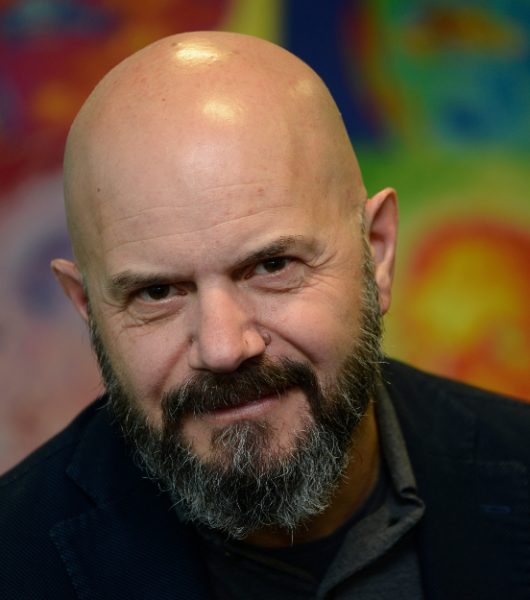 Alessandro Dalla Torre
Head of HR @ FBK
MORE INFO
Related articles