

The importance of mentorship in team growth
March 19, 2026
A meeting dedicated to the management community at FBK, to share relevant experiences and provide insights that support people management and development. Featuring Massimo Di Gregorio—former long-time manager at Thomson Reuters.
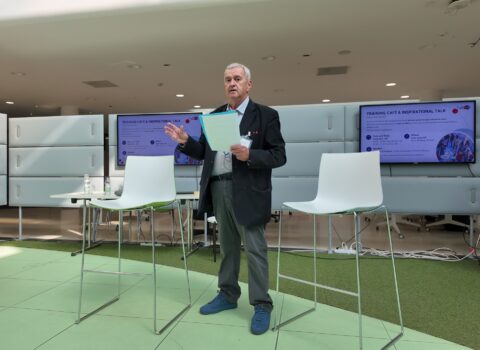
After the success of the inspirational talk held at the end of last year, Massimo Di Gregorio returned to FBK on March 12, 2026, to share experiences from his extensive career leading interdisciplinary and multicultural teams at Thomson Reuters.
The occasion was the first meeting of the “Lead Community,” a space for sharing best practices designed as an initiative to support the Talent Development Program, with the aim of encouraging reflection among managers on the theme of “cultivating talent.”
The meeting took place in an informal setting, as a peer-to-peer exchange in which the guest acted as a first among equals, drawing inspiration from very different figures such as Ettore Messina, François Pienaar, and Roberto Canessa. Each of them, in contexts far removed from business—such as basketball, South African apartheid, and a plane crash in 1972 followed by episodes of cannibalism —faced challenging, multicultural environments in which adaptability proved decisive. Di Gregorio explained how such stories can leave a deep and lasting impression, something that later proved valuable in his career when managing the people he was responsible for.
With this approach, in the spirit of sharing his experience from manager to manager, Di Gregorio presented a couple of anecdotes illustrating two aspects that were fundamental in his career path: the role of Talent Management and the centrality of Mentorship.
The first anecdote, drawn from a case study concerning McKinsey & Company—where “There is no such thing as a talent manager, but every manager has the responsibility to develop growth paths for the talent they oversee.”—highlighted the importance of talent management and development within organizations.
“We are looking for the next CEO”
The second, more personal story is an example of successful mentorship.
Thomson Reuters promoted an initiative that offered top international graduates a rotational path: four semesters in four different geographic areas, with four types of responsibilities.
In practice, it was an accelerated path designed to foster growth through continuous exposure to new organizational and cultural challenges —a way to test capabilities and fully express the potential of emerging talent.
“At that time,” says Di Gregorio, “there was an exceptional talent who had been placed in the wrong role. The tasks assigned by his manager were not helping him grow. I had the intuition to propose a win-win solution by bringing him onto my team for a period, so he could contribute to our objectives. His enthusiasm, along with his technical and linguistic skills, proved decisive in helping us make a qualitative leap in the Moroccan market, which at the time was still developing. It was a complete success: from frustration, with the risk of leaving the program, he went on to excel, was selected for a prestigious MBA at Harvard, and later chose to return to Reuters. Over the years, he quickly advanced through various managerial roles until, about 20 years later, he became my boss. Some might find it humbling that a former mentee became my boss, but for me it was a source of pride that I like to share!”
The trajectory of this talent can be summarized in a few key words: “There are no wrong people, only the right people in the wrong place.” Recognizing potential and trusting it over time proved to be the most forward-looking choice, allowing both mentor and mentee to achieve a successful outcome.
Mentoring as a mutual opportunity
These reflections helped strengthen awareness of the responsibility each manager has toward their team and the growth of its members, especially in a context as diverse as FBK, with nearly 60 nationalities among more than 1,100 active professionals. Mentorship—the speaker emphasized—represents a dual challenge for those who embrace it, offering a significant opportunity for both professional and personal growth.
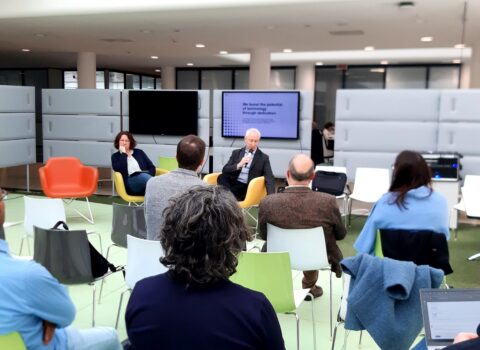
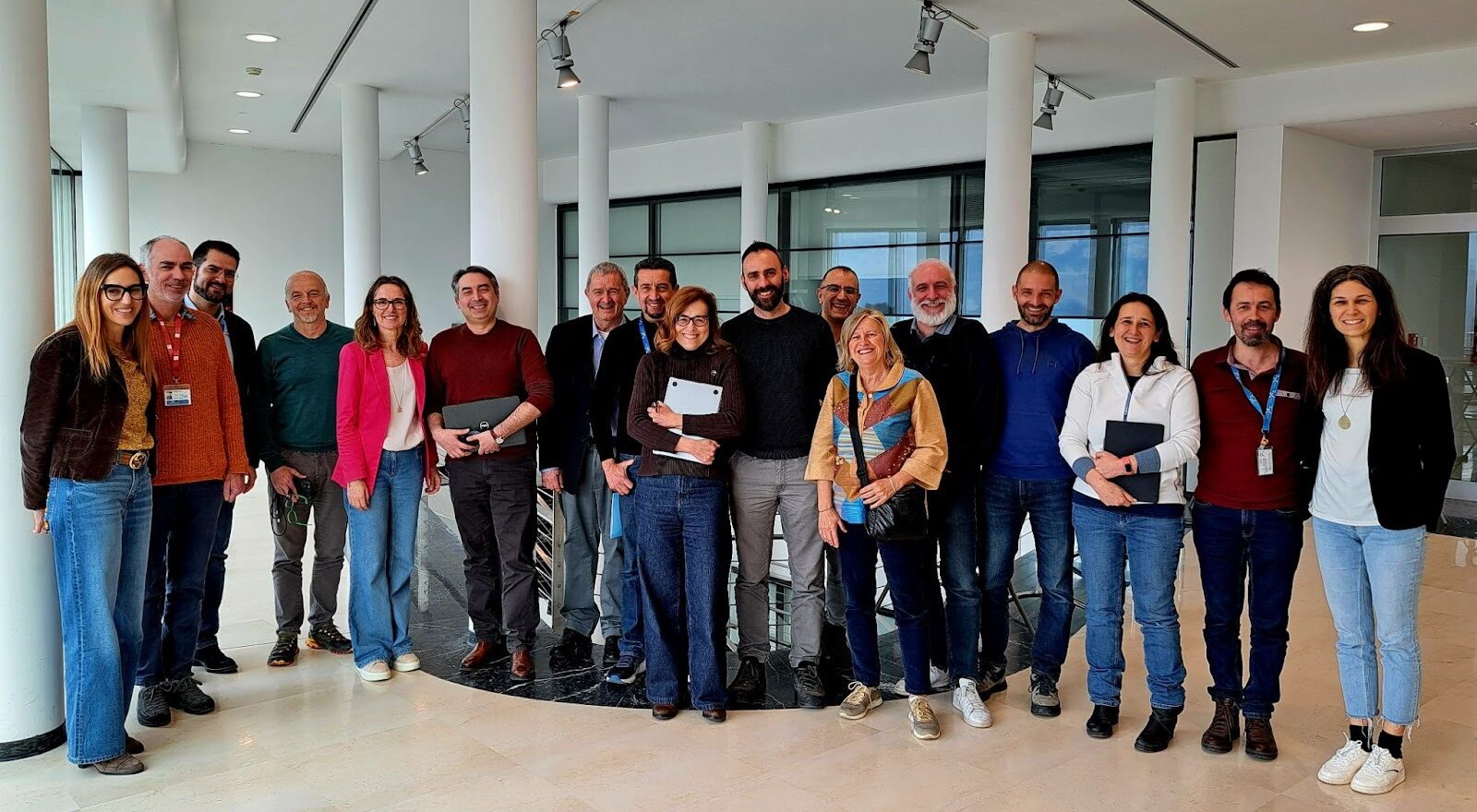
These inspirational stories were followed by questions and observations from the participants—about twenty-five unit managers from various research centers of the Foundation—who connected the lessons from the discussion to their daily work and shared the main leadership, mentorship, and talent development challenges they expect to face in the near future.
The discussion helped clarify several aspects, such as the possibility of practicing reverse mentorship, particularly in relation to soft skills and in the context of knowledge exchange across different organizational lines.
Another observation, based on daily experience, highlighted that in the rapidly evolving field of research, a form of reverse mentorship is already taking place: younger professionals are often the ones introducing new developments and guiding more experienced colleagues.
The exchange also raised important questions: “Are there practical strategies to help people feel more confident in expressing their ideas to managers? How can we best leverage the expertise of our collaborators?”
In response, the guest offered both a question and a reflection.
The question was: what motivates a person? What values and ambitions do they have? In this sense, clear, inclusive, and respectful communication is essential to ensure that multicultural diversity becomes an advantage rather than a barrier. While challenging, it is achievable: it begins with careful listening and the ability to offer opportunities (development plans), highlighting the personal and professional benefits that managerial challenges can bring.
The reflection served as a reality check: “You are not managing yourself.” Everyone is different, and it is necessary to work on the distribution and articulation of roles. In this context as well, choosing the right language and managing feedback carefully are essential. Di Gregorio recalled the maxim of management expert Ken Blanchard, “feedback is the breakfast of champions,” which he has followed throughout his career—not just as a professional guideline, but as a principle for life.
Finally, authenticity and intellectual honesty matter: acknowledging one’s own limits and asking for help often brings out potential, as it encourages everyone to focus together on solving shared challenges.
The discussion highlighted the complexity of how an organization like FBK operates—constantly balancing scientific excellence and socio-economic impact—and the key role played by middle managers, who are called upon to pursue “sustainable objectives,” meaning appropriate goals of continuous improvement, within a dynamic environment that requires strong cultural mediation. This is a demanding, almost maieutic effort, shaped by the pressures of international competition—a constraint that risks eroding the very meaning of work and diminishing its sense of purpose and wonder. This is why the support provided by the People Innovation for Research service, and in particular the psychological support desk, is essential to accompany these processes, ensuring that individual needs are addressed and that talent is gradually guided toward paths aligned with their highest aspirations.
Mentorship definition
Mentoring is a developmental relationship in which a more experienced individual (mentor) guides a less experienced one (mentee) in both professional and personal growth. Based on trust and empathy, it involves the transfer of knowledge, values, and skills, supporting the mentee’s development, career progression, and well-being. It is a key tool for onboarding and talent development in organizations. Mentors support mentees through advice, guidance, shared experience, and feedback.
The author/s
RELATED VIDEO
-
Talent Development Program
Related articles