
Those who speak poorly, think poorly and live poorly
November 26, 2025
Riccardo Gallotti interviews Luca De Biase: an unprecedented, inverted dialogue between a scientist and a journalist in the name of media ecology—combining critical analysis of today’s information landscape with proposals for interventions that help redefine the rules of the game to promote information quality.
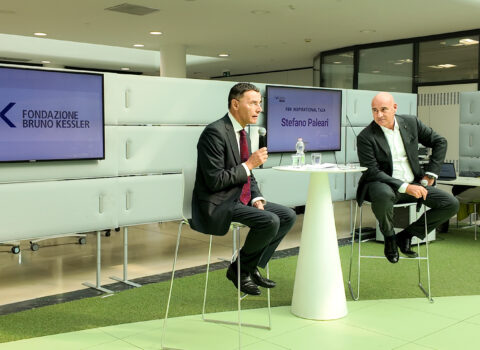
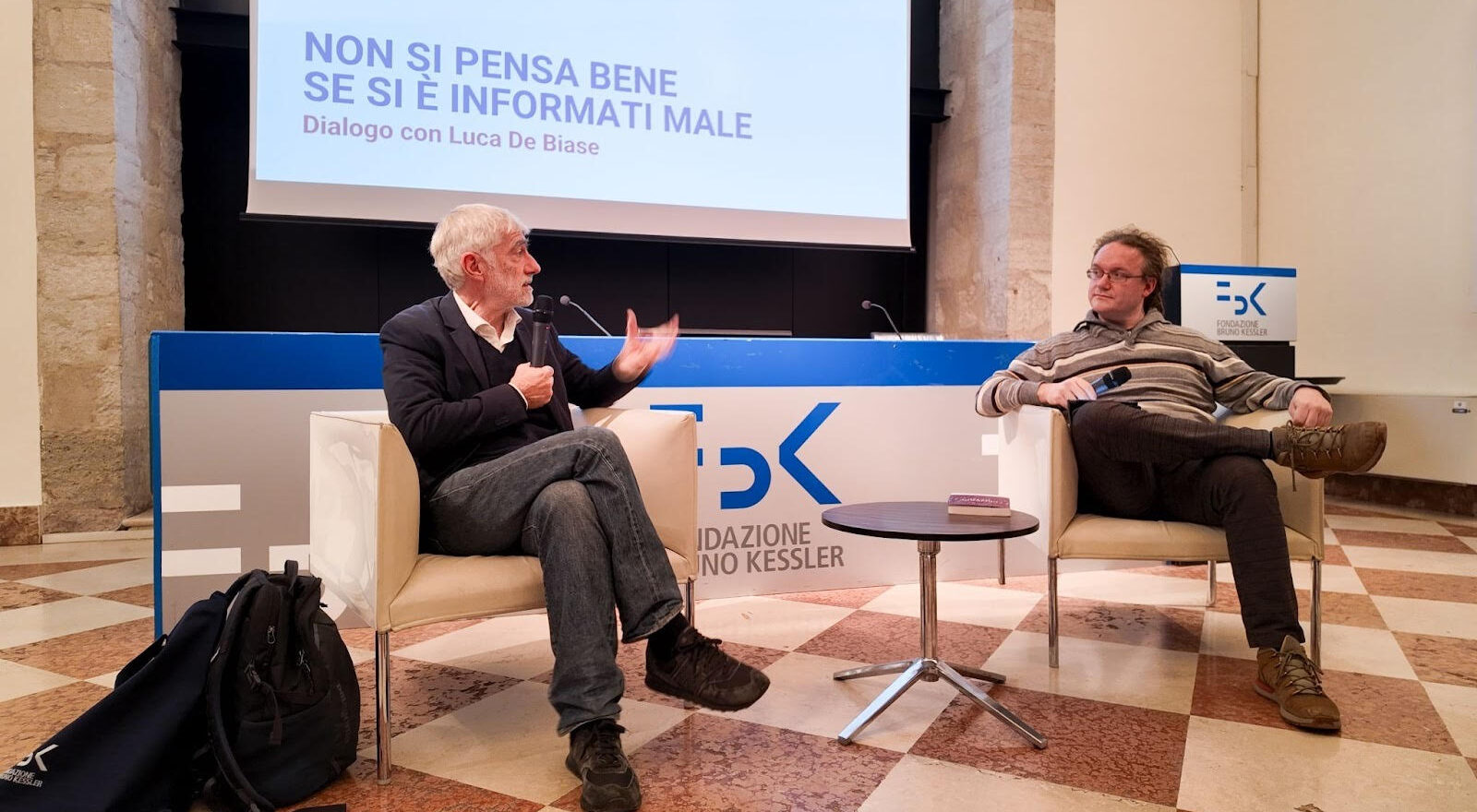
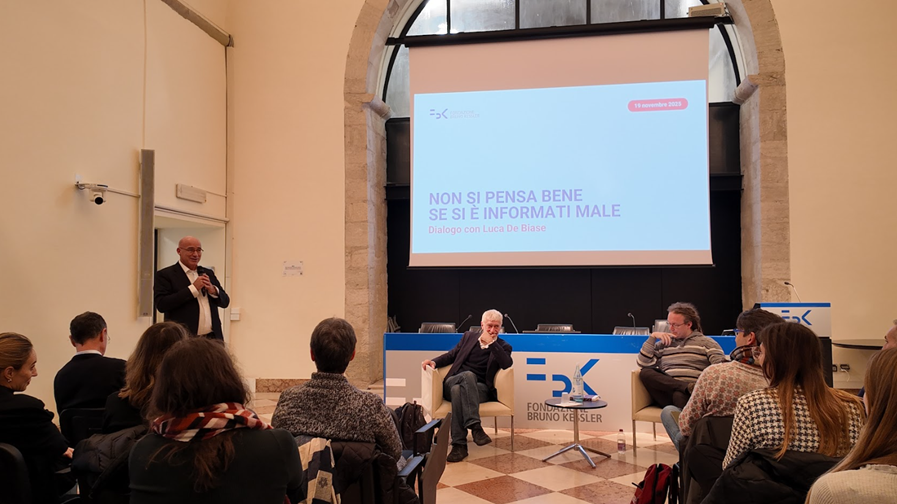
On Wednesday, November 19, 2025, the headquarters of FBK’s Humanities Center, hosted innovation journalist Luca De Biase as featured speaker of the inspirational talk entitled “You don’t think well if you are poorly informed.”
Speaking with him was Riccardo Gallotti, FBK Science Ambassador, head of the FBK Center for Digital Society’s CHub Lab, and coordinator of the European AI4TRUST project, which in recent years has produced a platform against disinformation that combines the contribution of artificial intelligence and a network of journalists and fact-checkers.
The central theme was media ecology, a topic long important to the guest. With this term, De Biase identifies the quality of information not only as a good to be protected but as an indispensable “nourishment” for renewing democratic debate and fostering the formation of informed opinions—opinions that are, in fact, as well informed as possible.
The current context for this reflection is a spiral involving the media, politics, and culture, which has generated a sort of adverse selection of information that tends to distort our perception of reality—one we are not fully aware of because it is overwhelmed by propaganda and commercial impulses that produce distraction, distrust, loss of meaning, polarization, and constant conflict.
Words are important.
Riccardo Gallotti: “A lot of available but not very authoritative and confusing information—often deliberately made confusing—creates the problem of the reliability of the information we ‘feed’ on daily through the feeds we receive. Are words still important? In a world where we have created automatic word generators, aren’t words now overabundant? Has AI started a ‘negative trend’?”
Luca De Biase: “We are immersed in a context that underestimates the effects of the machine that manages words. However, LLMs challenge us to improve. I consider—and invite you to consider—what generative AI produces as an additional document, nothing more. And as such, like any document, it must be subject to verification to assess how reliable and consistent the content is. Another key aspect we should not forget is that AI is not at all conscious nor in relation to people, like we are.”
The role of social media in society
RG: “The most widely used digital social media platforms currently offer interfaces that suggest other people for users to follow, encourage the ambition to gather many followers, and push them to judge any message. These design choices stem from a narrative that glorifies competition for prestige and notoriety; this narrative has turned each of us into an ‘expert’ entitled to an opinion, not necessarily an informed one. How much of the social and political problems we have faced in recent years is the fault of digital social platforms?”
LDB: “Today platforms have an enormous impact. The recommendation algorithm is central. In fact, platforms exercise an editorial function and are responsible for the content they convey, as the European Digital Services Act rightly establishes. The old saying ‘It’s not my fault, it’s not my responsibility—it’s the users who do it’ has fallen apart. Platforms also reveal something very important about the cultural result that emerges from interaction with them—they have become communication media. As Marshall McLuhan argued, the flow of information and communication inputs shapes our time, for better or worse. But the blame is not on the platforms themselves but on the people who built them this way and who, even after discovering the harm they caused, continued to perpetuate it. That’s why I see a strong analogy with ecology. The media world is a polluted ecosystem. Different rules are needed. In Clinton’s era, freedom from regulation served to grow the companies that later became oligopolistic giants so powerful that they now influence the U.S. government itself. The relationship that has developed between platforms and society is colonial in nature. Platforms have contributed to undermining our democracy. In fact, there is a close correlation between the use of quality information and voting. Hyperpolarization has distorted the interests of the masses, leading many people to believe that ‘they’re all the same—it’s better to stay home.’ This has always been the strategy of dictators.”
ECOSYSTEM and MEDIA ENVIRONMENTALISM
RG: “How can a society continue to thrive without being informed?”
LDB: “We need a different logic to overcome this impasse —a logic that reconnects us with the physical world. Consider the opportunity to re-center relationships by making platforms marginal in our lives. We don’t need to shut them down but to find the right proportions, limit technology development, reintroduce the physical context of the interactions in which platforms operate, and reconsider them for what they are: tools for communication and conversation, serving our interaction and collaboration. One proposal that has emerged is to apply a label to images produced by AI. To this I add that, given the increasing number of such images, it would also make sense to introduce a label that allows us to immediately recognize content produced by humans—a kind of ‘organic’ brand for information.”
Communicating science and the importance of the scientific method
RG: “You were one of the founders of the SOCIAL DATA SCIENCE ALLIANCE (of which Bruno Lepri is also a member), which explicitly calls for a data-access space for researchers studying online social behavior, in line with the requirements of the European Digital Services Act. What is DSA? What updates do we have?”
LDB: “Science must be able to access the data contained on platforms. The goal is to define a practice to make use of the law and interact with platforms in a predictable and facilitated way. There is a gap between reality and unreality; the distinction between advertising and editorial content has disappeared. Scientific and journalistic methods help us here—they are like a beacon for building trust: journalism is an ‘artisan version’ of the scientific method. One must verify, document, consult independent sources, explain any conflicts of interest, and so on. The main problem lies in the separation between facts and perception. 2016 was the Chernobyl of the media—reality exploded in the convergence of Brexit and the Facebook–Cambridge Analytica scandal that paved the way for the rise of Trump.”
RG: “A silent majority—89% of the population—wants stronger action against climate change, yet they do not believe they are a majority, partly because of the overrepresentation of scientifically ‘wrong’ positions based on the principle of false balance. What is the role and responsibility of researchers in communicating scientific results? How do we bring scientific truth to the forefront?”
LDB: “Scientists do not offer certainties but probabilities, based on the observed conditions of phenomena. Consensus forms around evidence that supports theories. The example of the International Panel on Climate Change is illustrative. The IPCC played a crucial role in highlighting that scientific consensus on the issue was overwhelming—99% of scientists agreed, while 1% did not. In such a context, giving equal weight to opposing positions seriously distorts public perception. Here we return to method: speaking proportionately is a journalistic rule; you cannot report on facts without considering the proportion of things. The instrumental use of the obligation to contradict produces mass distraction, distorts public consensus, and shifts opinions in favor of perceptions at the expense of facts. As a result, this spiral of causes and effects leads to less informed, less forward-looking choices.”
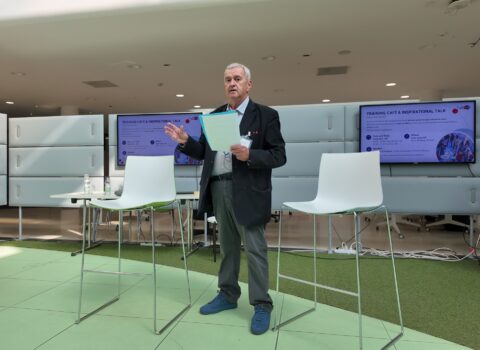
In the concluding debate, FBK President Ferruccio Resta intervened with an observation and a question: “The time factor influences our ability to gather and weigh up information inputs in order to draw conclusions that are useful for decision-making. In the attention economy that defines the present—marked by a constant stream of updates—we risk making hasty or risky decisions. What is information?”
LDB: “The constant chase should not frighten us. It is up to us to select the sources we consider to be high quality and determine the degree of depth necessary for each type of analysis or decision. Information, understood this way, precedes the here and now and is meant to prepare us to face events immediately. It becomes an evaluative and interpretive method—the result of long prior experience—that allows us to quickly recognize new events through recurring patterns and apply relevant interpretive keys. We must learn to connect the patterns we already know with new facts, or as Alessandro Bergonzoni says, ‘we need an intermental thread.’ Information lived this way is nothing more than culture.”
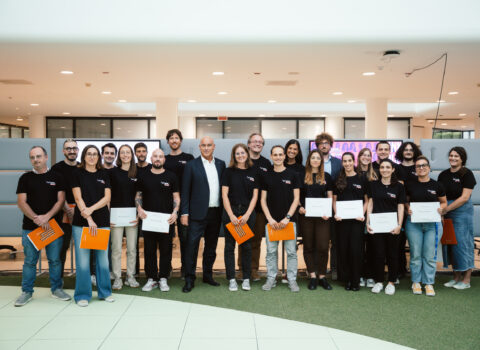
The meeting concluded with the presentation of the second edition of the FBK Science Ambassadors program, whose goal is to train young members of the FBK research and innovation community in scientific communication through storytelling, public speaking, and digital communication. The program offers a high level of training involving the Feltrinelli Foundation and the Holden School and develops through hands-on outreach activities. Last but not least, every ambassador represents FBK at public events like this one and has the opportunity to build interdisciplinary dialogue rooted in a shared desire to communicate the wonder and adventure of knowledge.
LUCA DE BIASE
Innovation journalist at Il Sole 24 Ore and author and voice at Rai Radio 3. Lecturer at the University of Pisa and at Luiss in Rome, gateway designer at the National Biodiversity Future Center, he directed the research on Media Ecology for Reimagine Europe in Brussels. Among his most recent books: Il lavoro del futuro (Code, 2018), Eppur s ‘innova (Luiss, 2022), Il codice del futuro and La legge dell ‘intelenza artificiale (both with Roberto Viola, Sole 24 Ore, 2023 and 2024), Apologia del futuro (Luiss, 2025). In 2016 he won the James Carey Award for Outstanding Media Ecology Journalism.
The author/s
-
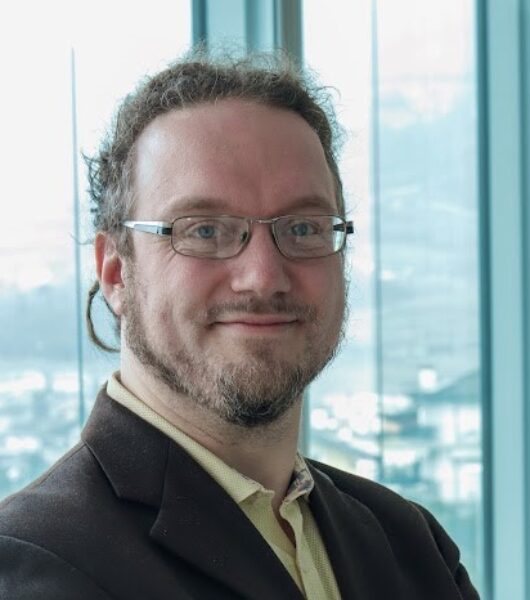 Riccardo Gallotti
Head of @ CHuB lab at Digital Society Center.
MORE INFO
Related articles