
What remains to be discovered about the Higgs boson
March 3, 2026
There will be 13,000 innovative ultra-fast silicon detectors, developed and produced by FBK, installed at the heart of the CMS (Compact Muon Solenoid) experiment at CERN in Geneva. The project, launched with INFN Turin, will help study and measure particle physics phenomena with greater precision.
The discovery of the Higgs boson marked a historic turning point for particle physics in 2012. But that announcement, far from closing a chapter, opened a new one. Today, the scientific community faces new challenges, aiming to explore crucial aspects such as the rare decay channels of the Higgs boson and the possibility of small deviations from the theoretical model that could point to new physics beyond the Standard Model. To address these questions, much more data is needed than has been collected so far by the Large Hadron Collider (LHC) at CERN in Geneva: more collisions mean more statistics and therefore more precise measurements. In this context, CERN is preparing a major upgrade of the Large Hadron Collider (HL-LHC), which in the coming years will significantly increase the number of particle collisions—up to five to seven times the current rate—allowing the Higgs boson to be studied with unprecedented precision and pushing the boundaries of knowledge even further.
As part of this upgrade, ultra-fast LGAD (Low Gain Avalanche Diode) silicon detectors will be used for the first time. These devices add a fundamental new dimension to event reconstruction: time. This breakthrough, known as 4D tracking, makes it possible to measure not only where a particle passes (the three spatial coordinates), but also when it does so, with an accuracy on the order of a few tens of picoseconds. This enables researchers to distinguish events produced in collisions that occur extremely close together in time, improving event reconstruction under high-luminosity conditions.
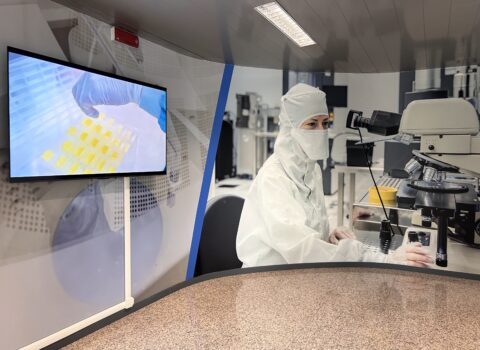
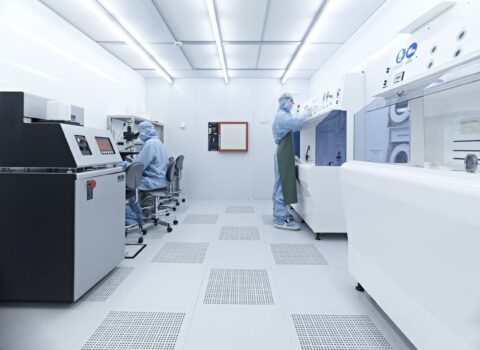
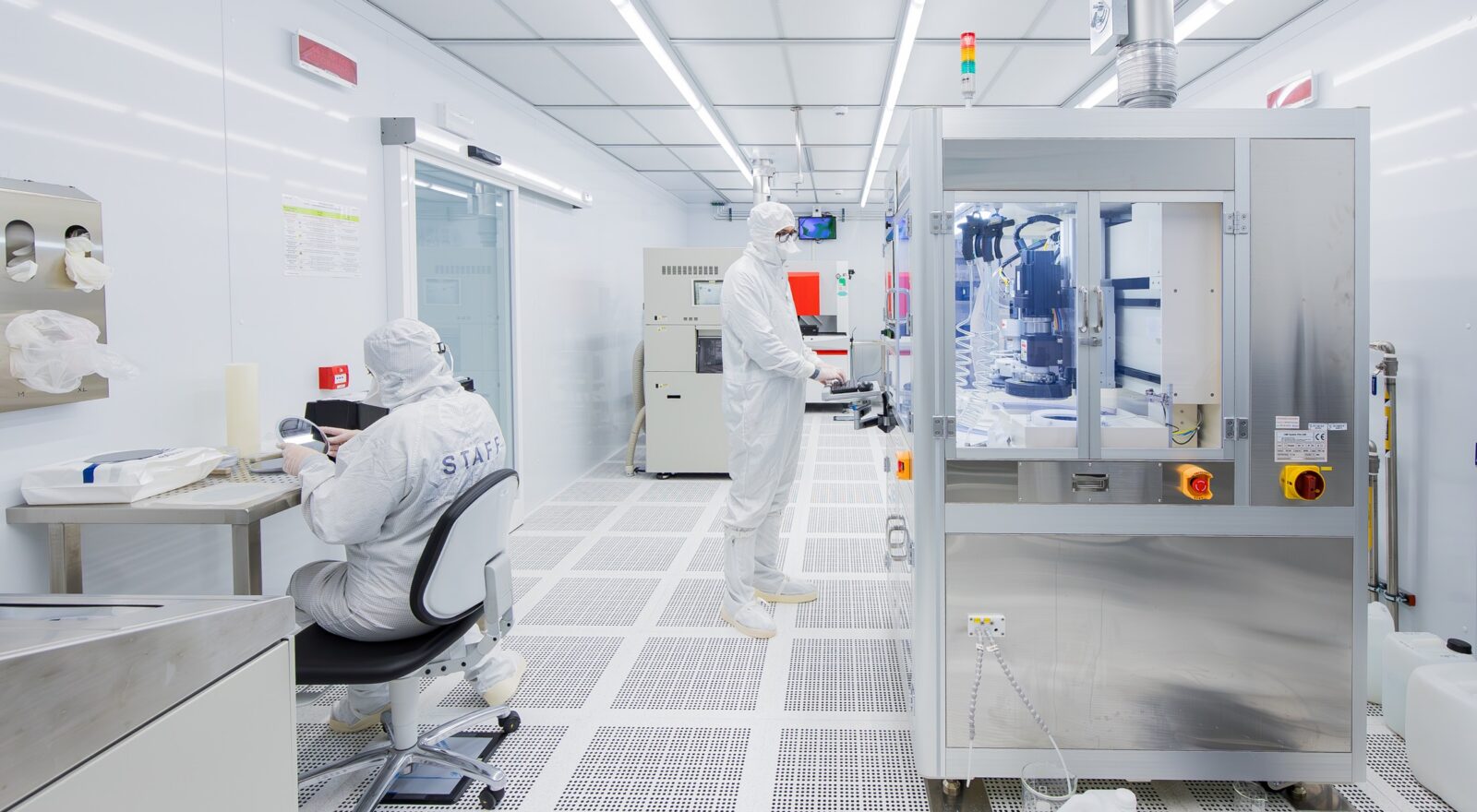
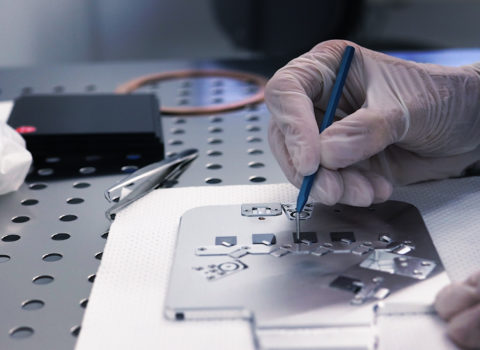
Fondazione Bruno Kessler has played a central role in the technological development, process optimization, and large-scale production of these detectors. The journey began more than ten years ago in FBK’s laboratories and clean rooms and has now resulted in a major supply of sensors for a high-energy physics experiment.
International recognition of this work came with the ICFA Instrumentation Award 2026, presented to Nicolò Cartiglia (INFN Turin) at the TIPP2026 conference in Mumbai “for the pioneering development of ultra-fast silicon detectors for precision timing, now widely used in the particle physics community and enabling 4D tracking detectors.” His scientific insight found in FBK’s clean rooms the capacity for technological optimization and large-scale production.
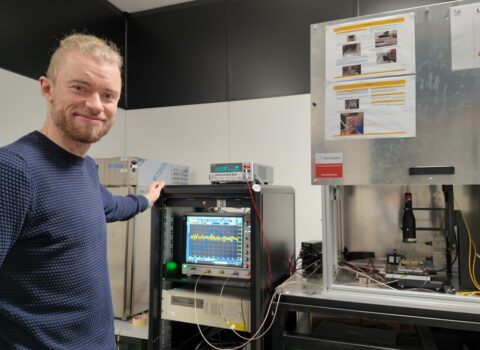
Giancarlo Pepponi, Head of the Custom Radiation Sensors (CRS) Unit at the FBK Center for Sensors & Devices , expressed great satisfaction with the research results:
“We are excited to consider Nicolò Cartiglia’s achievement as part of our own, the result of the long-standing collaboration between FBK researchers (Maurizio Boscardin, Giovanni Paternoster, and Matteo Centis Vignali) and the INFN group in Turin. The work carried out at FBK made it possible to overcome a double challenge: on the one hand, to design and build a device unlike any before, capable of detecting particles with a time resolution of less than 40 picoseconds—at least five times better than the state of the art; on the other hand, to turn a research prototype into an industrializable, stable, and radiation-resistant technology suitable for equipping the large active areas of the CMS detector within an extremely short timeframe. This result stems from the close integration of fundamental research and highly innovative technological development.”
As luminosity increases at the Large Hadron Collider, the number of events produced becomes greater and more closely spaced. Without extremely precise timing information, many interactions risk overlapping and becoming difficult to resolve. The sensors developed by FBK will instead make it possible to separate nearly simultaneous events and significantly improve the quality of the data collected, increasing the precision of measurements of the Higgs boson and paving the way for new discoveries.
Now, the 13,000 devices produced by FBK will be installed in the CMS Endcap Timing Layer, with the goal of increasing measurement precision, reducing background noise, and enabling increasingly refined analyses of the fundamental processes of matter.
The author/s
Related articles