August 2026: The FBK projects making headlines
September 1, 2026
From supercomputing for AI and drones for wildlife protection to clean rooms, complex systems, neuro-symbolic AI, and environmental history, FBK research once again received prominent coverage in local and national media throughout August.
Drones and artificial intelligence for wildlife protection
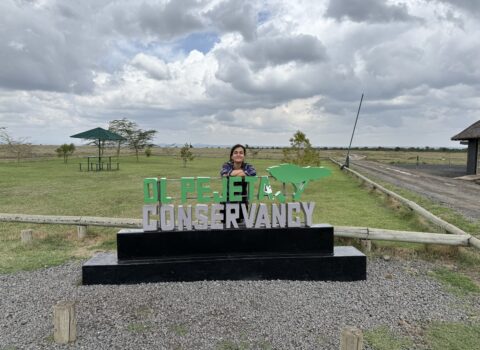
National Geographic provides in-depth coverage of WildDrone, the European project that uses drones and artificial intelligence to support wildlife conservation.
The project involves thirteen doctoral students from nine European and African countries and includes Fabio Remondino and Vandita Shukla, respectively head and doctoral student of the 3D Optical Metrology – 3DOM unit at FBK ‘s Center for Digital Industry. New technology solutions are being tested in a wildlife reserve in Kenya to make it easier, faster and less invasive to monitor wild animals.
Drones make it possible to detect animals across vast areas, while artificial intelligence can identify individual animals based on specific characteristics and collect biometric data. The next step is to apply 3D imaging techniques to the video footage to gather information about the animals’ health and behavior, reducing the need for invasive procedures.
The work will continue with WildBotics, a three-year project coordinated by Fabio Remondino that will build on the work of WildDrone, further advancing the integration of robotics, artificial intelligence, and biodiversity conservation.
National Geographic | “Il grande fratello che aiuta a salvare i leoni del Kenya” | August 2026
Eni’s supercomputing opens up to the innovation ecosystem
The announcement that Eni will make its supercomputing infrastructure available to companies, startups, and research centers received extensive coverage in the national media. The initiative will provide access to computing power, specialized expertise, and advanced tools for developing artificial intelligence and digital innovation solutions. Fondazione Bruno Kessler is among the organizations that have expressed interest in the initiative. Access to Eni’s supercomputing capabilities could support the development of new artificial intelligence models, advanced simulations, and projects requiring significant computing power, at a time when digital infrastructure and technological sovereignty are becoming increasingly strategic.
ENI | “Eni apre la propria capacità di supercalcolo all’ecosistema dell’innovazione” | July 28, 2026
Corriere della Sera | “Eni «offre» i suo supercalcolcolatori” | July 29, 2026
Avvenire | “Infrastrutture Eni di supercalcolo aperte ad aziende” | July 29, 2026
Libero | “Eni apre i suoi data center a imprese, startup e centri di ricerca” | July 29, 2026
AGI | “Eni, aperta capacità supercalcolo a ecosistema innovazione” | July 28, 2026
Inside FBK’s clean rooms
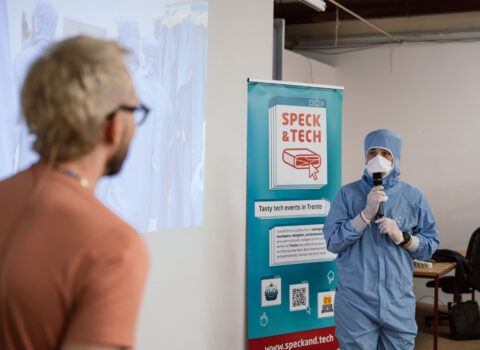
RaiNews24 takes viewers inside FBK’s clean room with Alessandro Cian, a researcher at the Center for Sensors & Devices and one of the Foundation’s Science Ambassadors. The story focuses on sensors and devices with applications ranging from healthcare and environmental monitoring to space missions and physics experiments at CERN in Geneva.
Among the cutting-edge technologies presented by Cian are diamond-based sensors. By using techniques that make it possible to introduce a small number of atoms into the material, researchers can create devices that are extremely sensitive to changes in their surroundings, with potential applications ranging from quantum technologies such as qubits to biomedicine.
RaiNews24 – Futuro24 | “Trento, una camera pulita per sensori high-tech” | August 2026
Predicting failures to design safer systems
On Smart City, Radio 24’s show dedicated to innovation and technological change, Alessandro Cimatti, director of FBK’s Center for Digital Industry, discusses the work of a team specializing in the analysis of potential failures in complex systems, from space and railways to transportation and manufacturing.
When many components interact, knowing how reliable each one is is not enough to predict how the system as a whole will behave. Using advanced models and software, FBK researchers map the dependencies between potential failures and identify combinations of events that could compromise critical functions. The goal is to assess risk in accordance with regulatory requirements and determine the appropriate level of redundancy at the design stage, ensuring that systems are sufficiently safe and reliable while avoiding the costs and energy consumption associated with making them more robust than necessary.
Radio 24 – Smart City | tervista ad Alessandro Cimatti| August 2026
Artificial Intelligence that reasons
Neuro-symbolic artificial intelligence and Luciano Serafini’s work were the focus of an in-depth report by RTTR following the FBK researcher’s two international awards.
Head of the Data and Knowledge Management Unit at the Center for Augmented Intelligence, Serafini works on the development of systems capable not only of learning from data, but also of using knowledge and rules to reason. This approach combines neural networks with symbolic logic to build artificial intelligence systems that are more reliable, interpretable, and capable of tackling complex problems.
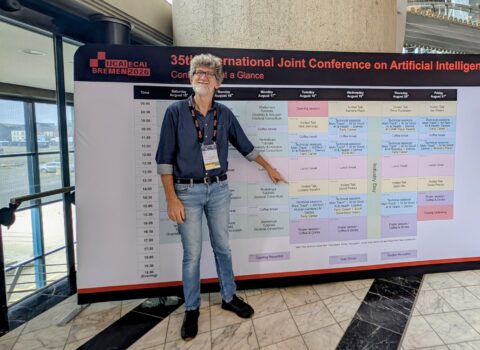
In August, Serafini was invited to give a keynote lecture at IJCAI 2026, one of the leading international scientific conferences on artificial intelligence, where he presented his work on Logic Tensor Networks. At the same event, he received the 2026 AIJ Prominent Paper Award, which recognizes scientific papers that have had a lasting impact on international research.
RTTR | evening news | August 21, 2026
Looking to history to understand today’s environmental crises
Repubblica dedicates an in-depth study to the conference “Ambiente e storie. Dall’antichità ai giorni nostri” (Environment and stories. From antiquity to the present day), organized by the Italian Society of Environmental History and scheduled September 3-5 at the University of Calabria in Rende. The event, organized in collaboration with FBK’s Italian-German Historical Institute and other institutions, with researcher Katia Occhi serving on its scientific committee, brings together historians and scholars from various disciplines to explore the roots of contemporary environmental crises. From hydrogeological hazards and water resource management to industrial pollution and climate change, the conference brings together historical research and biogeophysical disciplines to understand how the relationship between societies, the environment, and natural resources has evolved over time.
This long-term perspective allows us to see many of today’s environmental crises not as isolated phenomena, but as the result of transformations and choices rooted in history.
Supertimber, wood as strong as steel
Il T newspaper tells the story of Supertimber, a composite material created through a collaboration between FBK and Xlam Dolomiti and developed through a process that brings together scientific research and industry. From the first prototypes developed in the Foundation’s laboratories to full-scale industrial production, the project is a concrete example of technology transfer and of turning local research into real-world applications.
The result is a material in which wood is densified and combined with reinforcing matrices, increasing its mechanical strength and durability while retaining the properties of a natural, renewable raw material. Potential applications include sectors where strength and light weight are essential, from transportation components to space applications, where Supertimber could provide a lighter, more sustainable alternative to traditional materials. Other potential applications include construction, flooring, interior design, and sports equipment such as tennis rackets.
Il T | “Supertimber, il legno forte come l’acciaio che sogna lo Spazio” | August 30, 2026
The author/s
Related articles