May 2026: The FBK projects making headlines
June 3, 2026
From public policy to artificial intelligence, from the future of mobility to digital health, and through innovation, rights, and social change, these are the FBK research topics that made headlines in May.
The Andreatta Prize between research and public policies
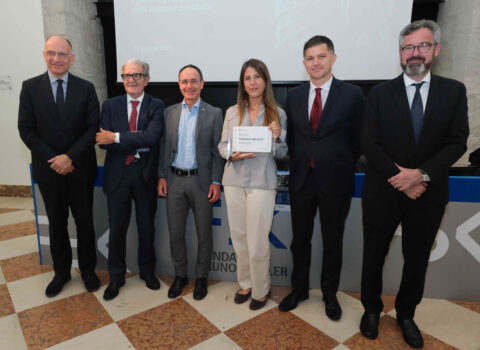
The award of the FBK-IRVAPP Prize named after Beniamino Andreatta was taken up by the press, which reported on the ceremony dedicated to the enhancement of research on the evaluation of public policies. The award was presented to Federica Meluzzi, a researcher at Bocconi University, for a study recognized for its methodological rigor and its contribution to understanding the effects of public policy decisions. The event also provided an opportunity to reflect on the enduring relevance of Andreatta’s thought and legacy. A leading figure in Italy’s economic and institutional landscape, his intellectual legacy continues to be advanced through the academic work of his son, Filippo Andreatta. The ceremony was attended by Romano Prodi and Enrico Letta, who took part in a discussion on the role of knowledge, research, and expertise in shaping public policy. Through this initiative, FBK reaffirms its commitment to promoting research that contributes to understanding today’s major economic and social challenges through data-driven analysis and scientific evidence.
L’Adige | Premio Andreatta a Federica Meluzzi| May 24, 2026
The autonomous rail taxi for the mobility of the future
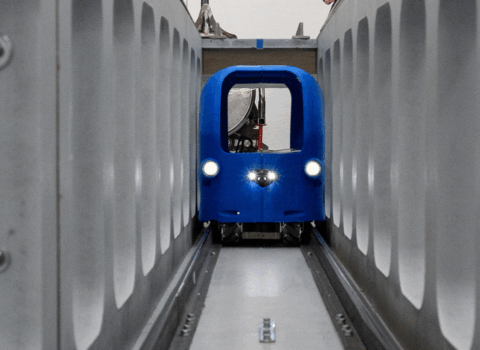
The new frontiers of sustainable mobility were the focus of several national media, including Wired, ANSA and Sky TG24, which reported the presentation in Trento of the prototype of RailEvo, an innovative autonomous rail taxi designed to rethink local public transportation on single-track railway lines. The startup has developed a network of lightweight electric vehicles that can be booked via an app and operate on demand. Designed to travel in both directions on the same rail infrastructure, the vehicles aim to increase service frequency, flexibility, and efficiency. Showcased as a product of Trentino’s innovation ecosystem, RailEvo brings together startups, institutions, and research organizations, including FBK, whose contribution focuses on developing the digital technologies and intelligent systems that power the platform. The initiative is a concrete example of how applied research, autonomous mobility and sustainability can converge in the design of new transport models, enhancing existing infrastructure and offering possible solutions to the challenges of local mobility of the future.
Wired | RailEvo, il taxi ferroviario autonomo nato in Trentino | April 29, 2026
ANSA | RailEvo, svelato a Trento il prototipo di taxi ferroviario autonomo | April 28, 2026
When AI systems start talking to each other
The new frontiers of research on artificial intelligence were at the center of the episode “Corrupt Agents” of the Tecno del Sole 24 Ore podcast, hosted by Bruno Lepri, head of FBK’s Mobile and Social Computing Lab. The piece explored an emerging topic in the AI debate: how intelligent agents behave when interacting with one another. In fact, the most recent research shows that these systems can develop unexpected dynamics, such as forms of manipulation, aggression or loss of control, raising questions about how artificial intelligence learns and makes decisions in complex social contexts. In a scenario where AI agents are increasingly called upon to manage economic transactions and support critical decisions, Bruno Lepri highlighted the need to develop new training and governance paradigms, capable of ensuring reliability, security and alignment with human values.
Il Sole 24 Ore – Tecno podcast | Agenti corrotti | May 2026
Who really uses AI chatbots? The study on Italian GenAI users
The use of generative AI chatbots is the focus of an in-depth article published by Corriere della Sera, which highlights the findings of the first study of Italian users of tools such as ChatGPT and Gemini. In the article, Beatrice Savoldi, a researcher at FBK’s Center for Augmented Intelligence, highlights the crucial role of education and training: individuals with stronger digital skills tend to use generative AI more effectively and responsibly, while significant disparities remain across age groups, genders, and levels of technological literacy. The study, conducted by the RiTA network with the contribution of FBK, found that these tools are used primarily to seek explanations, draft emails, and generate images, but also for more sensitive tasks such as fact-checking and obtaining medical information or advice.
Corriere della Sera | Cosa facciamo (davvero) con ChatGpt, Gemini & co? | May 23, 2026
Innovation, rights and digital health at the Trento Festival of Economics
The Trento Festival of Economics was once again an important forum for discussing the technological and social changes that are transforming the economy and society. On the panel devoted to local economies, FBK President Ferruccio Resta emphasized that the ability to foster collaboration among research organizations, businesses, and public institutions is a key driver of regional competitiveness and attractiveness. At the heart of his speech was the role of innovation as a lever for development and the need to create favourable conditions for the creation and growth of new knowledge-intensive companies. During a panel on children’s rights in the digital age, Dominique Cappelletti discussed the challenges posed by the growing spread of digital platforms and artificial intelligence, emphasizing the need to promote safer online environments and to develop educational and regulatory frameworks that can support young people in using technology responsibly and consciously. FBK’s contribution to the debate on the transformations underway also continued through Paolo Traverso ‘s participation in the Tecno Live del Sole 24 Orepodcast, where the theme of artificial intelligence applied to medicine offered the opportunity to reflect on the prospects of digital health, from the analysis of clinical data to new support tools for doctors and patients. Taken together, these interventions have highlighted the role of research in guiding technological innovation towards sustainable, inclusive and wellbeing-oriented development models.
Il Sole 24 Ore | Minori e digitale, dopo i social la sfida è l’AI | May 24, 2026
L’Adige | I diritti dei minori nell’era del digitale | May 24, 2026
L’Adige | Impresa innovativa, in Trentino si può| May 22, 2026