Training that nurtures talent
February 18, 2026
New year, new beginnings. The training opportunities for 2026, connected to the experiential tracks of the Talent Development Program, have been presented. FBK Academy is a continuous learning environment built on peer exchange, where individuals take the lead in their own professional development, continually strengthening both hard and soft skills.
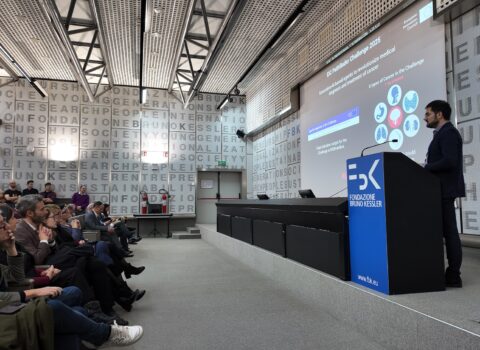
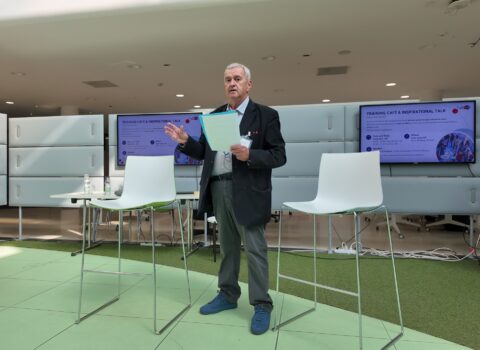
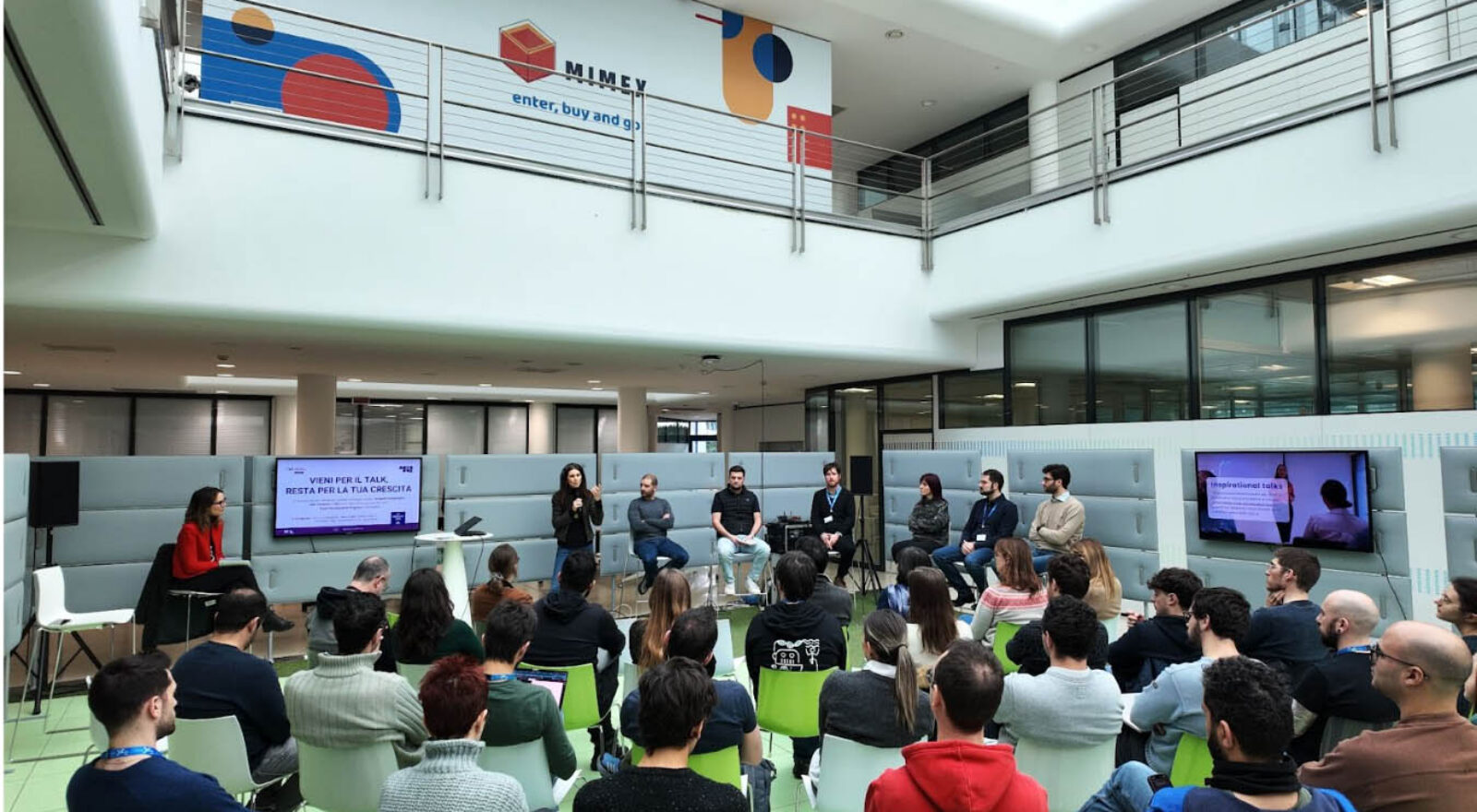
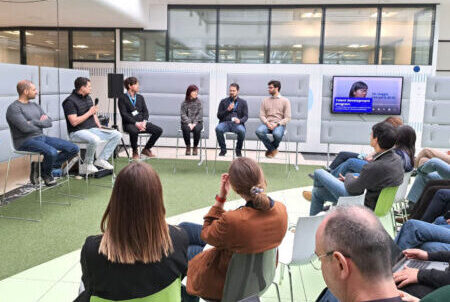
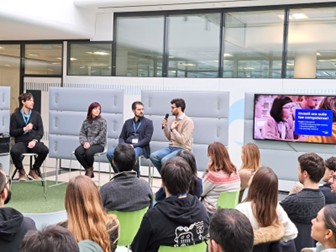
On January 29, FBK’s training café was held— a format that combines talks and sharing, firsthand testimony and reflection. It was an opportunity to explore the various training options available throughout the year, both in person and online, tailored by discipline, skills, and career path. A welcoming way to find inspiration and begin asking yourself: which direction do I want to take now?
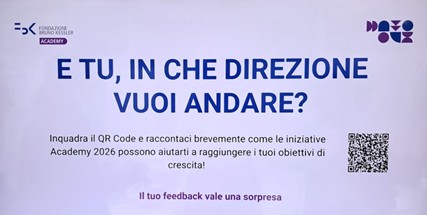
L’incontro si inserisce nella cornice del Talent Development Program che descrive quattro possibili sentieri di sviluppo per la propria crescita professionale in FBK, a cui sono collegate specifiche proposte formative.
Finding direction is essential for making decisions, and to find direction it is crucial to know yourself deeply, understand your strengths, and identify the missing pieces in the mosaic of your evolving professional profile.
Voices from those who stepped up
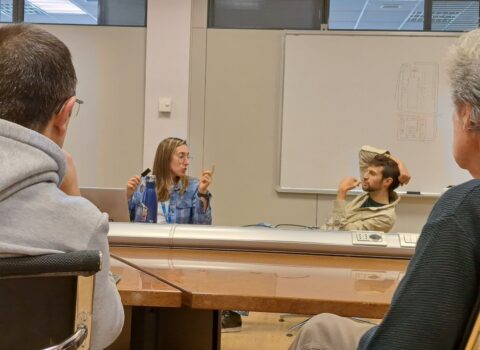
Monica Consolandi, Mauro Dragoni, Alessandro Lega, and David Novel took part in the discussion, sharing with colleagues some of the lessons they learned through the programs they experienced in recent months. The exchange was moderated, together with HR representatives Luisa Rigoni and Silvia Tomasi, by Marco Dianti and , who participated in the Science Ambassador program—an opportunity to train or refine soft skills and communication competencies essential for anyone wishing to engage with the challenges of innovation, bringing scientific knowledge into real-world contexts and tailoring it to specific applications.
INVESTING in yourself
“At a certain point in my path as a researcher,” Luca commented, “I realized I was accumulating skills, results, and ideas, but I struggled to move them beyond my own circle. Research often lives in very closed spaces, while I increasingly felt the need to speak outside the academic environment, to explain why what we do truly matters. I decided to invest in myself because I understood that growth is not automatic: if you don’t choose it, it doesn’t happen.
Participating in the FBK Science Ambassador program was this for me: a conscious choice—not only to improve as a researcher, but as someone who communicates, who steps forward, who accepts being listened to and even judged. It was a way of saying: okay, I’ll try to raise the bar. The most important thing this experience gave me was not a specific technique, but a shift in mindset. Before, communicating meant explaining something complex clearly. After the program, I understood that communicating above all means making space for those who are listening: understanding who is in front of you, what interests them, and what they can take away.
Thanks to Academy, I began moving in very different contexts, including high-visibility settings such as TED Talks, while at the same time seeing how useful these skills have been both inside and outside FBK.
An “external” example, strongly supported by the Foundation, is technology transfer, when I have to present a project to people without a technical background, thinking in terms of science entrepreneurship. I recommend it because it is not a ‘siloed’ path: it does not only help you deliver a strong talk, it changes how you think about your professional role.
I felt the urgency to challenge myself precisely now because I sensed I was reaching a crossroads. I could continue doing my job well within a relatively protected zone, or I could try to step forward more, taking the risk of discovering that my work and ideas may not appeal to everyone. Saying “yes” was a very concrete act: I chose to trust the process while also questioning myself. In hindsight, it was a choice that opened doors I had not even foreseen. Not only specific events and opportunities, but a deeper awareness of what I want to do and how I want to do it. And I believe this is the true value of investing in yourself: you don’t know exactly where it will lead, but you know it will move you. And often, that is all it takes.”
You never stop learning
Mauro Dragoni, head of the Intelligent Digital Agents (IDA) unit within the Center for Digital Health and Wellbeing, focused on the shift in perspective that comes with taking on responsibility when transitioning from researcher to research group leader. For managers and those in coordination roles, specific onboarding, assessment, training modules, and living lab sessions are offered, providing opportunities to reflect on topics such as leadership, negotiation, team management, and the importance of feedback.
“Becoming a manager,” Dragoni emphasized, “means evolving your research path and taking on new responsibilities in an extremely competitive environment such as scientific and technological research. For example, when it comes to feedback, knowing how to give it and how to receive it has always been a delicate issue for everyone. Growing in a stimulating environment like FBK offers the advantage of listening to the stories of other managers who have already built extensive experience. Skills are learned in context, one challenge at a time, and are also passed on informally among colleagues until they become part of the organizational culture.”
Multidisciplinarity and scientific excellence
Monica Consolandi is part of IDA’s multidisciplinary team, which brings together experts in Computer Science, Linguistics, and Philosophy. In her experience, participating in the ERC Pioneers program was an extremely demanding test.
“In hindsight,” Consolandi stated, “what makes the difference between generic professional development and the training offered by FBK Academy is the selection of tailored learning experiences that truly support each of us along different career development paths. For me, receiving advice from mentors to refine my proposal—making the project description clearer, more structured, and more compelling—was essential. Regardless of the outcome of the competition, which we know is extremely tough, this path has given me an important additional opportunity to grow toward a high-level scientific profile.”
From research to impact,
David Novel and Alessandro Lega participated in the Proof of Concept (PoC) program, experiencing firsthand how both perspective and language must change when engaging different stakeholders and audiences in order to present their solution, Flex Productions, which stems from their experience in sensor technology. Tiziano Facchinelli is also part of the working group. The PoC program increased the maturity level of their ideas and technology platforms through customized training and coaching paths for each team (also developed in collaboration with HIT), involving coaches and mentors in strengthening technical, entrepreneurial, and soft skills.
“The good scientist,” Lega explained, “is a ‘stoic’ who approaches things objectively and does not become attached to the initial idea or intuition, aware that even if it fascinates us, it may never come to fruition as we originally imagined. In this sense, we gradually learn to reassess our original idea of success, but also to simplify and round it in real people’s needs. The focus shifts from the theoretical realm of knowledge to the concreteness of the market, which seeks something tangible, immediately functional.”
A matter of quality
The Talent Development Program, through Academy, is one of the strengths of FBK’s people strategy. Recently, FBK received the prestigious European recognition HR Excellence in Research. About twenty institutions across Italy are listed on the EURAXESS website. “Excellent planning of staff training opportunities” is among the elements noted by the evaluators involved in the audit process.
This achievement reflects the organization’s daily commitment to ensuring that FBK can guarantee a high-quality and attractive work environment. A commitment renewed and strengthened through 54 planned actions that, over the next three years, implement the 20 key principles of the European Charter for Researchers.
If—as educator Ivano Gamelli states—“learning is that demanding process aimed at restoring a new and different (hopefully more advanced) balance,” then, paraphrasing Battiato, it is as if each researcher, with their whole self, were expressing a deeply held resolve: “Yes, I will take care of myself.”
The author/s
RELATED VIDEO
-
Training Cafè con Marco Dianti
Related articles