
Trentino as a laboratory of ideas for tomorrow’s businesses
May 20, 2026
Editorial by Ferruccio Resta, published in the newspaper L’Adige, May 20, 2026.
In recent years, Europe has gradually become aware that the ability to innovate is no longer merely a driver of economic growth, but a true matter of technological sovereignty. Geopolitical tensions, global competition, the energy transition, and the acceleration of Artificial Intelligence are reshaping global industrial balances, requiring regions to strengthen their position through research, skills, and the ability to transform knowledge into economic and social value.
In this scenario, Italy continues to display several structural weaknesses. Although about 60% of manufacturing companies claim to innovate, in most cases these innovations are still incremental and primarily environmental in nature, while fewer than 20% introduce truly new products to the market.
Added to this are research and development investments equal to just 0.8% of GDP — among the lowest in Europe — as well as a limited inclination toward open innovation and collaboration among research institutions, businesses, and private capital. These factors risk undermining the competitiveness of our production system precisely in sectors with higher technological content and greater capacity to generate long-term value.
It is within this context that Trentino also faces a crucial challenge. In fact, the risk of remaining tied to predominantly incremental innovation models affects even the most dynamic regions. However, Trentino can rely on distinctive assets — from investments and the quality of research to the presence of advanced scientific and industrial expertise — which, if fully leveraged, can enable it to respond effectively and strengthen its position in strategic technological sectors. The challenge today is to transform this potential into an increasingly concrete capacity to generate new entrepreneurship, attract investment, and create innovative high-value-added supply chains.
The path launched by Fondazione Bruno Kessler to promote a new culture of scientific entrepreneurship is also part of this broader direction. Today, conducting research means not only producing knowledge, but also creating the conditions for ideas, technologies, and skills to be translated into businesses, qualified employment, and new development opportunities for the local area.
The first signs in this direction are encouraging, as demonstrated by the first Proof of Concept program launched by FBK in 2025: a path designed to support the technical and industrial validation of project ideas before their entry into the market. The initiative gathered 37 innovative ideas and involved a total of 123 people. Today, the first spin-off has already been established, while among the other 17 teams created, some have begun discussions with private investors, such as Cassa Depositi e Prestiti Venture Capital, and industrial partners; others, meanwhile, are receiving important international awards and establishing themselves alongside major global Big Tech companies. These are concrete signs of how research can generate not only scientific progress, but also economic, employment, and social value.
In 2026, together with the University of Trento, the Autonomous Province of Trento, and the local strategic partners, we decided to further strengthen this path through the “PoC by Trentino” program, a system-wide initiative that makes 1.35 million euros available to support the development of new high-tech business ideas.
Applications increased to 41, involving 8 Foundation centers and 7 university departments, demonstrating an increasingly open, interdisciplinary, and cross-sector innovation ecosystem. Nearly one hundred people participated from FBK alone, one-third of whom were women, underscoring the importance of continuing to invest in the inclusion and advancement of talent.
The application areas range from healthtech to green energy, from advanced industry to social impact, and cybersecurity, while the technologies developed include Artificial Intelligence, digital systems, sensors, quantum computing, and new materials. This set of competencies reflects the growing convergence between sustainability, digitization, and advanced scientific research, and highlights how the major transformations underway increasingly require multidisciplinary approaches and integrative capabilities.
The challenge of the coming years will be to increase our country’s ability to transform research and expertise into new industrial supply chains, strategic technologies, and opportunities for sustainable growth. It is a challenge that requires long-term vision, investment, human capital, and a strong capacity for collaboration among research institutions, universities, companies, public institutions, and finance.
Along this path, the role of organizations such as FBK is to help build connections, accelerate innovation, and guide technological transformation while keeping people, sustainability, and the social impact of research at the center. Because today more than ever, the competitiveness of territories depends on the collective ability to govern change by transforming major global challenges into concrete opportunities for development and cohesion.
-
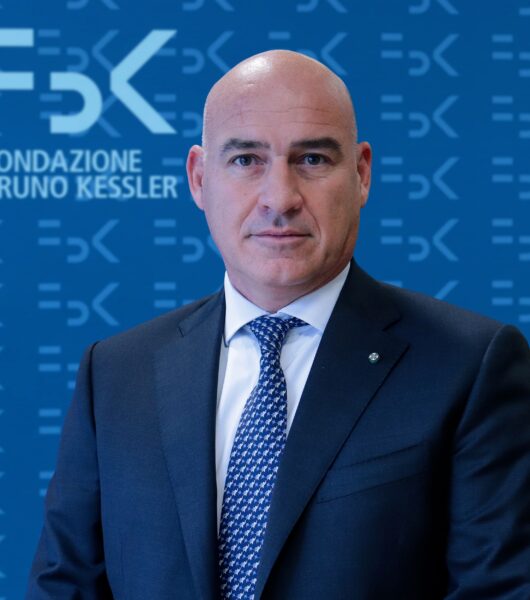 Ferruccio Resta
FBK President, appointed on April 28, 2023
MORE INFO
Related articles