
FBK-ISIG is now among Italy’s leading centers for historical research
February 24, 2026
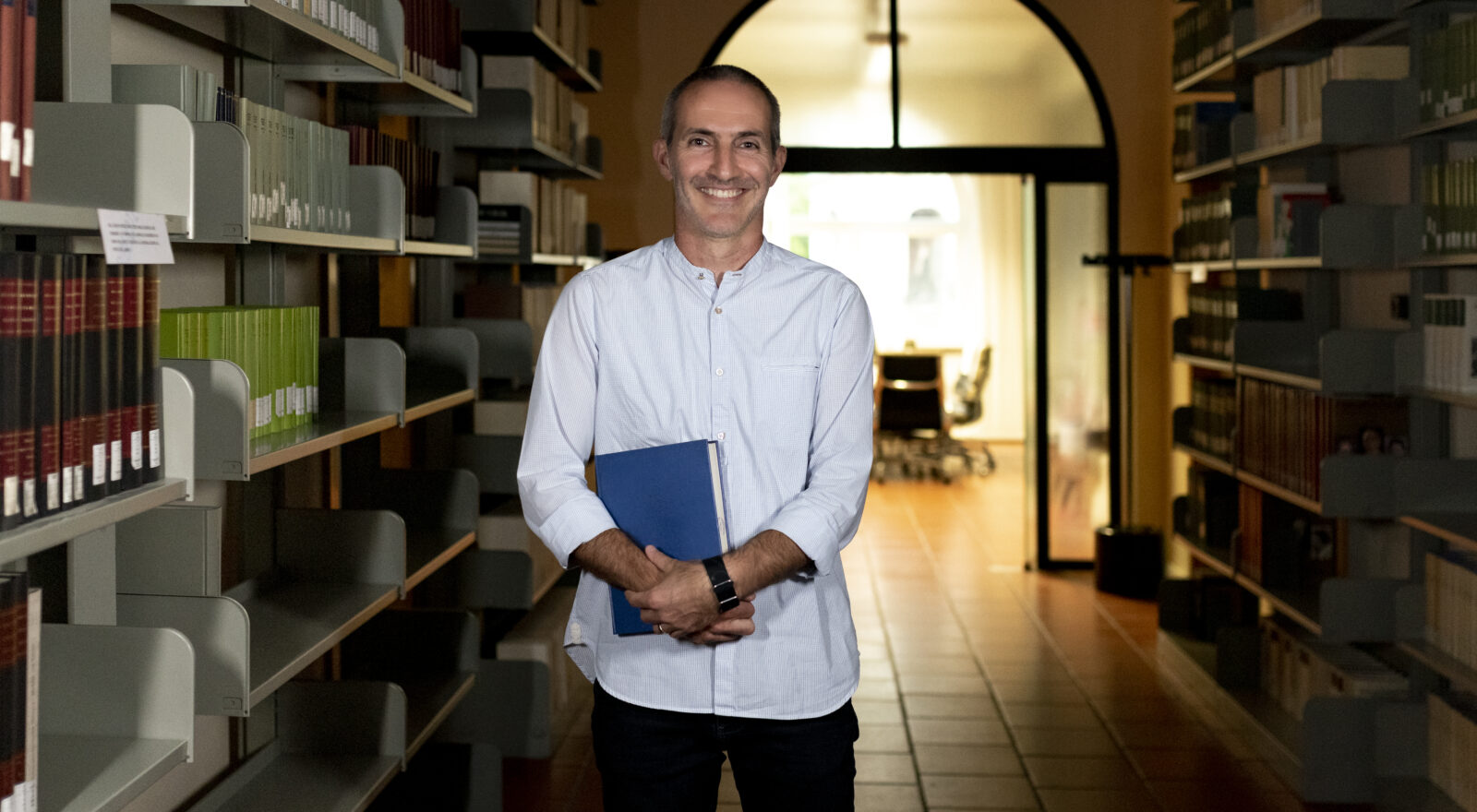
Massimo Rospocher, who has led the Italian-German Historical Institute at Fondazione Bruno Kessler since February 2023, has been confirmed as Director for the next three years. We asked him a few questions to reflect on this period and discuss upcoming projects
Director, can you assess what has been achieved so far at the helm of the Institute?
The Institute has grown significantly over the past three years and is now one of Italy’s leading centers for historical research. Several indicators clearly reflect this progress. An increasing number of international scholars choose ISIG as their host institution for the Marie Skłodowska-Curie Actions, the most prestigious European postdoctoral fellowship. This recognition firmly places us within the European research landscape. We are also hosting two major projects funded by the Italian Science Fund (FIS): BlackItaly, which explores Italy’s involvement in Atlantic slavery — a history long removed from our national memory — and TRAVEL, focused on mobility in the modern era, which will begin shortly. In addition, we are participating in European Research Council (ERC) projects and have launched doctoral programs in collaboration with several Italian universities, in line with FBK’s policy of attracting young talent.
Our initial goal was to strengthen ISIG as a research center rooted in the local context, faithful to its original vocation as a “relay station” between Italian and German-speaking cultures, while becoming increasingly international in scope. I believe we have achieved this. After all, good historical research cannot thrive within overly narrow boundaries.
Looking ahead, what are FBK-ISIG’s plans for the next three years?
Tradition and innovation will continue to guide our work. Research will develop across our five strategic areas — Environment, Media and Communication, Mobility, Politics and Society, and Public & Digital History — though some will take on greater prominence in response to current challenges. I am thinking in particular of environmental history, including the study of the Alpine ecosystem from the early modern period to the present, and the theme of the mobility of people, goods, and ideas, for which we have launched a collaboration with the University of Padua.
The newest challenge, however, concerns generative artificial intelligence. Its disruptive and, in some respects, unforeseen impact cannot be ignored by historians. Through the international seminar series “AI and History,” we have begun to examine what it means to conduct historical research in the age of algorithms: from new possibilities for source analysis to the risks of manipulating the past; from the transformation of professional roles in the humanities to the epistemological questions raised by AI. This is a field in which historians have much to contribute, as we are accustomed to critically examining sources and placing major technological transformations in historical perspective.
The FBK Historical Institute has a long tradition of initiatives and events designed not only for specialists but also for enthusiasts and the broader public. In short, it is a place where many open meetings on historical research are held, often in different languages. Will this continue?
Absolutely. There are many languages and tools through which we interpret and communicate the past — books, film, digital media. The Institute aims to be a space for dialogue between research and society, open to anyone who wishes to approach history with curiosity and a critical spirit.
In 2026, we confirm five event series: “Stories Under Construction: New Horizons in Contemporary History” and the “Modern History Roundtable,” specialist seminars dedicated to the latest developments in historiography; “AI and History,” focused on the use of AI in historical research, addressing opportunities, tools, and hallucinations; “Book of the Month,” featuring presentations of books on historical topics aimed at a general audience and dealing with current issues; and finally, the screening series “The Odd Couple,” which brings cinema and history into dialogue. We alternate highly specialized international research events with meetings open to the local community, because research only makes sense if it gives something back to the local area.
More broadly, in a world where change seems increasingly rapid, is there a greater or different responsibility for those who work in history?
In times of crisis, disorientation, or profound change — such as shifts in the global order or the digital revolution — historians are often asked to predict the future. But we are not oracles. History never repeats itself in identical ways, and those seeking easy or reassuring answers in the past are likely to be disappointed.
Our responsibility is different: to place current events within a broader perspective, to dismantle rhetoric, and to show that seemingly unprecedented phenomena often have precedents from which we can learn. One of the greatest historians of the last century, Marc Bloch, put it clearly in Apologie pour l’histoire ou Métier d’historien, written between 1941 and 1943: “Misunderstanding of the present is the inevitable consequence of ignorance of the past.” Historians do not offer prophecies, but tools to navigate and question their own time.
What is the added value of working within a context like Fondazione Bruno Kessler, which includes both humanities and social sciences centers and scientific-technological research centers?
Three years ago, at the beginning of my mandate, I would have spoken of potential. Today, I can speak of concrete results. The Foundation’s new Strategic Plan has placed ISIG within the “AI x Society” macro-area, alongside centers such as Digital Society, Augmented Intelligence, and Cybersecurity. This was no random choice: it recognizes that the humanities are not an ornamental complement to technological research, but an essential component in addressing the challenges of digital transformation.
Engaging daily with colleagues who build algorithms, sensors, and predictive models — and explaining to them why studying the sixteenth century or Atlantic slavery is equally urgent — is a healthy exercise. It forces you to take nothing for granted and to continually articulate the reasons for your work. If you cannot explain what history is for, perhaps you do not fully understand it yourself.
The author/s
-
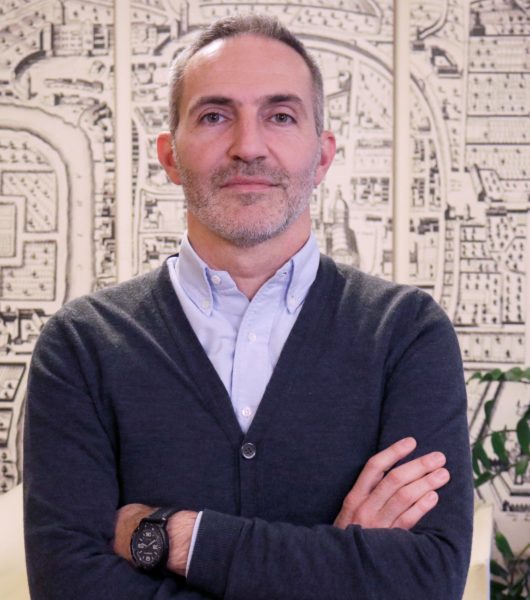 Massimo Rospocher
FBK-ISIG Director
MORE INFO
Related articles