
March 2026: FBK projects making headlines
April 1, 2026
From cybersecurity to particle physics, as well as innovation, digital health, and the energy transition: the FBK initiatives that made headlines in March
Alternative sources and energy security
A discussion on innovative energy technologies, sustainable transition, and security of supply was the focus of the event “Fonti alternative e sicurezza energetica” (Alternative Sources and Energy Security) organized on March 31 by RCS Academy in collaboration with Corriere della Sera. On this occasion, Luigi Crema, director of the FBK Center for Sustainable Energy, spoke, offering his perspective in a rapidly changing global context.
During the month, local media attention also focused on the development of the Rovereto hydrogen hub, a project that entered an operational phase with the imminent start of work. The initiative, as reported by L’Adige, aims to create an advanced infrastructure for large-scale testing and, above all, to promote the creation of a complete industrial hydrogen supply chain, from research to industrial application, in a market that is growing rapidly but is still consolidating.
L’Adige | Polo dell’idrogeno ora si fa sul serio | March 5, 2026
From research to business: PoC by Trentino is launched
Fostering technology transfer and enhancing research results are the objectives at the core of “PoC by Trentino.” Promoted by FBK and the University of Trento with support from the Autonomous Province of Trento and strategic local partners, the project aims to support researchers in developing projects with entrepreneurial potential.
Wired published an in-depth analysis of the initiative, highlighting how the program provides financial resources, dedicated training courses, and mentoring activities, with the goal of guiding ideas from early development stages through potential market validation. In this way, PoC by Trentino helps bridge the gap between the laboratory and the production system, supporting the creation of new high-innovation companies.
The project is part of a broader strategy to strengthen the Trentino innovation ecosystem and has attracted attention from several national newspapers, confirming growing interest in models that can transform scientific knowledge into economic value and social impact.
FBK’s contribution to Higgs boson research
Fundamental research was featured in Wired, which reported on the Italian contribution to the development of detectors for the upgrade of the Large Hadron Collider at CERN. The accelerator upgrade, expected in the coming years, will significantly increase the number of collisions, opening new possibilities for studying the Higgs boson and other phenomena that remain poorly understood.
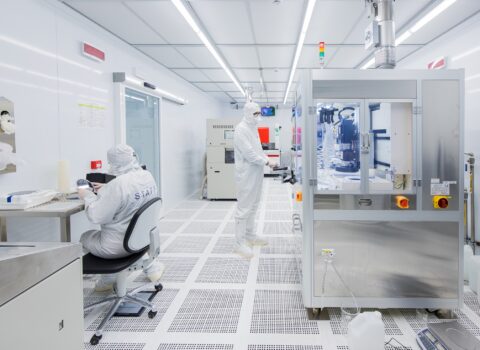
In this context, new technologies, including increasingly fast and durable silicon sensors, will play a key role in improving the quality and quantity of collected data. Within this international collaboration, Fondazione Bruno Kessler contributes in particular to the development of innovative sensors for next-generation detectors—essential devices for accurately tracking particles produced in collisions and deepening understanding of the fundamental structure of matter.
Visual screening in newborns: digital innovation and telemedicine serving pediatricians
Technological innovation applied to healthcare is at the center of a recent ANSA release dedicated to a new digital model for visual screening in the first months of life. A study published in Scientific Reports highlights how integration between community pediatrics and telemedicine improves early diagnosis of eye anomalies in newborns. The solution, developed as part of the “Digital Health and AI” project of the Autonomous Province of Trento, combines digital infrared reflection tests and asynchronous teleconsultation, showing high concordance with traditional methods.
Created by Fondazione Bruno Kessler, TrentinoSalute4.0, and the Trentino Integrated University Healthcare System (ASUIT), the project confirms the value of digital technologies in strengthening prevention and collaboration between pediatricians and specialists.
ANSA | Vista dei più piccoli, da Trento un nuovo modello digitale per pediatri | February 27, 2026
Deepfakes and AI: the challenge for digital content integrity
The evolution of artificial intelligence technologies and the risks related to manipulated content were the focus of an in-depth feature in Il T, which highlighted the work of Cecilia Pasquini of the FBK Center for Cybersecurity, directed by Silvio Ranise.
Until a few years ago, it was still possible to detect manipulated content—an inconsistent visual detail, a flaw in the voice—but advances in generative AI have made manipulated images, videos, and audio increasingly realistic and difficult to distinguish from authentic content. In this context, developing tools to ensure authenticity and traceability is essential: verifiable metadata, cryptographic signatures, and watermarking techniques make it possible to certify content origin and detect alterations. As deepfakes become more sophisticated, the issue of digital trust takes on a central role, also in light of new European AI regulations aimed at strengthening transparency, accountability, and security.
Il T | Fbk in prima linea contro i deepfake | March 12, 2026
Making micro-enterprises competitive
In Adige, an in-depth article by Alessio Tomelleri focused on the financial skills of micro-enterprises, based on the results of FBK-Irvapp research.
The analysis highlights how these businesses represent a central component of the economic system, both in terms of numbers and employment, and how the ability to manage financial instruments, credit, and risk is crucial to their resilience. At the same time, some vulnerabilities emerge, particularly in understanding key concepts such as compound interest rates, which can affect everyday financial decisions. The newspaper framed this issue as a strategic factor for regional competitiveness.
L’Adige | Rendere competitive le microimprese | March 14, 2026
Xenotransplantation: ethics, science, and new perspectives
The debate on the frontiers of medicine and the ethical implications of new technologies was brought back into focus by ANSA, which previewed the Vatican’s publication of a new document on xenotransplantation—that is, organ transplants between different species. The topic was also central to ICEEL 2026, held at the Vatican, where international experts and researchers discussed the scientific, ethical, and social implications of these emerging technologies. Among the contributors was Monica Consolandi, FBK researcher and member of the conference’s organizing and scientific committee, underscoring the Foundation’s active role in interdisciplinary dialogue on frontier topics. In a context where research is making significant progress to address the global organ shortage, collaboration among the scientific community, institutions, and civil society is increasingly essential to guiding the responsible development of biomedical innovation.
ANSA | Il Vaticano pubblicherà un nuovo documento sugli xenotrapianti | March 20, 2023
The author/s
Related articles