November 2025: FBK projects making headlines
December 1, 2025
From the RaiNews Futuro24 episode filmed at the Foundation to coverage on artificial intelligence for public administration, and advances in neuroscience, meteorology, history, and cybersecurity: these are the FBK initiatives that made headlines in November
Cutting-edge technologies including sensors, AI, and robotics
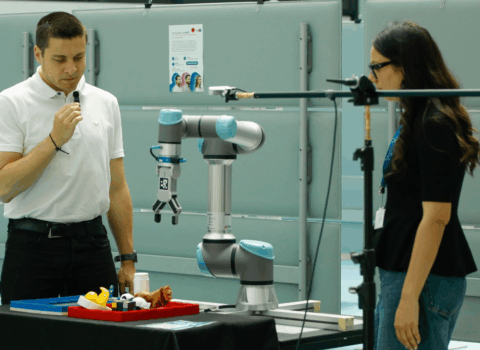
Futuro24, the RaiNews program dedicated to technology innovation, filmed an entire episode inside the Foundation’s laboratories, giving the public an up-close look at clean rooms, photonic technologies, sensor systems, and quantum applications. During the visit, Alessandro Cian and Federica Mantegazzini guided the crew through the clean room and the Center for Sensors & Devices laboratories, where, among other activities, sensors used to study heat islands and pollution are developed—topics also discussed in the episode by Andrea Gaiardo and Raniero Beber. In the area of advanced robotics, Fabio Poiesi presented Mage, the robotic arm developed by the TeV unit, which integrates vision and language. The episode offers an immersive narrative that highlights the range and technological maturity of the research carried out daily in the Foundation’s laboratories.
RaiNews – Futuro24: New technologies at Fondazione Bruno Kessler in Trento – November 4, 2025
A historical look at Native American nations
TG5 aired an in-depth segment on the history of Native American populations, featuring an interview with Claudio Ferlan, a researcher at FBK’s Italian-German Historical Institute. Ferlan emphasized that the history of Indigenous nations is not a marginal topic but a central component of North American history, marked by centuries of survival, conflict, displacement, and renewal. The Institute maintains a particularly rich library collection on the Americas, missions, and intercultural dynamics, and Ferlan’s research fits within this tradition, offering rigorous interpretations that also highlight Indigenous voices often overlooked.
TG5 – The Indians of America – November 8, 2025
A 3D atlas to understand brain connections
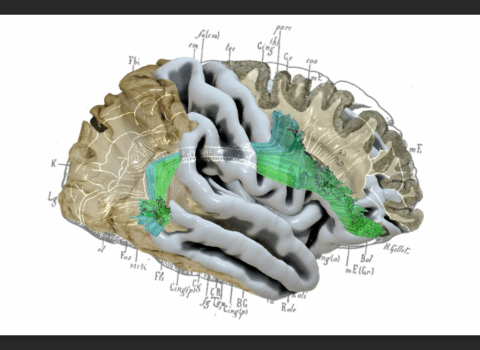
The study on BraDiPho—an innovative three-dimensional atlas of human white matter connections developed over more than five years through an international collaboration involving FBK, the University of Trento, the Provincial Health Services Company, Université de Bordeaux, and Université de Sherbrooke—was published in Nature Communications and covered by several media outlets. The tool enables comparisons between real anatomy and MRI images, opening new perspectives for neurosurgery, neuromodulation, and neuroanatomy teaching. The Neuroinformatics Laboratory (NILab) of the Center for Augmented Intelligence at FBK, led by Paolo Avesani, played a key role in developing the model through advanced artificial intelligence techniques that made possible a high-resolution reconstruction and precise quantitative analysis of brain connections.
ANSA – Cervello, in migliaia di immagini l’atlante 3D delle connessioni – November 7, 2025
Adnkronos – Un atlante 3D per studiare le connessioni del cervello, ecco BraDiPho – November 7, 2025
AIxPA and Progetto Bandiera: Trentino’s digital transition
At the beginning of November, the results of the Progetto Bandiera were presented. The project, funded with €20 million from the National Complementary Plan to the PNRR, aims to modernize the Trentino public administration’s information systems by promoting interoperability, cloud migration, data enhancement, and the development of increasingly efficient digital services. FBK’s Secretary General, Andrea Simoni, highlighted the value of the experience gained with the AIxPA platform, which introduced a new way of using data and predictive models to support public decision-making. The event featured presentations of results across the project’s various areas—from cloud platforms for research, work, and procurement, to new online services for citizens and businesses, and tools supporting AI adoption in public administration. A roundtable moderated by Andrea Nicolini brought together institutions to discuss future challenges for artificial intelligence in the public sector.
AI for weather and climate: the AIWCAS 2025 school
An episode of Progettiamo il futuro on Trentino TV and an in-depth feature inIl T covered AIWCAS25, the autumn school on artificial intelligence applied to weather forecasting and climate studies organized by the DSIP Unit at the Center for Digital Industry at FBK. Over four days, lecturers and researchers from national and international institutions worked together on topics such as nowcasting, downscaling, high-performance computing, and reducing computational costs. The program alternated theoretical sessions, practical workshops, and a lightning talk session on participants’ projects, with contributions from Agenzia ItaliaMeteo, Cineca, MeteoSwiss, and the Danish Meteorological Service. The school reaffirms FBK’s role as a national reference point for advanced training in AI applications for weather and climate systems.
Trentino TV – ““progettiamo il futuro-sostenibilità” – November 26, 2025
Il T – “AI applicata a meteo e clima: al via la scuola di Fbk”- October 30, 2025
Digital identity and security in the European cloud-edge
An in-depth interview with Silvio Ranise, director of FBK’s Center for Cybersecurity, was published In the Voices of 8ra interview series dedicated to building the European Multi-Provider Cloud-Edge Continuum.Ranise described the Foundation’s contribution through the “Cybersecurity & AI at the Edge” project, which involves the Center for Cybersecurity, the Center for Digital Society, and the Center for Augmented Intelligence. In the interview, he explained how digital identity, proximity to data, and choice represent key elements for the resilience of the future European cloud–edge. He also illustrated the role of Lab8ra—the testbed where technical solutions developed in the projects are validated under real-world conditions—and addressed issues such as the need for verifiable, low–energy-impact AI tools, preparation for post-quantum security, and challenges related to data management in complex environments such as smart cities and smart industry. His vision underscores the central role of FBK research in building a more secure, interoperable, and sustainable European digital infrastructure.
Voices of 8ra – “Identity becomes the new perimeter of security”
The author/s
Related articles