
Beyond the Algorithm: Why Europe’s Future Depends on Human Talent, Not Just AI
May 20, 2026
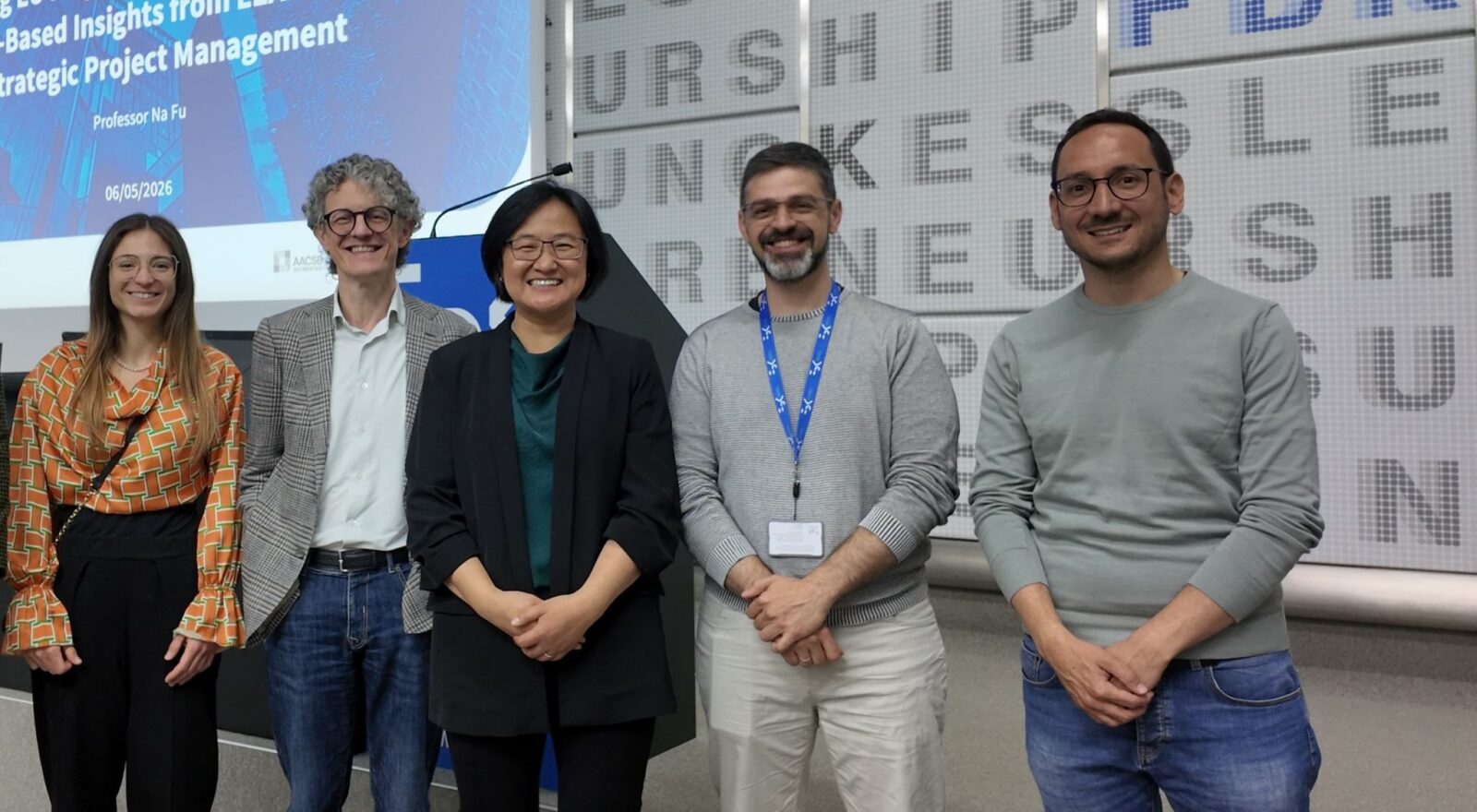
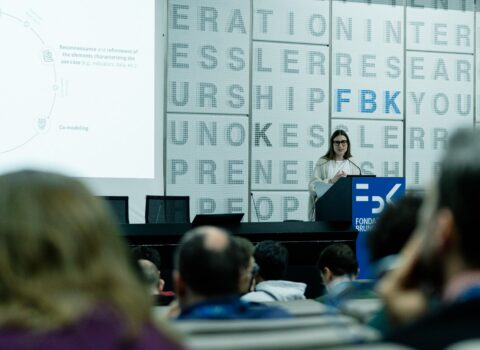
Professor Na Fu from the Trinity College in Dublin shared her vision during a recent seminar hosted by FBK as part of the DIGITAL MERIT project (an initiative of excellence dedicated to training the next generation of digital specialists in AI, Cybersecurity, and IoT), identifying a critical inflection point in the current technological revolution: a "crisis of human vision". Yet this crisis contains unprecedented opportunities for those prepared to seize them.
The Shift in Collaboration
We occupy an era defined by a pervasive anxiety: the fear that AI will inevitably diminish or replace the human role. This concern is understandable given the staggering pace of innovation. However, the Ireland-based expert, Professor Na Fu at Trinity College Dublin, indicates that the true challenge is not a zero-sum competition between man and machine, but rather the urgent need to adapt professional competencies to new collaborative frameworks. Europe’s future depends not on the sheer scale of its data centers, but on its ability to translate technical proficiency into social and strategic value.
The MERIT project, which involves the FBK Center for Cybersecurity, seeks to bridge this gap by increasing the number of young professionals capable of contributing to the digital economy. By providing students with the most suitable set of hard- and soft-skills, and connecting participating Universities with the Industry, it aims to develop the next generation of digital specialists in the AI, the Internet of Things (IoT), and Cybersecurity domains.
Europe’s Digital Gap: Why Change is Needed
The European Union has established an ambitious target for its “Digital Decade”: 20 million digital specialists by 2030. However, data presented by Professor Fu from the LEADSx2030 initiative, which coordinates EU projects within the ADS SO4 cluster (the Digital Europe Programme’s focus on Advanced Digital Skills), paints a sobering picture: at the current trajectory, Europe will not reach its 2030 talent goal until 2050. We face a twenty-year delay.
This discrepancy is not merely a numbers game; it is a failure of methodology. While 580 million euros have been invested across 58 projects (including MERIT), the underlying thesis suggests a systemic flaw. Fu argues that we must shift from “compliance-driven” management, characterized by meeting bureaucratic deadlines, to “impact-oriented” management. “It is not enough to exhaust a budget”, she warns. “Success must be defined by creating a return on investment and a long-term vision for a digital society that survives long after the funding cycles end”.
The example of Dublin, often cited as the “Digital Hub of Europe”, serves as a cautionary tale. Despite boasting one of the highest GDPs per capita globally, the challenge remains: attracting strong industry consortia is insufficient if the ecosystem does not cultivate leaders capable of steering technology rather than being subordinated by it.
Redefining Talent: From Career Mosaics to Interpretation
According to the Trinity scholar, we must move beyond the antiquated concept of linear career paths. In the emerging economy, professionals will navigate “career mosaics”, building their trajectories through transferable skills that allow for fluid movement between sectors.
A fundamental shift is underway: if the previous decade focused on the development and implementation of AI, the current premium is placed on the interpretation of its outputs. Generating content is no longer a competitive advantage; the true value lies in the human capacity to evaluate, contextualize, and validate that content.
Modern talent is less about the mechanics of coding,a task AI is rapidly automating, and more about “domain knowledge”. This allows professionals to identify nuances that escape both peers and algorithms. Key components of this new talent profile include:
- Critical Judgment: Analyzing data with a deep, contextual understanding of its implications.
- Ethical AI Development: Ensuring systems are transparent and rigorously aligned with human values.
- Strategic Change Management: Navigating and overcoming the organizational resistance that often stalls technological adoption.
The CEO Framework: Regaining Control
To prevent humans from becoming passive executors of algorithmic suggestions, Professor Fu proposes the CEO (Check, Edit, Own) framework as a mandatory professional standard:
- CHECK: Verify accuracy as a primary duty. Never accept AI outputs acritically; the professional’s first responsibility is rigorous validation.
- EDIT: Apply the “human touch”. Human intervention must refine and personalize content. Without this distinctive layer, the output lacks unique value.
- OWN: Assume full intellectual and ethical ownership. You are responsible for the final result, regardless of the tools used to generate it.
Ignoring this framework carries severe technical risks. Current data suggests that the superficial use of AI in software development could lead to a massive increase in software vulnerabilities, if developers “copy and paste” AI-suggested code without verifying security flaws or architectural integrity.
Human-Tech Complementarity
Moving beyond the “human-centered AI” paradigm, Fu champions Human-Tech Complementarity. She describes this as a symbiosis rather than a competition. In medicine, for example, AI can automate clinical note dictation or perform preliminary X-ray screenings. This does not displace medical staff; rather, it restores their most precious asset: time for patient empathy and the resolution of complex clinical puzzles.
A practical manifestation of this evolution is the Trinity AI XR Hub. In partnership with companies like Virtual Speech, students utilize VR and AI to hone soft skills. By immersing themselves in realistic scenarios, (such as interacting with AI avatar in various business settings) from having difficult conversations to presenting or managing a high-pressure board of directors,they receive real-time analysis of their body language and empathetic resonance.
The “WOTAM” Project: Productivity vs. Burnout
The “WOTAM” research project poses a provocative question: who actually benefits or should benefit from AI-driven productivity gains? While industrial revolutions have historically reduced working hours (and AI could finally facilitate a 4-day work week) there is a looming “burnout trap”.
If AI is utilized merely to force “ten times more tasks” into the same timeframe, the result is mass exhaustion rather than progress. Fu advocates for “time policies” that translate AI efficiency into sustainable goals and “regenerative” work processes. The focus must remain on the health of the worker and the generative capacity of the innovation process itself.
Resilience and the “Covid Generation”
The success of Europe’s digital decade depends on a resilient integration of policy, research, and industry. However, Fu highlights a critical human variable: the “Covid Generation“.
Observing today’s youth, including what she jokingly calls her “domestic sample” of three children, Fu notes that the pandemic has atrophied essential social skills: communication, initiative, and the resilience required to accept negative feedback. As automation eliminates many entry-level “Junior” roles, society must support young people in developing the traits technology cannot simulate. The future does not belong to those who know the latest software, but to those with the passion, vision, and compassion to lead.
Cybersecurity Perspectives: Closing Remarks
Silvio Ranise, Director of the FBK Cybersecurity Research Center, emphasizes that the European Commission has expressed heightened concern regarding the “Cybersecurity skill gap” since 2024.
The MERIT project addresses this by training security experts through an interdisciplinary lens. This involves a specific technical flow: IoT devices capture real-world data, which is then processed by AI models. If this data flow is not managed securely, the societal consequences are profound: ranging from deepfakes to the large-scale manipulation of Large Language Models (LLMs) which is now a “hot topic”. To prevent these outcomes, current research is focused on developing security techniques that guarantee the authenticity and integrity of data and AI models, a non-negotiable prerequisite for economic and social stability.
The author/s
Related articles