Federico Cabitza

Federico Cabitza is a professor at the University of Milan Bicocca, where he teaches human–computer interaction and decision support. He leads the Laboratory of Uncertainty Models, Decisions, and Interactions in the Department of Computer Science and coordinates the local unit of the national laboratory Informatica e Società (Computer Science and Society). Since 2016, he has collaborated with several hospitals, including the IRCCS Galeazzi-Sant’Ambrogio Hospital in Milan, with which he holds a formal affiliation. After serving as an associate editor of the International Journal of Medical Informatics, he is currently Section Editor-in-Chief of the Machine Learning and Knowledge Extraction Journal and a member of several editorial boards, including that of Mondo Digitale, the official journal of AICA. His research focuses on the design and evaluation of artificial intelligence systems to support decision-making processes, particularly in healthcare. To date, he has authored more than 300 research publications in international conference proceedings, books, and scientific journals, and has been consistently ranked among the top 2% of researchers worldwide by citation impact in the Stanford/Elsevier ranking since 2020. He is also co-author, with Luciano Floridi, of the book “Intelligenza Artificiale: L’uso delle nuove macchine” (Artificial Intelligence: The Use of New Machines), published by Bompiani (2021).
Spotlight's articles
-
 July 19, 2026Digital health and the importance of sentinel signalsIn an age where AI permeates every aspect of work, the concept of health must expand beyond physical integrity to include social and mental well-being. Risks such as techno-complexity (cognitive fatigue) and stress caused by opaque decision-making are real threats that can undermine human dignity. These dynamics often begin almost invisibly, for example through the unauthorized use of unvalidated tools—the so-called "Shadow AI"—which can increase anxiety and uncertainty.
 -
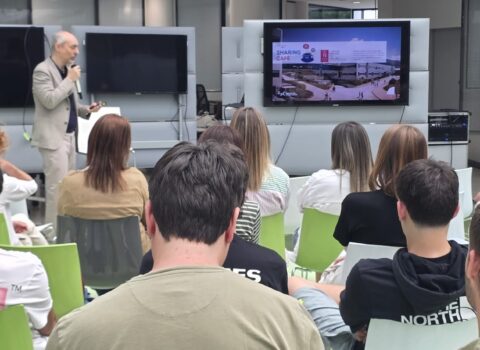 July 12, 2026Beyond the black box: the new security governanceAI is not a passing fad but a structural force transforming work processes and creating new risk profiles. For this reason, AI governance cannot remain confined to IT departments, nor can it be treated as a bureaucratic add-on to the Risk Assessment. What is needed is an integrated governance model that bridges the traditional silos between security, privacy, and fundamental rights.
 -
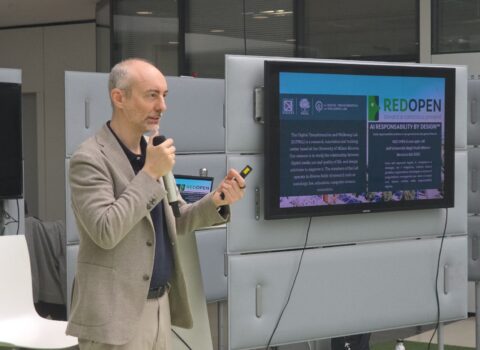 June 27, 2026Speed or competence? The challenge of AI in organizationsThe rollout of AI across organizations is often portrayed as a simple race toward optimization. But reducing AI to just another software upgrade underestimates its fundamentally "relational" nature. These systems do more than simply perform tasks—they generate recommendations that can profoundly shape our thinking. In a market that demands immediate responses, the real risk is trading speed for value.
 -
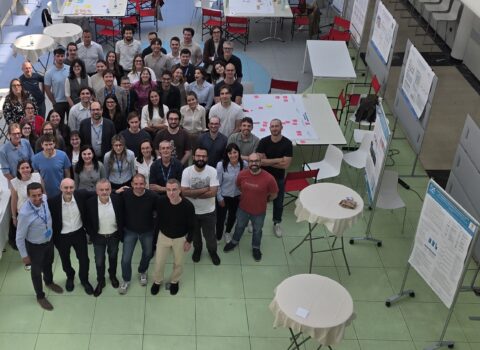 May 26, 2026Digital Health: AI becoming “normal” at the Center for Digital Health & Wellbeing showcase dayFrom research laboratories to everyday clinical practice: Fondazione Bruno Kessler’s Center for Digital Health & Wellbeing presented itself at Povo with an event dedicated to innovation, scientific research, and new calls shaping the future of healthcare.
 -
 February 4, 2026AI becoming “normal”: Federico Cabitza’s vision for the future of digital healthAs he begins his term as head of the Center for Digital Health and Wellbeing (DHWB), Federico Cabitza outlines a clear mission: to take artificial intelligence out of the lab and turn it into an established, everyday practice.